
The Extraterrestrial Origin of the Continental Tectonic Plates


Felsic-mafic banding and small-scale tight folding in migmatite and banded iron formations (BIF)indicates a common formation mechanism by modulated sedimentation from hydrothermal plumes, forming mounds around hydrothermal vents that slid and slumped when the slope of the mounds exceeded the angle of repose, causing small-scale tight folding.
Migmatite image credit: Marli Miller https://geologypics.com/
BIF image credit: Chris’s Granite Paradise https://www.youtube.com/watch?v=SqRGJsP66vw&ab_channel=Chris%27sGraniteParadise
¶ An extraterrestrial origin for Earth’s continental tectonic plates is premised on the central insight of the remarkable similarity between Algoma-type banded iron formations (BIF) and migmatite, with both exhibiting alternating felsic-mafic banding and small-scale tight folding. This study hypothesizes that the physical correspondence indicates a common formation process by modulated sedimentation from hydrothermal plumes, where aphanitic (fine grained) BIF formed on Earth and phaneritic (coarse-grained) metamorphic rock formed in hot classical Kuiper belt objects (KBOs). The ambient gravitational acceleration determined the size at which mineral grains fell out of aqueous suspension, creating fine-grained BIF on Earth and coarse-grained gneiss-schist-migmatite in KBO microgravity. And a lower extraterrestrial oxygen fugacity may partly account for mafic silicates in gneiss-schist-migmatite melanosomes and iron oxides in BIF.
¶ Then hot-classical KBOs, with sedimentary cores with a gneissic composition, were perturbed into the inner solar system during the late heavy bombardment (LHB), circa 4.2–3.8 Ga, with terrestrial geochronology dating to the exhumation date, when the ‘closure temperature’ of the mineral grains began to retain the daughter products of radioactive decay.
¶ This study suggests that only rock formed by the primary mechanism of modulated sedimentation from hydrothermal plumes will exhibit felsic-mafic banding, and that any degree of secondary metamorphism will blur the sedimentary banding. By comparison, the standard model struggles to explain why banding always proceeds folding, and why folds and tilted rock units fail to result in gneissic-banding overprinting, creating a checkered effect that is not observed.
¶ The continental tectonic plates differ sufficiently from chondritic material of the inner solar system to require a separate debris disk reservoir for the origin of hot classical KBOs, with a siderophile-depleted composition that lay on the 3-oxygen-isotope terrestrial fractionation line. Coincidentally, the constraints of this former reservoir dovetail with an alternative solar system formation mechanism, designed to explain the 3 sets of twin planets (Jupiter-Saturn, Uranus-Neptune, and Venus-Earth) in our highly unusual solar system, which formed in sequential pairs like Russian nesting dolls.
¶ If alternative hypotheses that are simpler, more intuitive, more predictive, more unifying, and more falsifiable than the standard model are easy to formulate, then this hypothesis has no particular merit, but if such hypotheses are fiendishly difficult to construct unless meritorious, then this study may warrant closer scrutiny.
………………..
Two Epochs of Baryonic Dark Matter, With Free-Floating Super-Puff-like Planets as the Second and Present Epoch

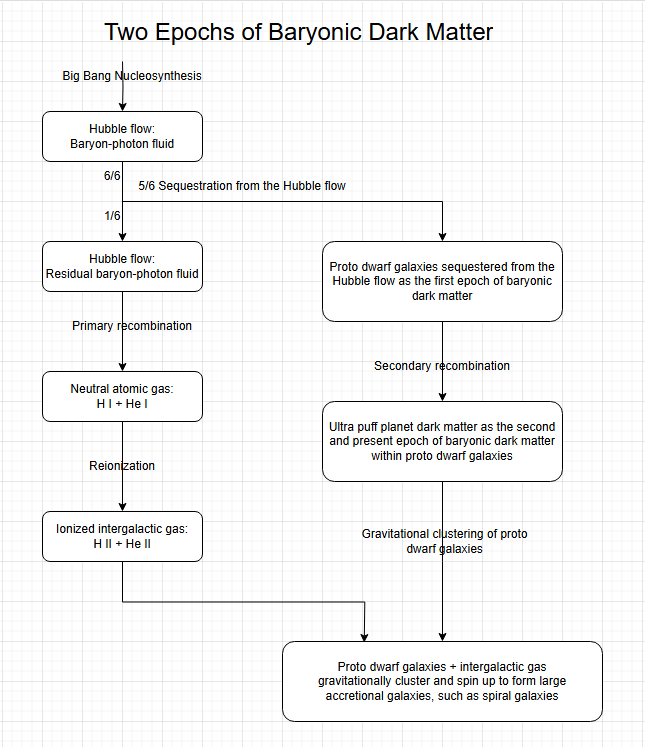
¶ Baryonic dark matter (DM) has an early universe problem. It apparently requires a 6-fold increased baryon-to-photon ratio, which is incompatible with Big Bang nucleosynthesis (BBN) and with the first acoustic peak in the cosmic microwave background (CMB) power spectrum. But, a canonical baryon-to-photon ratio, with sequestration of 5/6 of the baryon-photon fluid from the Hubble flow prior to recombination, may correspond with observations by creating globally canonical conditions at BBN and locally canonical conditions at recombination. This conceptual baryonic DM hypothesis proposes 2 epochs of baryonic DM, with the first epoch composed of photon-depleted proto dwarf galaxies (PDGs) prior to recombination, and the second epoch composed of free-floating super-puff-like planets following recombination.
¶ In the first epoch, 5/6 of the baryon-photon fluid was sequestered from the Hubble flow by primordial black holes (PBHs), and the associated primordial photons were sub-sequestered behind PBH event horizons, with sequestration running to completion by about the epoch of matter-radiation equality. In this scenario, rotating (Kerr) PBHs caused frame dragging of baryon-photon fluid in PBH ergospheres, which collimated the energetic and super-abundant primordial photons. Tangential kicks from collimated photons levitated charged particles (fermions and BBN nuclei) on a photon sea, preventing matter particles from crossing PBH event horizons, while promoting photon accretion. The levitated charged particles were presumably magnetically channeled to the PBH poles and ejected in polar jets, forming gravitationally-bound, photon-depleted baryonic halos around PBHs, which converted PBHs into PDGs. Accretion of primordial photons in their early energetic state swelled PBHs to supermassive black hole (SMBH) proportions, and in turn, these early SMBHs provided the horsepower to sequester 5/6 of the baryon-photon fluid by about the epoch of matter-radiation equality. Very early SMBHs appear to require a small degree of new physics. Roy Kerr proposes that singularities don’t physically exist in black holes, suggesting here that photons may continue to experience cosmic redshift after crossing black hole event horizons. This implies that primordial SMBHs underwent ‘black hole redshift’, wherein their photon-bloated early mass was redshifted away at a rate inversely proportional to the cosmic scale factor.
¶ The second and present epoch of baryonic DM emerged within PDGs following recombination, forming ‘ultra puff planet DM’, similar to stellar-system super-puff planets, but with still-lower density and ultra-low metallicity. Gravitational lensing of quasars detect variability by an apparently large population of objects with a mass of ∼10 M⊕. By contrast, gravitational lensing of stars in Galactic studies excludes the possibility of planets or planetary-mass black holes, “but objects that have a peak column-density Σ0<∼105 g cm−2 do not automatically violate the Galactic constraints because they’re not strong gravitational lenses in that context”. (Tuntsov, Lewis & Walker 2023) So pithy ultra puffs with a mass of ∼10 M⊕ could satisfy quasar microlensing findings, and may avoid violating Galactic microlensing null results.
¶ Photon decoupling at recombination released the external photon pressure on PDGs, which along with black hole redshift caused expansive cooling that presumably triggered ‘secondary recombination’ within PDGs; however, secondary recombination within PDGs was not accompanied by photon decoupling, since the associated primordial photons had already been sub-sequestered within PBHs. Cooling of ionized gas can lead to rapid, progressive thermal fragmentation, designated “shattering” for its rapidity. Shattering ceases at a characteristic length scale of ~ 0.1 pc/n, which is the scale at which fragmented cloudlets reach thermal equilibrium with their surroundings. (McCourt et al. 2016) Significantly, the mass of these shattered cloudlets is ~ 5.7 M⊕, which is within a factor of 2 of the estimated mass of quasar lenses (∼10 M⊕). Thermal fragmentation and Jeans instability required stellar metallicity to provide infrared cooling, which the very first stars, Population III (Pop III) stars, supplied. So, at least some Pop III stars must have expired in supernovae prior to secondary recombination in densified PDG halos. Jeans instability of planetary-mass cloudlets composed of atomic hydrogen was facilitated by the external pressure of the surrounding plasma, collapsing cloudlets to form ultra puff planet DM. Ultra puffs presumably acted as accretionary magnets, competing with stellar-mass Jeans instability for the residual gas. This competition transformed gaseous proto-dwarf galaxies (PDGs) into gas-free ‘primordial dwarf galaxies’, which may correspond to the very faintest modern ultra-faint dwarf galaxies (UFDs). Then ultra puffs went dark (transparent), due to condensation and sedimentation of their Pop III star metallicity, forming diminutive rocky-icy cores.
¶ Sequestration of 5/6 of the baryon-photon fluid by about the epoch of matter-radiation equality created a sub-canonical sound horizon at recombination, since less expansion was required to reach the canonical conditions of recombination with sequestration. And a sub-canonical sound horizon may resolve the tension in the Hubble constant in favor of the local distance ladder.
………………..
STARS, PLANETS, MOONS, MINOR PLANETS AND COMETS


Figure 1
Protostar system L1448 IRS3B, showing a central binary pair of protostars (IRS3B-a & IRS3B-b, with a combined mass of ∼1 M☉), orbited by a less-massive but much-brighter companion protostar (IRS3B-c, with a mass of ∼0.085 M☉) in a circumbinary orbit.
An alternative ‘symmetrical FFF’ ideology, presented here, suggests that the luminosity difference is the result of age difference, where the system formed by a flip-flop mechanism, designated, symmetrical flip-flop fragmentation (FFF). Symmetrical FFF suggests that the companion protostar formed at the center of the system, followed by a dual disk instability of two arms of a (spiral) density wave of a massive accretion disk. The resulting twin disk-instability objects were much-more massive than the diminutive prestellar/protostellar core, forming a dynamically-unstable system. Dynamic instability caused chaotic orbital interplay, with energy equipartition in orbital close encounters, ‘evaporating’ (flip-flopping) the diminutive core into a circumbinary orbit around the much-more-massive binary pair, forming a hierarchical trinary star system.
Image Credit: Bill Saxton, ALMA (ESO/NAOJ/NRAO), NRAO/AUI/NSF – Publication: John Tobin (Univ. Oklahoma/Leiden) et al.
¶ Revolutionary stellar and planet formation mechanisms that were designed to explain the 3 sets of twin planets in our highly-unusual solar system—Jupiter-Saturn, Uranus-Neptune, Venus-Earth—which coincidentally predict the formation of a siderophile-depleted debris disk just prior to the supposed 4,567 Ma birth of our solar system that lay on the 3-oxygen-isotope terrestrial fractionation line. This early debris disk with a terrestrial composition formed the hot-classical KBOs, which were perturbed into the inner solar system during the LHB, where they impacted Earth to form the continental tectonic plates on Earth.
………………..
YD Impact Boulder Fields


Hickory Run boulder field, Pennsylvania
¶ Discrete boulder fields attributed to the last glacial maximum (LGM) are suggested here to have had a catastrophic origin similar to that of the 500,000 Carolina bays distributed along the Atlantic seaboard and Gulf Coasts of the continental United States. Carolina bays are suggested by others to be secondary impact basins from the ejecta curtain of Laurentide ice-sheet fragments from a primary bolide impact on or airburst above the Laurentide ice sheet in the Great Lakes region, 12,800 B.P. Ballistic trajectories that fell short of the coastal regions and landed on thin soil may have fractured the underlying bedrock, in some cases creating discrete boulder fields that are still devoid of vegetative cover almost 13 thousand years later.
………………..
 Snowball Solar System (SSS)