 Figure 1: Triple protostar system L1448 IRS3B, showing a central binary pair of protostars (IRS3B-a & IRS3B-b, with a combined mass of ∼1 M☉), orbited by a less-massive but much-brighter companion protostar (IRS3B-c, with a mass of ∼0.085 M☉) in a circumbinary orbit.
An alternative ideology, presented here, suggests that the luminosity difference results from age difference, in a stellar system that turned itself inside out by a flip-flop mechanism, designated, symmetrical flip-flop fragmentation (symmetrical FFF). A high angular momentum accretion disk in the form of a dynamical bar-mode instability underwent disk fragmentation to form a twin pair of disk-fragmentation objects in orbit around the diminutive but more evolved protostellar core at the center of rotation. Then, equipartition of kinetic energy during orbital interplay gradually flip-flopped the former prostellar core into a circumbinary orbit around the much-more-massive but less-evolved twin disk-fragmentation objects, forming the observed hierarchical trinary protostar system.
Image Credit: Bill Saxton, ALMA (ESO/NAOJ/NRAO), NRAO/AUI/NSF – Publication: John Tobin (Univ. Oklahoma/Leiden) et al.
Abstract
¶
¶ This alternative conceptual study proposes several alternative mechanisms for catastrophically projecting mass inward in rotating, gravitationally bound astrophysical systems, resulting in alternative planetary and stellar formation mechanisms that accelerate the increase in entropy.
¶ A counterintuitive study (Tychoniec et al., 2018) found decreasing accretion disk mass with protostellar evolution. Disk dust mass was measured to decrease from 248 M⊕ in Class 0 protostars, to 96 M⊕ in Class I protostars, to 5–15 M⊕ in Class II protostars. This suggests the possibility of an early crossover point, where the disk mass could be (much) greater than the central protostar mass, especially if this discovery extends backward across the presteller-protostellar boundary to still younger prestellar systems with still smaller prestellar central cores. In a hypothetical system where the disk mass greatly exceeds the central core mass, the disk would have inertial dominance, such that the diminutive core would be unable to damp down disk inhomogeneities from amplifying into global disk fragmentation. And a stellar-mass disk fragmentation around a planetary-mass prestellar/protostellar central core would cause an inertial flip-flop, injecting the former core into a planetary orbit around the nascent disk-fragmentation object in a mechanism designated, ‘asymmetrical flip-flop fragmentation (asymmetrical FFF), making giant planets the older progenitors of their host stars.
¶ The bimodal populations of hot and cold Jupiters are separated by a 10–100 d orbital-period valley. This study suggests that hot Jupiters result from disk fragmentation of protostellar disks, while cold Jupiters result from disk fragmentation of more distant pseudodisks.
¶ In a system where high specific angular momentum distorts a protostellar disk into a dynamical bar-mode instability, disk fragmentation may trifurcate the triaxial bar, forming a twin pair of disk-fragmentation objects in orbit around the diminutive protostellar central core at the center of rotation in a process designated, ‘symmetrical FFF’. Symmetrical FFF forms unstable ternary systems that evolve through orbital interplay into stable hierarchical systems, most typically composed of the former diminutive protostellar core (companion) in a circumbinary orbit around the much-more-massive twin disk-fragmentation objects (binary stellar pair). The trinary Alpha Centauri system is a typical ternary star system formed by symmetrical FFF, and this study suggests that our own solar system also formed by symmetrical FFF, initially creating twin disk-fragmentation objects (that became our former Binary-Sun) around a brown-dwarf-mass former protostellar core.
¶ Asymmetrical FFF presumably forms giant planets, from mini-Neptunes through super-Jupiters and possibly up to low mass brown dwarfs, while symmetrical FFF tends to form more-massive objects, like brown dwarfs and red dwarf companion stars.
¶ This study suggests a third and very rare mechanism for planet formation in symmetrical FFF systems, in which the protostellar core is induced to spin-up during orbital interplay to the point of centrifugal fragmentation into 3 components by a well-constrained process designated ‘trifurcation’. During orbital interplay following symmetrical FFF, orbital close encounters between a diminutive protostellar core and it’s much-more-massive twin disk-fragmentation objects (nascent stars) results in equipartition of kinetic energy, which transfers kinetic energy and angular momentum from the more massive twin components to the diminutive protostellar core. This study suggests that equipartition of kinetic energy also extends to rotation, causing the core to spin up, possibly to the point of centrifugal fragmentation. Progressive spin up causes flattening of the core into an oblate sphere, followed by distortion into a triaxial Jacobi ellipsoid and then into a bar-mode instability. The centrifugal failure mode of a bar-mode instability is hypothesized here to be gravitational fragmentation into 3 components, hence trifurcation, which is analogous to the process for symmetrical FFF. The self-gravity of a bar-mode instability causes fragmentation, wherein the ends of the central bar gravitationally pinch off into independent Roche spheres, forming a twin-pair of gravitationally bound objects in orbit around the diminutive ‘residual core’, remaining at the center of rotation. This newly trifurcated system is a miniature version of the original symmetrical FFF system, which is similarly dynamically unstable. Thus, first-generation trifurcation promotes second-generation trifurcation, and etc., potentially forming multiple generations of twin binary pairs of objects in diminishing sizes like Russian nesting dolls. This study suggests that our solar system underwent symmetrical FFF, followed by 4 generations of trifurcation, creating a former Binary-Companion to the Sun with super-Jupiter-mass binary components in the 1st generation trifurcation, followed by 3 subsequent trifurcation generations as follows:
1) Symmetrical FFF―forming Binary-Sun (twin disk fragmentation objects) + Brown Dwarf* (protostellar core)
2) 1st-generation trifurcation―forming Binary-Companion + SUPER-Jupiter* (residual core)
3) 2nd-gen. trifurcation―forming Jupiter-Saturn + SUPER-Neptune* (residual core)
4) 3rd-gen. trifurcation―forming Uranus-Neptune + SUPER-Earth* (residual core)
5) 4th-gen. trifurcation―forming Venus-Earth + Mercury (residual core)
This accounting leaves out Mars, which presumably formed by ‘hybrid accretion’ like super-Earths, with ‘hybrid’ indicating hierarchical accretion of planetesimals formed by streaming instability.
¶ The trifurcated binary pairs from the 4 trifurcation generations extracted binary-binary resonant energy from former Binary-Sun, causing the binary pairs to spiral out from the gravitational wells of their ‘parent’ and ‘grandparent’ systems until they were captured by former Binary-Sun into heliocentric orbits. And the sibling binary pairs continued to spiral out from their binary barycenters until they separated to form solitary planets, except for Binary-Companion, which remained a binary pair. Ultimately, Binary-Sun spiraled in and merged at 4,567 Ma, forming a luminous red nova (LRN), with stellar-merger nucleosynthesis creating some of the short-lived radionuclides of our early solar system, notably Al-26 and Ca-41. And the stellar merger created the ‘solar-merger debris disk’, which spawned the asteroid belt in situ by streaming instability.
¶ Former Binary-Companion presumably orbited between Saturn and Uranus for nearly 4 billion years. Secular perturbation by the Sun caused the super-Jupiter-mass binary components to slowly spiral in, transferring their binary energy to progressively increasing the period of the heliocentric orbit. This progressive increase in heliocentric period caused its 4:1 mean motion resonance to progressively sweep outward through the Kuiper belt, perturbing Kuiper belt objects (KBOs), causing the late heavy bombardment (LHB) of the inner solar system. Ultimately, the binary components merged at 639 Ma in an asymmetrical merger explosion that gave newly merged Companion escape velocity from the Sun. And the resulting ‘Companion-merger debris disk’ spawned the young (639 Ma) cold-classical KBOs and fogged the solar system, causing the Marinoan glaciation on Earth.
* Note, unorthodox capitalization indicates unorthodox definitions. ‘Brown Dwarf’ is the name of the original protostellar core of the solar system, and ‘SUPER-Jupiter’, ‘SUPER-Neptune’ and ‘SUPER-Earth’ are the names for the transient residual cores formed in the first three trifurcation generations.
………………..
¶
Table of Contents
¶
1. Introduction
2. Hybrid accretion planets and moons
3. Flip-Flop Fragmentation (FFF)
4. Trifurcation by centrifugal fragmentation
5. Trifurcation moons
6. Former Binary-Companion
7. Protostellar disk and 3 debris disks
8. Venusian cataclysm
9. Solar system summary
10. The predictive and explanatory power of FFF-trifurcation ideology
References
¶
1. Introduction
¶
¶ The alternative conceptual astrophysics of this study is largely premised on several catastrophic mechanisms for the inward projection of mass in rotationally supported systems, with at least 2 mechanisms being entirely novel.
¶ The first novel mechanism is an inside-out formation mechanism for stellar systems with gas-giant planets, accompanied by a flip-flop, in which gas-giant planets originally formed as the central prestellar/protostellar objects at the center of rotation, followed by an inertial flip-flop due to a stellar-mass disk fragmentation of the surrounding protostellar disk. Disk fragmentation that breaks the radial symmetry of a stellar-mass protostellar disk around a planetary-mass prestellar/protostellar central object results in an inertial flip-flop, injecting the former core into a planetary satellite orbit around the nascent stellar-mass disk fragmentation object. This is an even more catastrophic mechanism than giant planet formation by disk instability, which is an important alternative hypothesis to the standard core accretion model.
¶ The second novel mechanism is the Russian nesting doll clockwork mechanism for the formation of the 3-sets of twin planets in our highly unusual solar system, namely Jupiter-Saturn, Uranus-Neptune and Venus-Earth + Mercury. This mechanism suggests that the equipartition of kinetic energy during orbital interplay that resolves stellar systems born nonhierarchical into stable hierarchical systems has a rotational component, tending to cause a diminutive ternary ‘companion’ to spin-up, while being ‘evaporated’ into a circumbinary orbit. In flat well-aligned stellar systems, this rotational spin-up may induce centrifugal fragmentation in a highly regimented fashion into 3 components, creating a massive twin binary pair in orbit around a diminutive residual core remaining at the center of rotation in a centrifugal-fragmentation mechanism designated ‘trifurcation’. Trifurcation creates a local decrease in entropy in the trifurcated companion, but results in an overall increase in entropy by projecting mass inward in the binary pair that induced the spin-up fragmentation during orbital interplay. This study suggests that our solar system originally formed as a ternary system like Alpha Centauri, but with 4 generations of trifurcation that created sufficient binary-binary resonance chasing to cause our former Binary-Sun to spiral in and merge at 4,567 Ma.
¶ Academia seems to be warming to a catastrophic origin of small solar system bodies (SSSBs) by gravitational collapse, by dust enhancement by streaming instability. Contact binaries and wide binary Kuiper belt objects (KBOs) of comparable mass may best be explained by gravitational collapse (Nesvorný et al., 2010). Similarly, the formation of binary and ternary star systems with twin components of comparable mass in close-binary orbits, like the Alpha Centauri star system, may be best explained by the catastrophic mechanism of disk fragmentation, as in the triple protostar system L1448 IRS3B (Tobin et al. 2016).
¶ Strategically combining these and other mechanisms, as laid out in this study, conceptually unifies many otherwise ad hoc solar system phenomena in a far-more falsifiable clockwork model than the standard clockwork models.
Hybrid accretion planets and moons § 2:
¶ Chains of super-Earths and chains of well-ordered moons around giant planets are suggested here to have formed by ‘hybrid accretion’, which is a hybrid mechanism consisting hierarchical accretion of planetesimals formed by streaming instability.
¶ Planetesimals that form by streaming instability at pressure bumps, particularly at the truncated inner edge of protoplanetary disks, may accrete to form planets, which may clear their orbits when attaining the nominal mass of a super-Earth.
¶ And super-Earth formed at the inner edge of a protoplanetary disk that clears its orbit pushes the inner edge of the protoplanetary disk outward, which may spawn a second generation of planetesimals by streaming instability against its strongest outer resonances, which may accrete to form a second super-Earth. In this way, chains of super-Earths and chains of moons around giant planets may form sequentially from the inside out by hybrid accretion.
Flip-Flop Fragmentation (FFF) § 3:
Terminology:
– A ‘dark core’ refers to a dense, cold region within a molecular cloud that may or may not be in a condition of freefall, which is dark because of its high opacity due to high density.
– A ‘protostar’ or central ‘prestellar object’ will be defined here to refer specifically to the central spherical object (nascent star) inside the ‘accretion disk’, and when the prestellar/protostellar phase is indeterminate, the central spherical object will be termed a ‘prestellar/protostellar central core’ or merely ‘central core’, and the term ‘former core’ refers to a central core that has been displaced by a flip-flop mechanism. ‘Accretion disk’ and ‘protostellar disk’ may be used interchangeably in this study to describe the early protoplanetary disk during the prestellar/early protostellar phase, generally avoiding the term ‘protoplanetary disk’, which has planetary connotations.
– ‘Disk instability’ is an alternative standard model hypothesis to core accretion for form forming gas giant exoplanets by a local mechanism, but this study suggests that disk instability necessitates a global mechanism that necessarily results in disk-instability objects that are much-more massive than their central prestellar/protostellar central cores. To distinguish classical disk instability, which is a local phenomenon, from the global form, suggested here, the global form of disk instability will be designated ‘disk fragmentation’, forming ‘disk-fragmentation objects’. Generally speaking, ‘disk fragmentation’ may be used interchangeably with ‘asymmetrical FFF’, but more precisely, disk fragmentation encompasses the entire process of global disk fragmentation, whereas asymmetrical FFF focuses on the resulting flip-flop between the resulting disk-fragmentation object and the former core.
Asymmetrical flip-flop fragmentation (asymmetrical FFF):
¶ A counterintuitive recent discovery finds that protoplanetary disks have their highest mass at earliest times, promoting disk fragmentation. “We find that the compact (< 1″) dust emission is lower for Class I sources (median dust mass 96 M⊕) relative to Class 0 (248 M⊕), but several times higher than in Class II (5-15 M⊕). If this compact dust emission is tracing primarily the embedded disk, as is likely for many sources, this result provides evidence for decreasing disk masses with protostellar evolution, with sufficient mass for forming giant planet cores primarily at early times.” (Tychoniec et al. 2018)
¶ “The compact components around the Class 0 protostars could be the precursors to these Keplerian disks. However, it is unlikely that such massive rotationally supported disks could be stably supported given the expected low stellar mass for the Class 0 protostars: they should be prone to fragmentation”. (Li et al. 2014)
¶ If protoplanetary disks are most massive at earliest times, then the dynamic stability of early protostellar and possibly prestellar systems may be called into question. Toomre’s stability criterion governs local ‘disk instability’, but when a disk is much-more massive than its diminutive central core, then the disk has inertial dominance of the system, such that positive feedback may result in runaway global disk fragmentation, affecting the entire disk. And a resulting disk-fragmentation object will necessarily be much-more massive than its diminutive central core, resulting in an inertial flip-flop that injects the former core into a planetary satellite orbit around the disk-fragmentation object (nascent star), in a process designated, ‘asymmetrical FFF’.
¶ The bimodal populations of hot and cold Jupiters, separated by a 10–100 d orbital-period valley, appear to telegraph separate origins for hot and cold Jupiters, where the standard model of planetary migration requires an unlikely all-or-nothing migration mechanism, resulting in a ‘discreteness problem’ for the standard model. Alternatively, if hot Jupiters result from disk fragmentation of protostellar disks (accretion disks) and cold Jupiters result from disk fragmentation of magnetically-controlled pseudodisks, then the discreteness problem is avoided.
¶ Asymmetrical FFF predominantly forms planetary-mass objects, from mini-Neptunes up to super-Jupiters and possibly up to low-mass brown dwarfs.
Symmetrical FFF:
¶ When a collapsing dark core has particularly high specific angular momentum, or the infalling dust and gas overwhelms the nebular magnetic field which projects angular momentum outward, the infalling dust and gas may form a bilaterally-symmetrical dynamical bar-mode instability, rather than a radially-symmetrical accretion disk. If such a dynamical bar-mode instability reaches sufficient mass and specific angular momentum for self-gravity to fragment the bar, this study suggests that the outcome will be trifurcation, fragmenting the bar into 3 components, consisting of a massive twin pair from the ends of the bar and a diminutive central core at the center of rotation. This creates a nonhierarchical trinary orbital system, composed of a twin pair in orbit around a diminutive core in a process designated, ‘symmetrical FFF’. And similar to asymmetrical FFF, symmetrical FFF is posited to involve global disk fragmentation.
¶ Symmetrical FFF creates an unstable, nonhierarchical trinary system, which evolves by orbital interplay into a stable hierarchical system, most typically injecting the former core into a circumbinary orbit around the twin components. Equipartition of kinetic energy in orbital close encounters during orbital interplay tends to transfer orbital energy and angular momentum from the more-massive twin components to the less-massive former core, which gradually ‘evaporates’ the diminutive former core into a circumbinary orbit as a ‘companion’ of the binary pair, creating a stable hierarchical system. The spiral-in of the twin components typically forms a binary pair, but may cause the binary pair to merge in a luminous red nova, converting the trinary system into a binary system, with the companion as the diminutive partner.
¶ The mass of former cores in symmetrical FFF may overlap the upper-mass range of former cores in asymmetrical FFF, and extend it to high-mass brown dwarfs and main-sequence stars. The massive twin components are generally main-sequence stars, but may be brown dwarfs and possibly as small as super-Jupiter-mass objects, possibly explaining binary super-Jupiter-mass objects, recently found by JWSP in the Trapezium Cluster of the Orion Nebula (Pearson and McCaughrean, 2023).
Trifurcation § 4:
¶ The 3 sets of twin planets in our highly-unusual solar system (Jupiter-Saturn, Uranus-Neptune and Venus-Earth + Mercury) are hypothesized here to have formed like Russian nesting dolls in successive generations of a dynamic mechanism designated, ‘trifurcation’. This study suggests a symmetrical FFF origin for our solar system, with a brown-dwarf-mass protostellar core and a twin pair of disk instability objects that became our former Binary-Sun. Then this symmetrical FFF trio initiated a multi-generational trifurcation process.
¶ In orbital close encounters between objects with a large mass disparity, the diminutive object receives a kinetic energy kick in a process known as equipartition of kinetic energy, which is the principle of gravitational assist used by interplanetary spacecraft. Equipartition of kinetic energy converts chaotic non-hierarchical systems into circumbinary hierarchical systems through orbital interplay. The principle of trifurcation suggests that that our former brown dwarf protostellar core received a rotational kick in addition to an orbital kick from equipartition of kinetic energy, causing a rotational spin up from orbital close encounters with the much-more-massive former Binary-Sun components. Centrifugal fragmentation from rotational spin up is the principle of trifurcation, wherein centrifugal fragmentation occurs by way of a bar-mode instability in which the bar trifurcates into a twin binary pair in orbit around the diminutive ‘residual core’. And because newly-trifurcated systems are mini versions of symmetrical FFF systems, they themselves are subject to next-generation trifurcation.
¶ In this manner, our former symmetrical FFF system presumably underwent 4 generations of trifurcation, forming
– 1st-gen: ‘Binary-Companion’ + ‘SUPER-Jupiter’ (residual core)
– 2nd-gen: Jupiter & Saturn + ‘SUPER-Neptune’ (residual core)
– 3rd-gen: Uranus & Neptune + ‘SUPER-Earth’ (residual core)
– 4th-gen: Venus & Earth + Mercury (residual core)
¶ The resulting ‘trifurcation debris disk’ spawned the hot classical Kuiper belt objects (KBOs). And binary-binary resonances with former Binary-Sun caused Jupiter-Saturn, Uranus-Neptune and Venus-Earth to spiral out and separate, leaving only former Binary-Sun and former Binary-Companion as binary subsystems. Then former Binary-Sun spiraled in and merged at 4,567 Ma in a luminous red nova, creating the ‘solar-merger debris disk’ that spawned the asteroids, and former Binary-Companion spiraled and merged at 639 Ma in an asymmetrical merger explosion that gave the newly merged Companion escape velocity from the Sun and forming the ‘Companion-merger debris disk’ that spawned the cold-classical KBOs.
Trifurcation moons and the Venusian cataclysm § 4, § 5:
¶ Trifurcation may be slightly more complex than the simplistic mechanism outlined above, which is expressed in a more complete form as the ‘trifurcation+2’ mechanism. In computer simulations, bar-mode instabilities have tails trailing from the twin ends of the central bar, which are suggested here to self-gravitate and form a twin pair of moons. ‘Trifurcation moons’ are stillborn, in a sense, being born without kinetic energy or angular momentum with respect to their respective twin planetary components, to which they are gravitationally bound. But due to the extreme dynamics of the trifurcation+2 subsystem within the greater system that induced trifurcation, the moons quickly acquire angular momentum with respect to the planets to which they are gravitationally bound, necessarily injecting one moon into a prograde orbit and its twin moon into a retrograde orbit. Thus, in the 4th generation trifurcation, Earth acquired its oversized trifurcation Moon (Luna) in a prograde orbit, and Venus acquired an oversized trifurcation moon in a retrograde orbit.
¶ This is the present and former list of trifurcation moons:
– Neptune with retrograde Triton
– Uranus with a former prograde moon
– Saturn with prograde Titan
– Jupiter with a former retrograde moon
– Earth with prograde Luna
-Venus with a former retrograde moon
¶ Jupiter’s former retrograde moon may have spiraled in and merged with the planet at 4,562 Ma, forming enstatite chondrites that lie on the terrestrial fractionation line. Uranus presumably lost all its original moons, including its prograde trifurcation moon, in orbital close encounters with former Binary-Companion, and later spawned a young set of hybrid-accretion moons from the 639 Ma Companion-merger debris disk. And finally, Venus’ former retrograde trifurcation moon spiraled in and merged with the planet, presumably at 579 Ma, causing the ‘Venusian cataclysm’ which completely resurfaced the planet and caused Venus’ slight retrograde rotation, as well as presumably causing Gaskiers glaciation on Earth.
Star formation stages:
¶ 1. Starless core: May be a transient phase or may progress to Jeans instability.
¶ 2. Prestellar core: The initial collapse phase ends when the core becomes optically thick, forming a pressure-supported first hydrostatic core (FHSC). The FHSC phase ends when molecular hydrogen endothermically dissociates into atomic hydrogen around 2000 K, causing a brief second collapse. The FHSC marks the end of the prestellar phase.
¶ 3. Protostar (Class 0, I, II, III): Begins with the collapse of the FHSC, designated the ‘second collapse’, which creates a second hydrostatic core (SHSC).
¶ 4. Pre-main-sequence star: A T Tauri, FU Orionis, or larger pre-main-sequence star powered by gravitational contraction.
¶ 5. Main-sequence star: Powered by hydrogen fusion.
¶ “Starless cores are possibly transient concentrations of molecular gas and dust without embedded young stellar objects (YSOs), typically observed in tracers such as C18O (e.g. Onishi et al. 1998), NH3 (e.g. Jijina, Myers, & Adams 1999), or dust extinction (e.g. Alves et al. 2007), and which do not show evidence of infall. Prestellar cores are also starless (M⋆ = 0) but represent a somewhat denser and more centrally-concentrated population of cores which are self-gravitating, hence unlikely to be transient.” (André et al. 2008)
¶ In Jeans instability, the cloud collapses at an approximately free-fall rate nearly isothermally at about 10 K until the center become optically thick at ~10-13 g/cm3 after 105 yr (Larson 1969). When the center becomes optically thick, the temperature begins to rise, forming a FHSC. “Numerical results for a typical case … show that the radius and mass of the first core are ~5 AU and ~0.05 M☉, respectively. These values are independent both of the mass of the parent cloud core and of the initial density profile.” When the temperature reaches about 2000 K, the hydrogen begins to dissociate endothermically, forming the second core, the birth of a protostar. The protostar grows in mass by accreting the infalling material from the circumstellar envelope, while the protostar keeps its radius at ~4 R☉ during the main accretion phase. (Masunaga et al. 1998)
¶ Vaytet et al. (2013) finds a variable first core, but a standard size for the second core. “The size of the first core was found to vary somewhat in the different simulations (more unstable clouds form smaller first cores) while the size, mass, and temperature of the second cores are independent of initial cloud mass, size, and temperature.
Conclusions. Our simulations support the idea of a standard (universal) initial second core size of ~3×10⁻³ AU and mass ~1.4×10⁻³ M☉.”
(Vaytet et al. 2013)
¶ A relatively consistent modest mass for the first collapse, the FHSC, and the early SHSC could allow for an oversized protellar disk to have inertial dominance of the system, promoting disk fragmentation.
FHSC:
¶ The development of a bar mode and spiral structure is expected for rapidly rotating polytropic-like structures (e.g. Durisen et al. 1986). Such instabilities occur when the ratio of the rotational energy to the magnitude of the gravitational potential energy of the first core exceeds β = 0.274. Bate was also the first to point out that because a rapidly rotating first core develops into a disc before the stellar core forms, the disc forms before the star. Rather than hydrostatic cores, such structures are better described as ‘pre-stellar discs’.
¶ Without rotation (β = 0), the first core has an initial mass of ≈5 MJ and a radius of ≈5 au (in agreement with Larson 1969). However, with higher initial rotation rates of the molecular cloud core, the first cores become progressively more oblate. For example, with β = 0.005 using radiation hydrodynamics, before the onset of dynamical instability, the first core has a radius of ≈20 au and a major-to-minor-axis ratio of ≈4:1. With β = 0.01, the first core has a radius of ≈30 au and a major-to-minor-axis ratio of ≈6:1. Thus, for the higher rotation rates, the first core is actually a pre-stellar disc, without a central object. As pointed out by Bate (1998), Machida et al. (2010) and Bate (2010), the disc actually forms before the star. For the very highest rotation rates (β = 0.04), the first core actually takes the form of a torus or ring in which the central density is lower than the maximum density.
¶ In each of the β = 0.001–0.005 cases, the first core begins as an axisymmetric flattened pre-stellar disc, but after several rotations, it develops a bar mode. The ends of the bar subsequently lag behind and the bar winds up to produce a spiral structure. Spiral structure removes angular momentum from the inner parts of the first core via gravitational torques (Bate 1998).
(Matthew R. Bate, 2011)
¶ “Class 0 objects are the youngest accreting protostars observed right after point mass formation, when most of the mass of the system is still in the surrounding dense core/envelope (Andre et al. 2000).”
(Chen et al. 2012)
¶ “Enoch et al. (2009a) discovered a massive circumstellar disk of ∼1 M☉ comparable to a central protostar around a Class 0 object, indicating that (1) the disk already exists in the main accretion phase and (2) the disk mass is significantly larger than the theoretical
prediction.” (Machida et al. 2011)
Evidence for Kuiper belt objects (KBOs) formed by gravitational/streaming instability:
¶ “The 100 km class binary KBOs identified so far are widely separated and their components are similar in size. These properties defy standard ideas about processes of binary formation involving collisional and rotational disruption, debris re-accretion, and tidal evolution of satellite orbits
(Stevenson et al. 1986).” “The observed color distribution of binary KBOs can be easily understood if KBOs formed by GI [gravitational instability].” “We envision a situation in which the excess of angular momentum in a gravitationally collapsing swarm prevents formation of a solitary object. Instead, a binary with large specific angular momentum forms from local solids, implying identical composition (and colors) of the binary components.”
(Nesvorny et al. 2010)
………………..
2. Hybrid accretion planets and moons
¶
¶ ‘Hybrid accretion’ is a working hypothesis for the formation of cascades or chains of well-behaved super-Earths in stellar systems and similar groupings of well-behaved moons around giant planets. This alternative planet formation mechanism combines the formation of planetesimals by streaming instability with the hierarchical accretion of these planetesimals into super-Earths or moons, hence the term “hybrid” accretion.
¶ This hybrid mechanism for planet formation was first proposed for the formation of gas giant planets by Thayne Curie (2005), but is proposed here for the formation cascades of super-Earths and similar cascades of moons.
¶ In protostellar disks, gas rotates at a sub-Keplerian rate due to pressure support, while dust particles, which do not experience pressure forces, must orbit at the Keplerian rate to maintain a stable orbit. The difference in rotational speeds creates a drag force on the dust, causing it to lose angular momentum and spiral inward. This process can lead to the accumulation of dust at regions of higher pressure, known as ‘pressure bumps.’ If the dust density at these bumps becomes high enough, it may trigger the streaming instability—a type of gravitational instability that can enhance dust clumping and potentially lead to planetesimal formation.
¶ This study suggests the sequential inside-out formation of hybrid-accretion cascades, where the innermost hybrid accretion object presumably forms at a pressure bump that constitutes the inner edge of the accretion disk, which is controlled by the magnetospheric radius, where the pressure from the star’s magnetic field balances the dynamic pressure of the accreting material in the disk. At the pressure bump constituting the inner edge of the accretion disk, streaming instability may form zillions of ~ 100 km planetesimals, which merge by hierarchical accretion until attaining sufficient mass to clear the orbit. Around a star, a hybrid accretion object must attain the nominal mass of a super-Earth to clear its orbit and create a new inner edge to the protoplanetary disk. Then a new round of planetesimal formation can commence, in or between the strongest outer mean motion resonances (MMRs) of the new hybrid-accretion object. In this way, the innermost (anchor) hybrid accretion object spawns a second hybrid accretion object against its strongest outer resonances and so forth, which may form a chain of hybrid-accretion objects from the inside out, like peas-in-a-pod.
¶ Hybrid accretion moons may similarly form around giant planets. The 5 planemo moons of Uranus (Miranda, Ariel, Umbriel, Titania and Oberon) are perhaps the best example of a well-behaved moony hybrid-accretion cascade in our solar system.
¶ Sourav Chatterjee and Jonathan C. Tan quantified this form of inside-out planet formation mechanism in a more general form, encompassing either pebble accretion or ∼1 M⊕ planet formation by gravitational instability. “Formation of a series of super-Earth mass planets from pebbles could require initial protoplanetary disks extending to ∼100 AU.” (Chatterjee and Tan 2013)
¶ In chains of super-Earths, the outermost planetary pair typically exhibits a greater period ratio than the other adjacent planetary pairs in the same stellar system. This may lend support to inside-out formation mechanism, where only the outermost last-forming super-Earth has not experienced a significant degree of inward migration due to the inward pressure of truncating a massive accretion disk against its outer resonances. See Table 1 for a comparison of the period ratios for 2 chains of super-Earths.
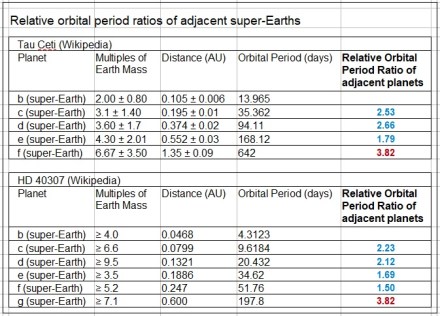
Table 1. Orbital period ratios of adjacent super-Earths. Note the greater orbital period ratio between the outermost adjacent super-Earth pairs (red) compared to inner adjacent super-Earth pairs (blue)
………………..
3. Flip-Flop Fragmentation (FFF)
¶
¶ ‘Flip-flop fragmentation’ (FFF) is an alternative hypothesis for the formation of most star systems with gaseous satellites, potentially forming gaseous satellites by 2 separate but related mechanisms. 1) Hot and cold Jupiters and their diminutives are suggested to primarily form by a flip-flop mechanism, designated, asymmetrical flip-flop fragmentation (asymmetrical FFF), in which a stellar-mass disk fragmentation displaces a planetary-mass prestellar/protostellar object into a planetary satellite orbit. 2) Brown dwarfs and red dwarf satellites, and possibly their diminutives may form when a dynamical bar-mode instability-shaped accretion disk trifurcates into a massive twin pair in orbit around a diminutive protostellar core at the system barycenter by a process designated, symmetrical FFF. A third mechanism for forming gaseous satellites, designated trifurcation, is discussed in § 4.
¶ Asymmetrical FFF is further subdivided into forming hot Jupiters in low ‘hot’ orbits (and their diminutives) and cold Jupiters in high ‘cold’ orbits, and their diminutives. Hot Jupiters are suggested here to for by disk fragmentation of accretion disks and cold Jupiters are suggested here to form by disk fragmentation of pseudodisks (beyond accretion disks).
¶ Symmetrical FFF systems are born as dynamically-unstable nonhierarchical systems that gradually evolve into stable hierarchical systems through orbital interplay that progressively ‘evaporates’ the diminutive prestellar/protostellar central core into a circumbinary orbit, as a ‘companion’, around the much-more-massive twin pair. Finally, the massive twin components of symmetrical FFF systems may be perturbed by their circumbinary companion to spiral-in and merge.
¶ These several mechanisms do not purport to explain all gaseous satellites, where many companion stars have presumably formed by alternative fragmentation mechanisms not explored here, and other mechanisms for forming gaseous exoplanets may also exist.
A counterintuitive protostellar disk discovery:
¶ Planet formation theory is constrained by the mass and evolution of protostellar disks. A counterintuitive discovery (Tychoniec et al., 2018) found decreasing accretion disk mass with protostellar evolution. The study measured a dramatic decrease in dust mass with increasing protostellar age, where measured dust mass is assumed to be a proxy for overall accretion disk mass. Disk dust mass was measured to decrease from 248 M⊕ in Class 0 protostars, to 96 M⊕ in Class I protostars, to 5-15 M⊕ in Class II protostars. And if the youngest (Class 0) protostars have the most massive disks, then a reasonable extrapolation suggests that still-younger prestellar objects might have still more-massive disks. If protostars are steadily accreting while their surrounding accretion disks are rapidly dissipating, then these opposing trends suggests the possibility of an early crossover point, before which accretion disks may be (much) more massive than their diminutive, planetary-mass prestellar/protostellar central cores, resulting in dynamically unstable systems. “The compact components around the Class 0 protostars could be the precursors to these Keplerian disks. However, it is unlikely that such massive rotationally supported disks could be stably supported given the expected low stellar mass for the Class 0 protostars: they should be prone to fragmentation”. (Li et al. 2014)
¶ Another study of 90 protostellar systems finds the highest dust opacity in the youngest Class 0 disks: “The ratio of disk-averaged brightness temperature to predicted dust temperature shows a trend of increasing values toward the youngest Class 0 disks, suggesting higher optical depths in these early stages” (Hsieh et al., 2025), where optical depth presumably correlates with disk mass.
Hot Jupiters Saturns and Neptunes by asymmetrical FFF of protostellar disks:
¶ The Tychoniec et al. (2018) finding of decreasing disk mass with protostellar evolution suggests the possibility of an early crossover point, where the disk mass may be greater than the core mass. If this occurs, the disk’s self-gravity dominates the dynamics of the system. The gravitational potential of the disk itself becomes the primary factor, effectively decoupling the dynamics of the disk from the influence of the central core. This shifts the system from being core-dominated to being disk-dominated, and the central object contributes less to the system’s stability. In a core-dominated system, the disk’s material follows approximately Keplerian motion; however, when the disk dominates, the rotational profile becomes non-Keplerian, reflecting the disk’s self-gravitating structure. Toomre’s Q-criterion governs local instabilities, but for extremely massive disks, the assumption of localized perturbations breaks down, and global effects must be considered. Thus, Toomre’s stability criterion is critical in local disk instability, whereas global effects take over in disk fragmentation. In a disk that is much-more massive than its prestellar/protostellar object, the self-gravity of the entire disk must be considered, while conserving system angular momentum. If the self-gravity of a single inhomogeneity dominates the disk, it will progressively displace the core from the center of rotation, causing the former core to spiral out into a satellite orbit around the much-more massive disk fragmentation, which becomes the new prestellar/protostellar object at the center of rotation. The inward projection of mass that occurs during asymmetrical FFF converts potential energy to kinetic energy in the form of heat, which increases the number of microstates of the system, thereby increasing system entropy, which is thermodynamically favored.
¶ In Fig. 2, a tight knot of hot Jupiters is clustered along the top diagonal line segment demarcating the triangular-shaped exoplanet desert. The negative slope of this hot Jupiter cluster indicates an anticorrelation between mass and orbital distance. Tychoniec et al. (2018) discovery that found decreasing accretion disk mass with protostellar evolution may explain the anticorrelation of mass with orbital distance if the Tychoniec discovery extends into the prestellar realm. Thus, if earlier, lower-mass presolar objects are typically surrounded by more massive accretion disks than older, more-massive presolar objects, then the resulting asymmetrical FFF (disk fragmentation) should inject low mass prestellar objects into higher orbits than higher-mass prestellar objects, partly due to the greater specific angular momentum of more-massive accretion disks, and partly due to the increasing mass of prestellar objects over time, since less-massive planetary satellites need to be injected into higher orbits to have comparable angular momentum to more-massive planetary satellites.
¶ A following subsection will make the argument for 4 Mj being the dividing line between the mass of prestellar objects and protostellar objects. If we name the clustered hot Jupiters with an anticorrelation ‘classical hot Jupiters’, we note from Fig. 2 that a fair number of hot Jupiters lie above the knot of classical hot Jupiters, with a fair number above the purple horizontal line at 4 Mj, presumably dividing former protostars above the line and former prestellar objects below the line. These nonclassical hot Jupiters remain unexplained, although some may have been injected into lower orbits by subsequent episodes of disk fragmentation in systems with multiple instances of asymmetrical FFF.
¶ Cold Jupiters often have sibling cold Jupiters, whereas hot Jupiters and hot/warm Neptunes tend to be solitary gaseous planets, suggesting that disk fragmentation of accretion disks generally only occurs once, whereas disk fragmentation of pseudodisks is more likely to repeat.
¶ The displacement of the former core from the center of rotation by disk fragmentation will not absorb sufficient angular momentum, however, to allow the entire disk to collapse directly into a star, such that the new disk-fragmentation object will necessarily inherit a sizable accretion disk of its own, which will include the former core as a planetary satellite. As the disk-fragmentation object (nascent star) accretes gas from the new disk, its growing mass will cause the inertially-displaced former core to spiral-in over time, ultimately installing the former core in a low ‘hot’ orbit as a hot Jupiter or a warm/hot Neptune- or Saturn-mass planet.
¶ Disk fragmentation of protostellar disks (accretion disks) is suggested here to form hot Jupiters, and disk fragmentation of pseudodisks is suggested below to form cold Jupiters. Accretion disks are known to have elevated dust-to-gas ratios, compared to their natal molecular clouds, which supports the formation of hot Jupiter host stars by disk fragmentation of dusty protostellar disks. the host stars of hot Jupiters are relatively metal rich, [Fe/H] = 0.18 ± 0.13, and the host stars of cold Jupiters are relatively metal poor, [Fe/H] = 0.03±0.18 (Banerjee et al., 2024) The standard model of core accretion turns the finding on its head, by suggesting that star systems with elevated metallicity are more likely to form giant planets, but since hot Jupiters are supposedly born as cold Jupiters that have migrated inward, this explanation does not explain why the stars hosting hot Jupiters should have a higher metallicity than stars hosting cold Jupiters.
¶ This conceptual study makes no pretense of explaining or justifying the orbital radii of hot and cold Jupiters, nor the relative difference in orbital radii between hot and cold Jupiters.
The effect of magnetic fields in forming protostellar disks:
¶ Jeans instability in a dark core causes freefall collapse of dust and gas. A magnetic field with an hourglass B-field morphology channels gas and dust in freefall along magnetic field lines, forming a flattened envelope perpendicular to the field lines known as a ‘pseudodisk’ around the central object. In scenarios where the magnetic field is aligned with the rotation axis, magnetic braking is highly efficient, often leading to the suppression of large, rotationally supported disks—a phenomenon known as the “magnetic braking catastrophe.” However, when there is a significant misalignment between the magnetic field and the rotation axis, the efficiency of magnetic braking decreases, facilitating the formation of larger accretion disks.
¶ In the HH 212 protostellar system, HCO+ indicates infalling with small rotation (i.e., spiraling) in the flattened envelope (pseudodisk) extending out to ~800 AU. “Inside the flattened envelope, a bright compact disk is seen in continuum at the center with an outer radius of ~120 AU (0.3″). This disk is also seen in HCO+ and the HCO+ kinematics shows that the disk is rotating.” “The RSD [rotationally supported disk] is expected to be Keplerian when the mass of the protostar dominates that of the disk.” In order to produce enough disk continuum emission, a jump in density by a factor of 8 is necessary between the pseudodisk and (protostellar) disk, which is consistent with an isothermal shock at the interface. In many models of magnetic core collapse, the magnetic field creates efficient magnetic braking that prevents a RSD from forming, resulting in only a pseudodisk forming around the central protostar.
(Lee et al., 2014)
Cold Jupiters by asymmetrical FFF in pseudodisks:
¶ The bimodal hot and cold Jupiter populations are separated by a 10–100 d orbital-period valley, which presumably indicates formation by separate mechanisms. The standard model of core accretion hypothesizes gas-giant planet formation in the Goldilocks zone beyond the frost line, followed by Type II planetary migration to inject gas-giant planets into low ‘hot’ orbits as ‘hot Jupiters’. By the standard model, the wide gulf between the hot and cold populations requires an unlikely all-or-nothing planetary migration mechanism, resulting in a ‘discreteness problem’. Alternatively, asymmetrical FFF may avoid a discreteness problem, with separate origins for the hot and cold populations, where hot Jupiters form by disk fragmentation of accretion disks and cold Jupiters form by disk fragmentation of more-distant pseudodisks.
¶ Additional evidence for disparate origins for hot and cold Jupiters comes from the disparate metallicity of their host stars, where the host stars of hot Jupiters are relatively metal rich, [Fe/H] = 0.18 ± 0.13, and the host stars of cold Jupiters are relatively metal poor, [Fe/H] = 0.03±0.18 (Banerjee et al., 2024). But this would be the expected outcome for an asymmetrical FFF origin from separate disks, if accretion disks are dustier than pseudodisks.
¶ So, separate origins from separate disks may provide a solution to the discreteness problem. Magnetic fields are known to cause magnetic braking in pseudodisks, which transfers angular momentum outward, creating magnetically-truncated accretion disks that are rotationally supported. When there is a significant misalignment between the magnetic field and the rotation axis, the efficiency of magnetic braking decreases, resulting in larger accretion disks that may form hot Jupiters by disk fragmentation, but when the magnetic field is aligned with the rotation axis, magnetic braking is highly efficient, resulting in magnetic truncation of accretion disks. If a seesaw mechanism creates a proportionally more-massive pseudodisk when its associated accretion disk is magnetically truncated, then there may be potential for disk fragmentation in massive pseudodisks.
¶ The angular momentum of gas in the pseudodisk twists the magnetic field lines, compressing the entrained gas, and if the twisted field lines are anisotropic, then the resulting compressed mass will create an anisotropic mass inhomogeneity, which may inertially displace the central prestellar/protostellar object (core) from the center of rotation. And if the anisotropic inhomogeneity is of sufficient size to cause positive feedback in the core, then the potential for a runaway state exists. One further condition is necessary for a runaway state, which is magnetic reconnection of the twisted field lines that libreates the magnetically-compressed dust and gas, allowing self-gravity to take over. When a disk inhomogeneity is much-more massive than its stellar core, then core-disk feedback will be unable to damp down disk inhomogeneities from undergoing runaway disk fragmentation, presumably resulting in asymmetrical FFF, where the former core is injected into a planetary satellite orbit around the disk-fragmentationj object as a nascent star.

Figure 2: Log-log plot of planetary mass as a function of orbital period:
– Red lines: Relative desert of giant planets with an orbital period of 10–100 days, separating hot Jupiters from cold Jupiters
– Purple line: Relative desert of giant planets with a mass of 4 Mj
– Black dashed line segments, meeting at a right angle: outlines the planetary desert
– Black lines with arrowheads: indicates formational mass and resulting mass
Image credit: Modified from Mazeh, Holczer and Faigler, A&A 589, A75 (2016), Fig.1
¶
Symmetrical FFF:
¶ Neptune-, Saturn- and Jupiter-mass planets have been discovered in circumbinary orbits, but the overwhelming majority of companion objects in hierarchical trinary systems are low-mass stars. “At least 32 sub-stellar companions orbiting stellar or brown-dwarf binaries have been detected to date.” (Mogan and Zanazzi, 2024) This compares with 5,600 exoplanets overall. In the Mogan and Zanazzi (2024) study, the complete absence of planets around sub-seven-day period binaries indicates the relative difficulty of finding circumbinary planets, compared to finding planets around solitary stars. And the Gaia spacecraft, which has examined 2 billion stars overall, discovered only 376 new hierarchical triple system candidates in 2022 (Czavalinga et al., 2023), with the stellar companions all having ≲ 1000 day orbital periods. This low number of circumbinary planets and stars is presumably a reflection on the relative difficulty in discovering circumbinary objects, rather than an indication of their relative abundance. The Gaia survey was not designed to find wide circumbinary companions, but the fact that our nearest neighbor star system, Alpha Centauri, has a wide circumbinary companion with a 550,000 year orbital period, suggests that wide hierarchical triples may be very commonplace.
¶ When a collapsing dark core has particularly high specific angular momentum, or its magnetic fields are unable to effectively project angular momentum outward, the infalling dust and gas may form a bilaterally-symmetrical dynamical bar-mode instability, rather than a radially-symmetrical accretion disk. If such a dynamical bar-mode instability reaches sufficient mass and specific angular momentum for self-gravity to fragment the bar, this study suggests that the outcome will be trifurcation, creating new twin Roche spheres from the bar + the core at the center of rotation, creating a trinary system composed of a twin pair in orbit around a diminutive core in a process designated, symmetrical FFF. Symmetrical FFF is indeed a form of trifurcation (§ 4), in that both mechanisms involve the fragmentation of dynamical bar-mode instabilities into a trinary system, such that symmetrical FFF could alternatively be called ‘zero-generation trifurcation’. And similar to trifurcation, the resulting nonhierarchical trinary system is dynamically unstable, which evolves through a process of orbital interplay into a stable hierarchical system, most typically injecting the former core in a circumbinary orbit around the twin components. Equipartition of kinetic energy in orbital close encounters during orbital interplay tends to transfer orbital energy and angular momentum from the more-massive twin components to the less-massive former core. This gradually ‘evaporates’ the diminutive former core into a circumbinary orbit as a ‘companion’ of the binary pair, creating a stable hierarchical system. The spiral-in of the twin components typically forms a binary pair, but secular perturbation by the companion may cause the binary pair to spiral-in and merge in a luminous red nova, converting the trinary system into a binary system, with the companion being the diminutive partner. Our own solar system presumably formed by symmetrical FFF, followed by 4 generations of trifurcation, followed by the spiral-in merger of the twin components (as former ‘Binary-Sun’) in a luminous red nova (LRN). And the LRN created the ‘solar-merger debris disk’ at 4,567 Ma, which spawned the asteroid belt.
¶ The percentage of binaries increases with stellar mass, which may be explained by the angular momentum of the infalling gas overwhelming the nebular magnetic field that serves to transfer angular momentum outward. Thus, more-massive dark cores tend to have higher angular momentum accretion disks, which deform into dynamical bar-mode instabilities and beyond that into dumbbell configurations. dynamical bar-mode instability presumably forms cores at the center of rotation, but the most massive systems with the highest angular momentum that exhibit a dumbbell configuration may fail to form central cores at the center of rotation (the system barycenter). So the most massive stellar systems with the highest specific angular momentum that create dumbbell-shaped ‘accretion disks’ may be born as binary systems without central cores, and therefore are not symmetrical FFF systems, whereas less-massive systems with dynamical bar-mode instability-shaped ‘accretion disks’ presumably form trinary systems by symmetrical FFF.
¶ Some number of the most-massive ‘cold Jupiters in Fig. 2 may have formed by symmetrical FFF, potentially followed by the spiral-in merger of the twin components, leaving a companion orbiting a solitary star, and since symmetrical FFF systems necessarily have high specific angular momentum compared to asymmetrical FFF systems, companions formed by symmetrical FFF should have particularly high (cold) orbits. Indeed, the ‘brown dwarf desert’ below 5 AU may be explained by brown dwarf formation by symmetrical FFF, followed by the spiral-in merger of the twin components, in the case of solitary star systems with brown dwarfs. In addition to forming brown dwarfs as the central protostellar cores, brown dwarfs can also apparently form in binary pairs as the much-more-massive twin components in symmetrical FFF systems, and a new study has found super-Jupiter-mass binary pairs. A recent study (Pearson and McCaughrean, 2023) discovered 540 planetary-mass candidates with masses down to 0.6 Jupiter masses in the Trapezium Cluster, and surprisingly, 9% of these planetary-mass objects are in wide binaries, which challenges current theories of both star and planet formation. The term ‘JuMBOs’ was coined for these Jupiter Mass Binary Objects. A follow up study by Diamond and Park er (2024) of the JuMBOs in Orion Nebula suggests that super-Jupiter-mass binary pairs may be the result of photoerosion by nearby hot stars that quenched star formation in its earliest stages by stripping away the surrounding infalling envelopes. The binary separation of JuMBOs matches the typical Gaussian distribution of A-type star binaries, supporting the photoerosion supposition. If this is the case, then binary brown dwarf systems may be the lowest-mass systems formed by symmetrical FFF without photoerosion.
¶ Our own solar system presumably formed by symmetrical FFF, creating a twin stellar pair, designated ‘Binary-Sun’, and a low-mass brown dwarf core, designated ‘Brown Dwarf’. The Alpha Centauri system presumably also formed by symmetrical FFF, with twice the mass of our solar system and much-greater angular momentum. If our solar system and our nearest stellar neighbor both formed by the same mechanism, then symmetrical FFF may be one of the most prevalent stellar formation mechanisms going.
¶ Similar size and color binary Kuiper belt objects and similar size binary asteroids may indicate that symmetrical FFF may be the typical outcome of streaming instability. The Pluto system is amenable to a symmetrical FFF origin, with Pluto and Charon as twin components. Then the former central core of the system appears to have undergone 2 generations of trifurcation, with Nix-Hydra as 1st-generation trifurcation twins and Styx-Kerberos as 2nd-generation twins.
(Mini)-Neptune- and Saturn-mass planets in relation to the exoplanet desert:
¶ Interstellar gas experiences a degree of pressure support during Jeans instability freefall, such that dust and ice grains have a higher terminal velocity than gas and may accumulate at the center of freefall, disproportionate to the system metallicity. And as freefall increases gas density in the central core, it also increases the partial pressure of volatiles, promoting their condensation onto dust grains. Thus, very-early prestellar objects may form rocky-icy centers before the gas even becomes opaque to infrared radiation at the first hydrostatic core phase.
¶ The relative prevalence of Neptune-mass planets compared to Saturn-mass planets, as apparent in Fig. 2, suggests the possibility that (mini-)Neptunes may have formed as Saturn-mass prestellar objects that lost the bulk of their gaseous component in the upheaval of disk fragmentation, potentially causing Saturn-mass prestellar objects to dissipate into Neptunes or mini-Neptunes. The vertical black arrows in Fig. 2 indicate the suggested Saturn-mass origin of some of the Neptune-mass planets in the 10–100 d orbital period valley, prior to losing the bulk of their gaseous component, suggesting that Saturn-mass planets are not as formationally scarce as they are observationally scarce. This could explain the relative dearth of Saturn-mass exoplanets in the hot Jupiter population derived from asymmetrical FFF of protostellar disks, but the same does not appear to be true in the cold Jupiter population derived from asymmetrical FFF of pseudodisks.
Conservation of angular momentum during asymmetrical FFF:
¶ In rotationally-supported systems, such as protostellar disks, the specific angular momentum
increases with the square root of the radius. So, if a prestellar system with a protostellar disk measuring in the 10s of AU transforms into a hot Jupiter planet with a semimajor axis measured in 10ths to 100ths of an AU, then there must be some form of high-angular momentum compensation to conserve system angular momentum. This requires a mechanism to imbue a percentage of the disk with substantially-greater angular momentum, likely entailing high-velocity outflows with escape velocity from the system. The standard model similarly requires an outward transfer of angular momentum in an accretion disk to enable the inward migration of a planet.
4 Jupiter mass (Mj) giant-planet valley:
¶ Santos et al. (2017) finds a relative scarcity (a valley) of gas-giant exoplanets, with a mass of about 4 Mj.
¶ The most noteworthy occurrence in the prestellar phase is the formation of the first hydrostatic core (FHSC), which marks the transition from prestellar to protostellar objects. As gas falls onto a prestellar object, its potential energy is radiated away as infrared photons, but when it reaches a critical density, the prestellar object becomes optically opaque in the infrared, causing its temperature to rise, which results in hydrostatic pressure that supports the gas against gravitational collapse, forming a FHSC of brief duration.
¶ Gas falling onto the FHSC from the accretion disk creates a shock front that extends to a radius of ~ 5–10 AU (Tsitali et al. 2013). This study suggests that this extreme pithiness may cause a FHSC to viscously engage with the surrounding accretion disk, temporarily damping down the positive disk-core feedback necessary for runaway disk instability, resulting in a temporal hiatus in asymmetrical FFF. The mass of the FHSC is not well constrained observationally or theoretically, with rotation and magnetic fields greatly increasing its theoretical mass above the simple solution calculated by Larson (1969) of 1 Mj, but the importance for this purpose is the resultant mass of the inertially displaced prestellar object after FFF, which is presumed to create the 4 Mj gas-giant planet valley. Bate (2011) predicts a FHSC mass of 5 Mj for nonrotating cores, which suggests the possibility that rotation causes mass loss approximately down to the nonrotating solution for FHSCs.
¶ The duration of the FHSC is calculated to last a few hundred to a few thousand years (Young, 2023), depending on rotation and magnetic fields, with the short duration creating a narrow valley.
L1448 IRS3B (Fig. 1):
¶ The triple star system, L1448 IRS3B, is suggested here to have been formed by symmetrical FFF, where the diminutive former core outshines its more-massive twin siblings, due to its more advanced development. This triple star system is composed of a similar-sized binary pair, IRS3B-a & IRS3B-b, with a combined mass of ~1 M☉ in a 61 AU binary orbit, and a distant tertiary companion, IRS3B-c, with a minimum mass of ~0.085 M☉ in a 183 AU circumbinary orbit around the binary pair. This system may become more hierarchical over time, coming to resemble the Alpha Centauri system at half the mass. “Thus, we expect the [L1448 IRS3B] orbits to evolve on rapid timescales (with respect to the expected stellar lifetime), especially as the disk dissipates. A natural outcome of this dynamical instability is the formation of a more hierarchical system with a tighter (few AU) inner pair and wider (100s to 1,000s AU) tertiary, consistent with observed triple systems.” (Tobin et al. 2016)
¶ The tertiary protostar, IRS3B-c, is embedded in a spiral arm of the outer disk, which has an estimated mass of 0.3 M☉. The standard model of companion star formation, expressed in the Tobin paper, suggests that IRS3B-c formed in situ by gravitational instability from the spiral disk, making IRS3B-c younger than IRS3B-a & IRS3B-b; however, IRS3B-c is brighter at 1.3 mm and 8 mm than its much more massive siblings, which is apparent in Fig. 1. Alternatively, the brighter, tertiary companion supports formation by symmetrical FFF, with the diminutive companion as the more-evolved central protostar of the system.
Hot Jupiters and hot Neptunes in polar orbits:
¶ Hot Jupiters exhibit bimodal obliquity. Hot Jupiter orbits that are misaligned with their host stars “show a preference for nearly perpendicular orbits (ψ = 80 − 125°) that seems unlikely to be a statistical fluke” (Albrecht et al., 2021) (Fig. 3). Another article that discovered two hot Neptunes in polar orbits states, “we performed a hierarchical Bayesian modeling of the true obliquity distribution of Neptunes and found suggestive evidence for a higher preponderance of polar orbits of hot Neptunes compared to Jupiters” (Espinoza-Retamal et al. 2024).
¶ This discovery of star systems with giant planets in low, hot polar orbits is suggested here to be formational, and not due to subsequent migration, as is commonly assumed. Since stars formed by asymmetrical FFF are younger than their planets, and since their giant planets have much-greater orbital angular momentum than the rotational angular momentum of their stellar hosts, it’s likely that collapsing disk fragmentation objects have a propensity to torque their rotational axes perpendicular to the orbit of inertially-displaced former stellar cores.
¶ In asymmetrical FFF, the former prestellar core and the nascent disk-fragmentation object creates a system barycenter, which may interfere with the formation of a local center of rotation in the contracting disk-fragmentation object when it’s in the same plane as the barycenter. In this context, a lower energy state may be attained by torquing the rotation axis of the disk-fragmentation object perpendicular to the barycenter rotation axis, allowing for the more-rapid contraction of the disk-fragmentation object into a nascent star. Torquing the spin axis of the disk instability object may occur gradually by precession of the collapsing disk-fragmentation object by a reaction against the residual protostellar disk and the former prestellar core in its nascent satellite orbit. Since giant planets contain the vast majority of the angular momentum in stellar systems, the much-higher angular momentum of the former core torques the much-more-massive nascent disk-fragmentation object into a perpendicular orientation. In order to compete for the center of rotation, the former prestellar core must be close to the nascent disk-fragmentation object, which is why only hot Jupiters are commonly found in polar orbits.
¶ Systems that fail to undergo perpendicular torquing of their disk-fragmentation objects may retain more mass in their protostellar disks and thus may be susceptible to further occurrences of asymmetrical FFF, potentially forming multiple hot Jupiters. This suggests that perpendicular torquing of a disk-fragmentation object may generally preclude further instances of disk fragmentation by more efficiently incorporating the dust and gas of the fragmented accretion disk, which predicts that in systems with multiple hot Jupiters, all or none will be found in polar orbits. The 3 super-puff planets in the Kepler-51 system (Table 2) may be a good test of this principle. Two of the planets have perfect 90° obliquity (Kepler-51b & Kepler-51d). If the third super-puff planet is also discovered to have a polar orbit, this may lend support to this hypothesis and to the torquing of the rotation axis of the stellar component rather than the planetary component.
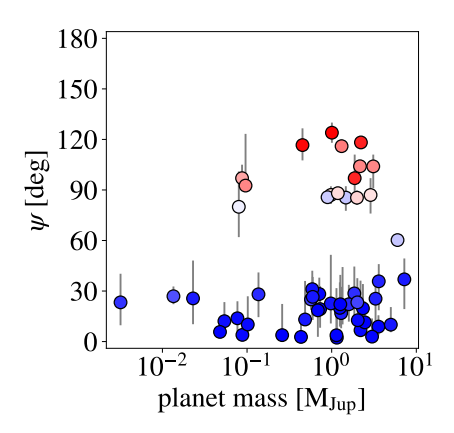
Figure 3: Bimodal distribution of hot Jupiters by obliquity, from (Albrecht et al., 2021)

Table 2: Super puff planets of Kepler-51, from (Masuda 2014) & (Libby-Roberts et al. 2019)
¶
Galactic FFF:
¶ FFF might also explain the formation of large spiral and elliptical galaxies from primordial dwarf galaxies formed prior to recombination. (See: Two Epochs of Baryonic Dark Matter, with Free-floating Super-puff-like Planets as the Second and Present Epoch). This ideology suggests that spiral galaxies may have formed by asymmetrical FFF through an inertial flip-flop of a diminutive core formed at the center of rotation. Similarly, giant elliptical galaxies may have formed by symmetrical FFF, followed by the spiral-in merger of twin components.
¶ Galactic asymmetrical FFF presumably forms by asymmetrical FFF, where the Large Magellanic Cloud may be the former core of the disk of primordial dwarf galaxies that formed the Milky Way galaxy. Potentially lending support to this hypothesis is the resemblance of hot Jupiters in polar orbits with vast polar structure (VPOS) or polar disk of satellites (DoS) surrounding the Milky Way and other nearby galaxies, suggesting a common formation mechanism in which the contracting disk-fragmentation object torques itself perpendicular to the system barycenter to attain a lower energy state.
Symmetrical FFF planets, analogous to trifurcation moons (§ 5):
¶ This study suggests that trifurcation also creates a twin pair of trifurcation moons in each trifurcation generation, which are gravitationally bound to their respective twin components. This suggests a refinement to trifurcation, designated ‘trifurcation+2’, with the +2 encompassing the twin trifurcation moons. And because of the similarity of symmetrical FFF to trifurcation by way of a common dynamical bar-mode instability, symmetrical FFF may create 2 symmetrical FFF planets, 1 for each twin component.
¶ Computer simulations indicate spiral tails emanating from the ends of the bar in dynamical bar-mode instabilities. When the bar gravitationally trifurcates, the twin spiral tails may detach from the trifurcating bar to form their own Roche spheres. In the case of trifurcation where the twin components are planetary in mass, gravitational collapse of the spiral tails are designated as ‘trifurcation moons’. In the case of symmetrical FFF where the twin components are stellar in mass, gravitational collapse of the spiral tails are designated ‘symmetrical FFF planets’.
¶ In this regard, if Alpha Centauri indeed formed by symmetrical FFF, then each twin component should have formed with a symmetrical FFF (S-type) planet. The twin binary stars of the Alpha Centauri system may each have a planet, although neither planet has been confirmed, and these unconfirmed planets are of very different sizes and orbit at very different distances from their host stars. The unconfirmed planet, ‘Candidate 1’, of Alpha Centauri A is determined to have a mass range of 9–35 M🜨, at a semimajor axis of 1.1 AU, and the still-less-confirmed possible planet around Alpha Centauri B is determined to have a radius of ~ 0.92 R🜨 and a median likely orbit of 12.4 days (Demory et al., 2015).
¶ Objects formed by the gravitational collapse of spiral tails during trifurcation of dynamical bar-mode instabilities are born without any angular momentum with respect to their trifurcation twins. In the case of trifurcation moons, buffeting by the much-more-massive twin components that induced trifurcation gives the system an initial kick that presumably injects 1 moon into a prograde orbit around its trifurcation twin and (necessarily) injects the other moon into a retrograde orbit around its corresponding trifurcation twin. In the 4th-generation trifurcation in our solar system, Earth acquired the prograde Moon Luna, and Venus presumably acquired a retrograde moon that spiraled in and merged with Venus, possibly at 579 Ma, causing the Venusian cataclysm. But in the case of symmetrical FFF, there are no larger-mass objects to kick the twin components to initiate orbital rotation of the twin symmetrical FFF planets, although the former core, Proxima Centauri, may have provided small kicks or the heterogeneity of the fragmenting disk could have provided the necessary kick to prevent the planets from falling into their twin components.
………………..
4. Trifurcation by centrifugal fragmentation
¶
¶ In a high angular momentum prestellar/protostellar system in which the accretion disk is much more massive than its diminutive core, the disk has inertial dominance of the system, which promotes stellar-mass disk instability. The type of disk instability may depend on the mode of a (spiral) density wave resident in the accretion disk, with asymmetrical (m = 1 mode) density waves forming solitary disk-instability objects by asymmetrical FFF, and symmetrical (m = 2 mode) density waves collapsing to form twin disk-instability objects by symmetrical FFF.
¶ Asymmetrical FFF inertially displaces the stellar core from the center of mass of the system as the system becomes progressively more asymmetrical during the incipient disk instability, but symmetrical FFF preserves the bilateral symmetry of the system, with the protostellar core remaining at the center of the system; however, the much-greater overlying mass of the twin disk-instability objects is dynamically unstable, resulting in subsequent chaotic orbital interplay that progressively projects mass inward.
First-generation trifurcation:
¶ Symmetrical FFF creates twin stellar-mass disk-instability objects in orbit around a diminutive protostellar core. The much greater overlying mass of the twin disk-instability objects constitutes a dynamically-unstable (non-hierarchical) trinary system, which is gradually resolved by orbital interplay into a stable hierarchical system, but another consequence of orbital interplay may be centrifugal-fragmentation of the protostellar core by way of trifurcation. Orbital interplay causes equipartition of kinetic energy, wherein kinetic energy is transferred from the much-more-massive disk-instability objects to the diminutive protostellar core, and if this kinetic energy transfer includes rotational energy, then this study suggests that orbital interplay in symmetrical FFF systems may induce centrifugal fragmentation of protostellar cores. Trifurcation implies centrifugal fragmentation into 3 components, creating a trinary subsystem that locally decreases the trifurcation subsystem entropy.
Equipartition of kinetic energy in 2 spatial and 1 rotational degrees of freedom:
¶ Globular clusters composed of stars of varying masses undergoing mass segregation, also called core collapse, exhibit a property known as negative heat capacity, where the core heats up as it loses energy to the periphery. The mechanism driving mass segregation, which projects mass inward, is equipartition of kinetic energy through gravitational close encounters, which tends to equalize the kinetic energy in each degree of freedom. Since velocity has an inverse relation to the square root of mass in kinetic energy, equipartition of kinetic energy creates disparate velocities between objects of disparate masses, which projects mass inward. Equipartition of kinetic energy is the principle used to extract orbital energy from planets by interplanetary spacecraft in a process known as ‘gravitational slingshot’ or ‘gravity assist’, in which the spacecraft parasitizes the orbital energy of the planet by means of a gravitational interaction. Multiple star systems that have undergone mass segregation are said to be hierarchical, but symmetrical FFF systems and newly trifurcated systems are born nonhierarchical and evolve toward hierarchical equilibrium by orbital interplay governed by equipartition of kinetic energy.
¶ Because rotation is a degree of freedom, equipartition of kinetic energy will necessarily cause a spin up of less-massive objects in corotating systems during orbital close encounters. Indeed, Scheeres et al. (2000) calculates that the rotation rate of asteroids tends to increase in gravitational encounters with other asteroids and planets, providing evidence for the rotational spin up underpinning trifurcation. Symmetrical FFF forms prestellar/protostellar cores at the center of rotation that are born with zero kinetic energy in the 2 spatial degrees of freedom in a coplanar system, but they are born with high prograde spin rates in the rotational degree of freedom. By comparison, the twin stellar-mass disk-instability siblings of prestellar/protostellar cores are born with high kinetic energy in the 2 spatial dimensions and are presumably also born with high prograde spin rates. Because prestellar/protostellar cores are already rapidly spinning at formation, any additional spin up from gravitational interactions with the twin disk-instability objects will cause early distortion into a triaxial shape on the way to centrifugal fragmentation. And trifurcated systems are merely miniature versions of symmetrical FFF systems.
¶ Rotation causes a planemo object to distort into an oblate sphere. Additional spin up distorts the oblate sphere into a triaxial Jacobi ellipsoid. Still greater spin up forms a dynamical bar-mode instability. This study suggests that the centrifugal failure mode of a dynamical bar-mode instability is fragmentation into 3 components, hence trifurcation, wherein self-gravity fragments the bar, causing the opposing ends to pinch off into independent Roche spheres to create a twin pair of objects in orbit around the diminutive residual core remaining at the center of rotation. Thus, a single Roche sphere trifurcates into a gravitationally bound Keplerian system composed of 2 new twin Roche spheres in orbit around the diminutive residual core at the center of rotation, which constitutes the third Roche sphere. (Additionally, dynamical bar-mode instabilities exhibit trailing tails that lag behind the ends of the bar. These trailing tails constitute additional masses that may pinch off to form independent moony Roche spheres that remain gravitationally bound to their respective twin trifurcation components as ‘trifurcation moons’ § 5.)
¶ At the moment of trifurcation, the trinary components resemble a smaller (Mini-Me) version of the original symmetrical FFF system, with a massive twin-binary pair orbiting a diminutive residual core. And like symmetrical FFF, the trifurcated trinary components constitute a dynamically unstable system that’s resolved by orbital interplay, with accompanying spin up of the residual core, promoting next-generation trifurcation, potentially creating a cascade of successively smaller binary pairs, like Russian nesting dolls. Our solar system retained 3 of the 4 sets of twin binary pairs from 4 generations of trifurcation, only losing the largest twin binary pair, Binary-Companion.
¶ No other planetary systems have yet been identified as having formed by trifurcation, which presumably explains why our solar system is so unusual, and if other trifurcation systems exist, they may also be conducive to life. While trifurcation systems may be quite rare, symmetrical FFF is apparently quite common, since our closest star system, Alpha Centauri, also appears to have also formed by this mechanism. The Alpha Centauri system has much-greater angular momentum than our solar system, which suggests the reason why our solar system may be so unusual. Protoplanetary disks can be surrounded by more-distant pseudodisks, where asymmetrical FFF of protoplanetary disks is suggested as the origin of hot Jupiters, and asymmetrical FFF of pseudodisks is suggested as the origin of more-distant cold Jupiters (§ 3). While hot and cold Jupiters appear to be formed in roughly similar numbers, protoplanetary disks may be vastly less likely to undergo symmetrical FFF than more distant pseudodisks, where our solar system could be a rare instance of symmetrical FFF of a protoplanetary disk. And perhaps the higher specific angular momentum of symmetrical FFF in pseudodisk systems somehow precludes first-generation trifurcation.
Why trifurcation and not bifurcation or shattering fragmentation:
¶ A flywheel on a piece of machinery spun up to the point of centrifugal failure will shatter in an unpredictable fashion, but for a relatively liquid object, trifurcation may represent a lower energy state. In a spinning object like a glob of mercury held together by surface tension, whatever shape resulted in the lowest total surface area, while conserving energy and angular momentum, should be thermodynamically favored. Centrifugal fragmentation by bifurcation into twin objects without a residual core would have a lower surface area than trifurcation, but self-gravity in the bar may win out before attaining sufficient angular momentum to achieve bifurcation.
Dynamical Bar-mode Instability
¶ Our solar system presumably formed by symmetrical FFF, followed by 4 generations of trifurcation, which created 1 + 4 = 5 sets of binary pairs (Binary-Sun, Binary-Companion, Jupiter-Saturn, Uranus-Neptune, and Venus-Earth + residual core Mercury):
– 1st-gen trifurcation of Brown Dwarf (protostellar core) by Binary-Sun yields, Binary-Companion + SUPER-Jupiter (residual core)
– 2nd-gen trifurcation of SUPER-Jupiter by Binary-Companion yields, Jupiter-Saturn + SUPER-Neptune (residual core)
– 3rd-gen trifurcation of SUPER-Neptune by Jupiter-Saturn yields, Uranus-Neptune + SUPER-Earth (residual core)
– 4th-gen trifurcation of SUPER-Earth by Uranus-Neptune yields, Venus-Earth + Mercury (residual core)
(Note, unorthodox capitalization indicates unorthodox definitions. ‘SUPER-Jupiter’, ‘SUPER-Neptune’ and ‘SUPER-Earth’ are the names for the former residual cores formed in the first three trifurcation generations. And ‘Brown Dwarf’ is the name of the original protostellar core of the solar system.)
Trifurcation as a fractionation process:
¶ Trifurcation is presumably a fractionation process, which is particularly manifest in differentiated cores, such that the volatile gaseous components are centrifugally slung into the bar-mode arms, while more of the denser solids remain behind at the center of rotation. In a stellar Jeans instability, dust and ice sedimentation may form solid cores in prestellar objects, particularly if dust and ice freefall faster than gas, due to partial pressure support of gas, resulting in solid cores in prestellar/protostellar objects. The progressively denser elemental composition of the solar system planets with decreasing size appears to bear out the internal differentiation of former Brown Dwarf. And indeed, the residual core of the 4th-generation trifurcation, Mercury, has a proportionally-larger iron core than Earth or Venus.
¶ Fractionation during trifurcation is presumably isotopic as well, which may partly explain Jupiter’s elevated deuterium-to-hydrogen (D/H) ratio, which is about twice primordial, which may be partially the result of hydrogen fractionation during 1st-generation trifurcation, with former Binary-Companion presumably depleted in deuterium. Elements with 3 stable isotopes, like oxygen and silicon, are similarly fractionated by trifurcation, but as long as the fractionation is mass dependent, the ratio of ratios between the heavyweight and middleweight isotopes (O18/O17) and the middleweight and lightweight isotopes (O17/O16) remain constant before and after fractionation. Mass-dependent fractionation of oxygen merely represents a displacement along the fractionation line. Thus, all trifurcation descendants in our solar system should lie on the former 3-oxygen-isotope Brown Dwarf fractionation line, which we know as the (3-oxygen-isotope) terrestrial fractionation line (TFL), since all trifurcation descendants evolved from the former Brown Dwarf reservoir, which was presumably well mixed. This predicts that Jupiter-Saturn, Uranus-Neptune and Venus-Earth-Mercury will all lie on the TFL, where Earth will appear in its familiar place on the graph and Uranus-Neptune will be displaced up and to the right along the TFL and Jupiter-Saturn will be displaced even further up and to the right along the TFL. Indeed the Moon (Luna) is displaced slightly up and to the right on the TFL compared to terrestrial samples from Earth, which is in keeping with the twin tails extending from the bar ends of the bar-mode instability being slightly more fractionated than the bars themselves, where the bar ends formed Venus and Earth and the twin tails formed their respective twin trifurcation moons, namely prograde Luna and Venus’ former retrograde trifurcation moon (§ 5). Mars is not a trifurcation planet and indeed we know that it does not lie on the TFL.
Trifurcation debris disk:
¶ Trifurcation is presumably a messy process, such that 4 generations of trifurcation presumably created a massive ‘trifurcation debris disk’, which was shaped by the dynamic unwinding of the trifurcation subsystems. The debris disk had an outer component beyond Neptune and may have had an inner component at the site of the present asteroid belt. The debris disk was siderophile depleted, because the trifurcated cores were internally differentiated, which largely sequestered the iron-nickel cores from evaporation during the trifurcation process. Additionally, the trifurcation debris disk lay on the 3-oxygen-isotope TFL, as part of the well mixed Brown Dwarf reservoir. The trifurcation debris disk presumably spawned the hot classical KBOs, which are siderophile depleted and lay on the TFL.
Three secular evolution mechanisms:
¶ Three principles are recognized here for transferring energy and angular momentum between orbiting objects in Keplerian systems, namely, equipartition of kinetic energy in gravitational close encounters, resonance chasing, and tidal effects.
¶ In Keplerian systems, equipartition of kinetic energy projects mass inward by attempting to equalize the kinetic energy between objects with disparate mass in orbital close encounters. This mechanism converts chaotic nonhierarchical star systems into stable hierarchical systems.
Alpha Centauri is a good example of a symmetrical FFF system that was presumably born non-hierarchical, with Proxima Centauri as the original protostellar core at the center of rotation, followed by its gradual perturbation into a hierarchical circumbinary orbit by orbital interplay with the much-more-massive twin disk-fragmentation objects that became Alpha Centauri A & B.
¶ Tidal effects are an inverse cube function with distance that falls off faster than the inverse square function of gravity, such that moony tides can even exceed stellar tides on planets, such as on Earth. During the unraveling of 4 trifurcation generations, various trifurcation components would have had separations more in line with planets and their moons than the planets and the Sun, causing dramatically greater tidal effects during the trifurcation epoch, and its subsequent unwinding.
¶ Resonance chasing is a mechanism of orbital energy transfer mediated by gravitational effects, where periodic gravitational interactions drive orbiting bodies toward mean motion resonances (MMRs). These resonances occur when the orbital periods of two bodies maintain a ratio of small whole numbers, leading to a synchronization that can alter their orbital parameters in a self-reinforcing manner. But resonance chasing can only proceed in the thermodynamically favored direction, which corresponds to an inward projection of mass. With the complex orbital epicycles of multiple trifurcation generations during the trifurcation epoch, the solar system would have been alive with binary heartbeats and epicycle periods, with resonances chasing one another as well as chasing the orbital period of Binary-Sun.
¶ Imagine a hierarchical quadruple system composed of two binary pairs, where the less-massive binary is in a circumbinary orbit around the more massive binary. Such a ‘hierarchical quadruple system’ or ‘double binary system’ can be designated AB-CD, where AB is the more-massive central binary and CD is the less-massive circumbinary binary. Secular evolution of a multiple star system is driven by increasing closed system entropy, but this process necessarily entails decreasing subsystem entropy in order to conserve system energy and angular momentum. Secular evolution of a double binary system projects mass inward by causing the binary components of AB to spiral in toward the AB barycenter, and system energy and angular momentum are conserved by the outward migration of the CD components. This outward migration of the CD components can take 2 forms, causing the CD components to spiral out from their binary barycenter, and/or by causing the CD binary to increase its circumbinary orbit. Resonance chasing suggests that secular evolution by these 2 mechanisms may alternate, by chasing whichever resonance is closest in the thermodynamically favored direction.
¶ With 4 trifurcation generations, our solar system had 4 sets of binary planets in addition to former Binary-Sun, which created multiple ‘heartbeats’ in the early solar system, resulting in a multiplicity of simultaneous resonance chasing. Secular evolution resulting from equipartition of kinetic energy, tidal effects and resonance chasing was a complex multi-body problem. Jupiter-Saturn binary pair, for instance, would have been induced to spiral in by Neptune-Saturn (children) and Venus-Earth-Mercury (grandchildren) and induced to spiral out by Binary-Companion (parents) and Binary-Sun (grandparents), such that binary pairs may have alternately spiraled in and spiraled out in the complex dynamics of unwinding the trifurcation systems. The extreme flatness of our solar system allowed 4 generations of trifurcation, where less flatness may have resulted in fewer trifurcation generations and greater flatness may have resulted in additional trifurcation generations.
¶ In our solar system, it appears that the trifurcation generations did not unwind in a hierarchical fashion. The present-day configuration of the solar system can best be explained by Jupiter-Saturn gravitationally capturing Venus-Earth-Mercury from Uranus-Neptune and then Binary-Companion capturing Uranus-Neptune from Jupiter-Saturn. Then Binary-Sun captured Uranus-Neptune via Binary-Companion’s far-side L2 Lagrange point and Binary-Sun captured Jupiter-Saturn, with Venus-Earth-Mercury in tow via Binary-Companion’s near-side L1 Lagrange point. Finally, Binary-Sun captured Venus-Earth-Mercury from Jupiter-Saturn via Jupiter-Saturn’s near-side L1 Lagrange point.
¶ With all orbits being prograde, capture of Uranus-Neptune by Binary-Sun from Binary-Companion at its L2 Lagrange point included a prograde kick, since the old Uranus-Neptune orbit around Binary-Companion was in the same direction as the new heliocentric orbit of Uran-Neptune at the instant of capture at the L2 Lagrange point. By comparison, Jupiter-Saturn, with Venus-Earth-Mercury in tow, received a retrograde kick at the L1 Lagrange point, since the old Jupiter-Saturn orbit around Binary-Companion was exactly opposed to its new heliocentric orbit at the L1 Lagrange point. Thus, the velocity vectors add at the L2 Lagrange point, resulting in a prograde kick in the new heliocentric orbit, whereas the velocity vectors subtract at the L1 Lagrange point, resulting in a retrograde kick in the new heliocentric orbit. A similar thing happened when the binary planets spiraled out from their binary barycenters to be captured into solitary heliocentric orbits, where the planet further from the Sun, at the binary L2 Lagrange point, received a prograde kick, while its binary companion at the L1 Lagrange point received a retrograde kick. The original distance of Binary-Companion from the Sun, the size of the various Roche spheres and the various prograde and retrograde kicks at the time of heliocentric capture gave us the locations and spacing of the planets in our highly unusual solar system, with the spacing known as the Titius-Bode law.
Pluto system:
¶ Binary asteroids and Kuiper belt objects (KBOs) presumably formed by symmetrical FFF, and some may have undergone trifurcation as well. The Pluto system has 4 small moons that could be characterized as two sets of twin binary pairs in descending size from two trifurcation generations of a former sedimentary core formed at the center of rotation of the streaming instability. Thus, Pluto-Charon would be the symmetrical FFF twins, with Nix-Hydra (50 × 35 × 33 km), (65 × 45 × 25 km) as 1st–generation trifurcation twins, and Styx-Kerbos (16 × 9 × 8 km), (19 × 10 × 9 km) as 2nd-generation trifurcation twins, but the residual core from the 2nd-generation trifurcation is either missing or more likely below the resolution of the Hubble telescope. This characterization would make the Pluto system a miniature version of our solar system; however, Pluto’s smaller moons are some 275,000 times less massive than Pluto and Charon combined, whereas the Sun is only 1000 times the mass of Jupiter, possibly pointing to differing dynamics in systems formed by streaming instability.
¶ The elongated shapes of the 4 small moons may be evidence for elongation of a core into an bar-mode-instability, with the trifurcated objects having insufficient mass to subsequently assume hydrostatic equilibrium.
………………..
5. Trifurcation Moons
¶
¶ The extreme isotopic similarity between Earth and Moon points to a common origin from the Brown Dwarf reservoir by way of trifurcation. But the Moon cannot be the residual core of the 4th-generation trifurcation because its iron core is disproportionately small compared to Earth’s iron core. Instead, spiral tails emanating from the ends of the bar in dynamical bar-mode instabilities suggest an origin mechanism for forming ‘trifurcation moons’. In computer simulations, dynamical bar-mode instabilities intermittently exhibit spiral tails, trailing from the 2 ends of the central bar in dynamical bar-mode instabilities, similar to the spiral arms that trail from the central bar in barred spiral galaxies. And when these tails become detached from the central bar due to trifurcation of the bar, they may gravitationally coalesce into their own Roche spheres to form trifurcation moons. Prior to trifurcation, the spiral tails are physically attached to the bar, and after trifurcation the nascent trifurcation moons remain gravitationally bound to their respective nascent twin-binary siblings. By this mechanism, Venus and Earth would have each acquired a gravitationally bound trifurcation moon in the 4th-generation trifurcation.
¶ In a dynamical bar-mode instability, the bar rotates like a solid object, governed by the specific kinetic energy of the system and the self-gravity of the bar. Solid rotation causes the ends of the bar to rotate at super-Keplerian speed, which may cause material to slough off into twin swept-back tails that rise into slightly higher Keplerian or near Keplerian orbits, which is what appears to happen in this computer simulation.
¶ So, the rotational spin up of a prestellar/protostellar core following symmetrical FFF may cause centrifugal fragmentation of the core into 5 components, where the bar trifurcates into a twin pair of trifurcation planets plus a planetary-mass residual core, and where the spiral arms gravitationally pinch off into a pair of trifurcation moons. So if spin up centrifugal fragmentation of protostellar cores and residual cores indeed form 5 objects, then a more fitting term would be ‘quintifurcation’, which is sufficiently awkward that ‘trifurcation+2’ will suffice when including twin trifurcation moons. And trifurcation+2 occurs in higher-generation trifurcations as well as in the original symmetrical FFF.
¶ Trifurcation moons are born with no net angular momentum with respect to their respective their respective twin-binary siblings, but the first kick from the host binary pair that induced trifurcation+2 apparently injects one trifurcation moon into a prograde orbit around its respective twin planet, while symmetrically injecting its twin trifurcation moon in a retrograde orbit around its respective twin planet. Thus, since Luna acquired a prograde orbit around Earth, we presume that by symmetry, Venus acquired a corresponding trifurcation moon in a retrograde orbit, which was doomed to decay and ultimately merge with the planet.
Jupiter-Saturn:
¶ If Titan is Saturn’s prograde trifurcation moon, then Jupiter presumably had a retrograde trifurcation moon that has long since merged with the planet, possibly at 4,562 Ma, forming enstatite chondrites that lie on the 3-oxygen isotope ‘terrestrial fractionation line’, with the moony merger explosion possibly melting water ice in nearby CI chondrites, forming dolomites in internal fissures.
Uranus-Neptune:
¶ The retrograde orbit of Triton at Neptune presupposes a former prograde trifurcation moon at Uranus, which was presumably lost when Binary-Companion’s progressively increasing eccentricity overran Uranus, stripping Uranus of its moons and causing its 98° axial tilt. If any of Uranus’ moons merged with Binary-Companion they would have fogged the solar system and contributed to the Sturtian glaciation of the Cryogenian period. Triton’s retrograde orbit will ultimately spiral in to merge with Neptune in about 3.6 billion years, which may cause another glaciation on Earth.
Venus-Earth:
¶ The prograde orbit of Earth’s Moon, Luna, presupposes a former retrograde trifurcation moon around Venus, which may have spiraled in and merged with Venus at 579 Ma, fogging the inner solar system, causing the Gaskiers glaciation on Earth (§ 8).
Trifurcation moon summary:
– Jupiter: former retrograde trifurcation moon that may have merged with the planet at 4,562 Ma
– Saturn: prograde trifurcation moon Titan
– Uranus: lost prograde trifurcation moon
– Neptune: retrograde trifurcation moon, Triton
– Venus: former retrograde trifurcation moon that may have merged with the planet at 579 Ma
– Earth: prograde trifurcation moon, Luna
¶ Earth’s oversized Moon is much larger in proportion to Earth than Titan is to Saturn, which may be expected, since a rocky planetary core must achieve a mass of 5–10 M⊕ before it can hold onto hydrogen and helium. The 1st-generation residual core, SUPER-Jupiter, was overwhelmingly composed of volatile hydrogen and helium, and since the spiral arms represent an additional fractionation, the gravitational collapse of the rocky and icy components was only able to form a moon the size of Titan.
¶ The rocky residual core of the 4th-generation trifurcation, SUPER-Earth, had essentially no hydrogen and helium envelope, such that the spiral arms trailing from the outer ends of the central bar were nearly gas free, resulting in a proportionally-more-massive trifurcation moon at Earth compared to Saturn. But the fractionation of the spiral arm trailing from the bar end that became Earth explains the proportionally smaller iron core of the Moon compared to Earth. The size of the Lunar core is only about 20% of the volume of the Moon, in contrast to about 50% for Earth and Venus.
………………..
6. Former Binary-Companion
¶
¶ This study suggests that former Binary-Companion was the twin pair from the first-generation trifurcation of the protostellar core of our solar system, designated Brown Dwarf. In this clockwork scenario, our solar system formed by symmetrical FFF, in which a lopsided accretion disk (bar-mode instability) fragmented to form twin disk fragmentation objects that became our former Binary-Sun, which induced the spin-up fragmentation (trifurcation) of Brown Dwarf to form the twin super-Jupiter-mass components of Binary-Companion.
¶ The mass of former Brown Dwarf and former Binary-Companion may someday be estimated if enough extra-solar-system examples of planetary systems formed by trifurcation can be identified, and the reason for the scarcity of trifurcation planets in stellar systems formed by symmetrical FFF (such as Alpha Centauri) may be deduced.
¶ For planetary trifurcation, we only have one residual core for examination, that of Mercury; however, Mercury and the other terrestrial planets were presumably eroded by solar plasma during their brief immersion in the luminous red nova (LRN) phase of the merged Sun at 4,567 Ma, with Venus more deeply immersed than Earth, and Mercury more deeply immersed than Venus. Plasma immersion presumably stripped away atmospheres and oceans and likely boiled off an indeterminate quantity of crustal material as well. Some studies indicate that Venus has a similar-size iron core as Earth in a planet with only 81.5% of Earth’s mass, which could be indicative of the differential mass loss between Earth and Venus, and if so, then Mercury lost a still greater percentage. So, the 4th generation trifurcation is presumably tainted by LRN immersion, but even without an LRN, there would be a sharp distinction between terrestrial planets and gaseous planets capable of retaining hydrogen and helium, with a cutoff from core accretion theory of about 5 M⊕.
¶ Uranus and Neptune are able to retain hydrogen and helium, and thus wouldn’t have automatically lost a volatile inheritance from trifurcation. Additionally, their semimajor axes put them beyond or at least far out in the LRN envelopment, presumably with much less effect than that experienced by the terrestrial planets.
¶ Unlike the smaller trifurcation twins, Jupiter and Saturn have a large mass disparity. While Jupiter and Saturn are more likely to have gained than lost mass by LRN immersion, and Jupiter more than Saturn because of deeper immersion and deeper gravity well, the brief, circa 1 month duration of the envelopment should have had a minor effect on their overall mass, so the mass disparity is most likely an aspect of trifurcation. While there are no other exoplanetary systems suspected to have formed by trifurcation for comparison, there should be enough trinary star systems formed by symmetrical FFF from bar-mode instability precursors, similar to the bar-mode instabilities in trifurcation, to assess the relative mass disparity of twin components formed by fragmenting bar-mode instabilities. In the trinary Alpha Centauri system, presumably formed by symmetrical FFF, the twin components are quite similar in mass, with α Centauri A having a mass of 1.079 M⊙, and α Centauri B having a mass of 0.909 M⊙.
Relative mass progression between trifurcation generations:
(mU + mN) / (mV + m⊕) = 31.69 m⊕ / 1.815 m⊕ = 17.46
(mJ + mS) / (mU + mN) = 412.96 m⊕ / 31.69 m⊕ = 13.03
mBC / (mJ + mS) = ?
Binary-Companion and Brown Dwarf mass:
¶ A mass regression between the 1st and 2nd generation twin binary pairs equal to that of the regression between the 2nd and 3rd generation twin binary pairs may have imbued former Binary-Companion with a mass of 13 * 413 m⊕ = 5,369 m⊕ * 1 mJ / 318 m⊕ = 16.6 mJ, where even a 3:1 mass disparity between the twin components of Binary-Companion, like the mass disparity between Jupiter and Saturn, would most-likely keep both of the twin binary components of former Binary-Companion below the brown dwarf threshold.
¶ The mass loss due to each trifurcation generation is unknown, but it was apparently sufficient to form hot classical KBOs. All that can be said for the mass of Brown Dwarf is that it was greater than that of all the other planets combined, Binary-Companion included, Mars excluded.
Why the twin components of each trifurcation generation remained paired:
¶ The configuration of our solar system with twin-binary planets in adjacent heliocentric orbits suggests that twin-binary pairs were captured by Binary-Sun from Binary-Companion as binary pairs, before the twin pairs spiraled out and separated. Jupiter-Saturn were apparently captured by Binary-Sun via the near-side L1 Lagrange point of Binary-Companion, while Venus-Earth-Mercury were still embedded in the Jupiter-Saturn gravity well. By contrast, Uranus-Neptune were presumably captured by Binary-Sun via the far-side L2 Lagrange point. This arrangement placed Binary-Companion in a heliocentric orbit between present day Saturn and Uranus.
¶ Gravitational capture via the L1 Lagrange point caused Jupiter-Saturn, with the terrestrial planets in tow, to fall into a heliocentric orbit much below the L1 Lagrange point of Binary-Companion. At the L1 Lagrange point, the velocity of the prograde orbit (CCW) of Jupiter-Saturn around Binary-Companion was 180° opposed to the velocity of the prograde heliocentric orbit (CCW) of Binary-Companion around Binary-Sun, such that the kinetic energy of the two orbits subtracted. Thus, Jupiter-Saturn, with the terrestrial planets in tow, received a retrograde kick when captured by Binary-Sun and fell into a heliocentric orbit much below the L1 Lagrange point of Binary-Companion.
¶ The opposite effect happened to Uranus-Neptune at the L2 Lagrange point of Binary-Companion, where the velocity of the prograde orbit of Uranus-Neptune around
inary-Companion was in the same direction as the velocity of the heliocentric orbit, such that the kinetic energy around binary-Companion added to the heliocentric kinetic energy, giving Uranus-Neptune a prograde kick into a much-higher heliocentric orbit than the L2 Lagrange point.
Resonance chasing § 4:
¶ Gravitational interactions in the form of resonance chasing drives orbits toward mean motion resonances (MMRs). But resonance chasing can only proceed in the thermodynamically favored direction, which corresponds to an inward projection of mass that causes the spiral in of relatively more-massive components and the spiral out of relatively less-massive components, which can entail the spiraling in/out of both twin-binary components and twin-binary pairs. Thus, resonance chasing between Uranus-Neptune and Binary-Companion caused Uranus and Neptune to spiral out from their binary barycenter and also caused the twin-binary pair (Uranus-Neptune) to spiral away from Binary-Companion until being captured by Binary-Sun at binary-Companion’s L2 Lagrange point, and the energy and angular momentum driving the spiral out of Uranus and Neptune came from the spiral in of the super-Jupiter-mass components of binary-Companion, resulting in an overall inward projection of mass. The continual/continuous spiral in/out inherent in resonance chasing during the unwinding of multiple trifurcation generations creates only temporary MMRs that quickly fade, necessitating the chasing of the next upcoming MMR in the thermodynamically-favored direction. In this manner, binary-Companion cleared its Hill sphere of trifurcation planets presumably prior to the binary spiral in merger of binary-Sun at 4,567 Ma.
Secular evolution of Binary-Companion and the LHB:
¶ In a prograde-coplanar system with a binary planet orbiting its star, secular energy transfer from a binary’s internal orbit to the heliocentric orbit can occur through gravitational interactions mediated by quadrupole perturbations. The gravitational potential of a binary planet includes a time-varying quadrupole moment, due to its orbital motion. This quadrupole moment perturbs the central star and vice versa, enabling energy and angular momentum exchange. The binary’s orbital motion creates an asymmetric gravitational potential, approximated by its quadrupole moment, which varies periodically at twice the binary’s orbital frequency, causing a ‘heartbeat’ effect. The quadrupole potential at the Sun is given by Eq. 1, which is proportional to the square of the semimajor axis of the internal binary components “a” divided by the cube of the heliocentric semimajor axis “r”. The binary’s quadrupole moment varies as the components orbit the binary barycenter, creating a time-varying gravitational field at the Sun, leading to the exchange of energy and angular momentum between the binary and heliocentric orbits of Binary-Companion. The exact mathematical treatment would involve expanding the gravitational potential to the quadrupole order, deriving the equations of motion for the orbital elements, and solving the secular equations to find the long-term evolution.
¶ Secular evolution due to the binary quadrupole may operate by several mechanisms:
– Secular tidal torques: The binary’s quadrupole creates tidal bulges on the central star. A phase lag in the star’s response (due to internal dissipation or dynamical delays) generates a torque.
– Three-Body Secular Resonance: The binary’s orbital precession (driven by the star’s quadrupole) couples with the heliocentric orbit’s precession, creating a resonant exchange.
– Eccentricity Pumping via Quadrupole Coupling: The binary’s quadrupole induces periodic perturbations on the star, driving slow oscillations in the heliocentric orbit’s eccentricity.
¶ In addition to the quadrupole moment inherent in binary orbits, a highly-oblate early Sun would have had a significant quadrupole moment of its own. The newly merged Sun would have had a rapid rotation rate, which may have transiently adopted a triaxial Jacobi ellipsoid shape after its binary spiral-in merger at 4,567 Ma, but even after settling into an axisymmetric Maclaurin spheroid, its early rapid rotation rate would have resulted in a significantly-oblate spheroid with a comparably-significant gravitational quadrupole moment of its own, which directly perturbed Binary-Companion. The Sun’s quadrupole moment could have caused apsidal precession in the binary’s internal orbit, altering its orientation. And precession modifies the binary’s quadrupole orientation, which in turn could have affected the heliocentric orbit’s evolution. Additionally, the combined gravitational potential includes cross terms from both quadrupoles:
Φtotal ∝ ΦSun + Φbinary + ΦSun-binary
The cross term (interaction term) ΦSun-binary arises from the product of the stellar and binary quadrupole moments. These terms are nonlinear and can dominate in regimes where both quadrupoles are significant.
¶ But if abinary/aheliocentric ≳ 0.1, then chaotic three-body interactions may have dominated over the secular effects described above.
¶ Regardless of cause, the spiral-in of Binary-Companion would have progressively increased the eccentricity and semimajor axis of the heliocentric orbit over time. Orbital energy is inversely proportional to the semimajor axis alone (E ∝ -1/a), but angular momentum is proportional to the square root of the semimajor axis times (1 – e²), so angular momentum is a function of semimajor axis and eccentricity (L ∝ √(a(1 – e²))). Since E scales with 1/a and L with √a, the ratio E/L scales as 1/(a * √a) = a(-3/2), which increases as a decreases, so the energy-to-angular momentum transfer ratio (E/L) progressively increases without limit as a binary pair spirals in toward ultimate merger. In our early solar system, the progressive abinary decrease caused a progressive aheliocentric increase, but while the binary orbit circularized (ebinary → 0) due to tidal effects between the binary components, the heliocentric orbit was forced to become progressively more eccentric over time to accommodate the progressively-increasing E/L ratio. So, the spiral-in of the twin super-Jupiter-mass components of Binary-Companion progressively increased the heliocentric semimajor axis and eccentricity over time, overrunning Uranus orbit and driving the heliocentric 1:4 MMR through the Kuiper belt, progressively perturbing KBOs, causing the LHB of the inner solar system.
¶ Slotting Binary-Companion between Saturn and Uranus may provide a mechanism for the LHB of the inner solar system, by the progressive outward migration of the 1:4 MMR of Binary-Companion’s heliocentric orbit through the Kuiper belt around 4 Ga.

Equation 1: The quadrupole potential of a binary orbit
¶
Evidence for a short-duration early pulse in a bimodal LHB, at 4.22 Ga:
¶ MMR perturbation of KBOs by Binary-Companion predicts a bimodal late heavy bombardment, with a narrow early pulse, as the 1:4 resonance encountered Plutinos in a 2:3 resonance with Neptune at an average semimajor axis of 39.4 AU, followed by a much-broader main pulse, as the MMR encountered the classical KBOs (cubewanos) that lie between the 2:3 resonance and the 1:2 resonance with Neptune, centered at about 43 AU. Indeed, a bimodal LHB with a bright-line early pulse is supported by lunar regolith returned by Apollo missions.
¶ Lunar rock in the range of 4.04–4.26 Ga, from Apollo 16 and 17, separates the formational 4.5 Ga highland crust from the late heavy bombardment (LHB) melts and breccias. (Garrick-Bethell et al. 2008) An early impact at 4.229 Ga ± 0.008 Ga has been determined from Garrick-Bethell et al. (2008), as calculated and plotted (Fig. 4) by ChatGPT 4o using the Inverse-Variance Weighted Mean with uncertainty.
¶ Another study reported, ” Here we report U–Pb isotopic compositions of zirconolite and apatite in coarse-grained lunar melt rock 67955, measured by ion microprobe, that date a basin-scale impact melting event on the Moon at 4.22 ± 0.01 Ga”. (Norman and Neomycin 2014)
¶ Černok et al. (2021) record a lunar impact at 4.2 Ga that may have formed the Serenitatis Basin, 4.2 Ga ages in samples from Apollo 14, 16 and 17.
¶ In addition to lunar evidence, a 4.2 Ga impact affected an LL chondrite parent body. (Trieloff et al., 1989, 1994; Dixon et al., 2004)
¶ The proceeding evidence suggests a short-duration early pulse of a bimodal LHB occurring at 4.22 Ga, when Binary-Companion’s outer 1:4 MMR passed through the Plutinos.

Figure 4: Evidence of an ancient lunar impact comes from Table 1 of Garrick-Bethell et al. (2008), with an inverse-variance weighted mean value of 4.229 Ga ± 0.008 Ga. This early impact provides evidence for a short-duration early pulse of a bimodal late heavy bombardment, which is a requirement for this alternative clockwork model of the solar system.
References: * Garrick-Bethell et al., (2008). [3] Takeda, H., et al. (2006) EPSL 247, 171. [4] Nyquist, L.E., et al. (2006) GCA 70, 5990. [7] Lugmair, G.W., et al. (1976) PLSC 7th, 2009. [8] Premo, W.R. and M. Tatsumoto (1992) LPSC 22nd, 381. [9] Huneke, J.C. and G.J. Wasserburg (1975) LPI VI, 417. [10] Schaeffer, O.A. and L. Husain (1974) PLSC 5th, 1541. [11] Norman, M.D., et al., LPSC 38th, 2007, abs. 1991. [12] Turner, G. and P.H. Cadogan (1975) LPSC 6th, 1509. [13] Oberli, F., et al (1979) LPI X, 490. [14] Aeschlimann, U., et al. (1982) LPI 13, 1-2. [15] Nyquist, L.E., et al. (1982) PLSC 12th, 67.
The 98º obliquity of Uranus and its moons:
¶ The extreme obliquity of Uranus (98º), compared to the other planets, indicates a traumatic event, which this study suggests to be the overrunning of Uranus’ orbit by the progressively increasing heliocentric period and eccentricity of Binary-Companion.
¶ Uranus does not possess an oversized trifurcation moon comparable to Triton at Neptune, but the dwarf planet Eris (D = 2326 km, ρ = 2.43 g/cm3) might fit the Triton (D = 2702 km, ρ = 2.06 g/cm3) profile, if Eris had lost its low-density icy crust during a passage inside the Roche limit of Uranus or one of Binary-Companion’s components, in the process of getting slung into the scattered disc. Even among the disturbed orbits of the scattered disc, Eris is an outlier, with its orbital inclination of 44°, and Eris has an anomalously high density for all trans-Neptunian objects (TNOs), with the comparably sized Pluto having a density of only 1.85 g/cm3.
¶ Uranus has perhaps the most well-behaved cascade of hybrid-accretion moons in the form of Miranda, Ariel, Umbriel, Titania and Oberon, which resemble the multi-planet cascades of super-Earths around many dwarf planets. This low-eccentricity, low-inclination cascade of moons, with their regular spacing and regular mass progression, is particularly surprising for a planet whose spin axis has been so severely tilted, suggesting young, in situ moon formation after the traumatic tilting event. Uranus would have lost all its moons if it had briefly passed inside or near the Roche limit of one of the super-Jupiter mass binary components of Binary-Companion. And starting fresh with no preexisting moons to disrupt a young accretion disk from the Companion-merger debris disk, Uranus could have formed a pristine cascade of moons, unparalleled in the solar system.
639 Ma spiral-in merger of Binary-Companion:
¶ As the binary components of Binary-Companion spiraled in due to secular perturbation from the Sun, the Hill spheres of the binary components shrank, perhaps liberating the moons from well behaved s-orbits into chaotic orbits. The moons of Binary-Companion may have consisted of 2 oversized trifurcation moons, which may have had the size and composition of mini-Neptunes, along with hybrid-accretion moons that may have been Mars sized or larger. Moons liberated into chaotic orbits could have been disrupted when passing inside the Roche limit of one of the super-Jupiter-mass components and chaotic orbits of disrupted streams could have ejected moony material from the Binary-Companion gravity well, contaminating the rest of the solar system. Additionally, moony collisions with one of the binary components could have created explosions that exceeded Binary-Companion’s Hill sphere, also contaminating the rest of the solar system. Thus, moony contamination of the solar system by the spiral-in of Binary-Companion is proposed as the cause of the extended Sturtian glaciation (717–660 Ma) of the Cryogenian Period on Earth.
¶ Then the subsequent Marinoan glaciation was the result of the binary spiral-in merger itself, again fogging the solar system, causing the second glaciation of the Cryogenian Period on Earth. The Marinoan glaciation’s ca. 4 Myr duration (ca. 639–635.2 Ma) is evidenced by U-Pb CA-ID-TIMS dates of tuffaceous samples (639–638 Ma) for onset, deglaciation at 635.2 Ma from the Keilberg cap dolostone, continuous Ghaub Formation stratigraphy with 10 stable grounding line cycles, and a 3–20 m compensation length scale indicating a hard snowball state over 4 Myr, spanning approximately 639 to 635 Ma. (Tasistro-Hart et al., 2025)
¶ Binary mergers can result in a velocity kick to the resultant merged object, when the merger explosion is asymmetrical. And since the Sun lacks a super-Jupiter-mass planet, newly merged Companion apparently acquired escape velocity in an asymmetrical merger explosion. The merger explosion left behind a high angular momentum Companion-merger debris disk that presumably spawned young, cold classical KBOs in situ beyond Neptune in ‘cold’ low-inclination low-eccentricity orbits that have not been perturbed by MMRs with Binary-Companion. Similar to the hot classical KBO population, the cold classical KBO population should also lie on the 3-oxygen-isotope terrestrial fractionation line (TFL), but unlike the hot classical population, the cold classical population is not siderophile depleted.
………………..
7. Protostellar disk and 3 debris disks
¶
– Protoplanetary disk (> 4,567 Ma)—Brown Dwarf, Mars, and likely Oort cloud comets
– Trifurcation debris disk (> 4,567 Ma)—hot-classical KBOs, and likely giant planet moons
– Solar-merger debris disk (4,567 Ma)—asteroids, chondrites, and likely giant planet moons
– Companion-merger debris disk (639 Ma)—young cold-classical KBOs, and Uranus’ moons
– Protoplanetary disk, >4,567 Ma:
¶ Our solar system presumably formed by asymmetrical FFF, followed by 4 generations of trifurcation, but prior to trifurcation, the protoplanetary disk presumably spawned a cloud of small solar system bodies (SSSBs) by streaming instability around the brown-dwarf-mass protostellar core, designated ‘Brown Dwarf’. And these SSSBs gravitationally coagulated by hybrid accretion to form the planet Mars. The residual SSSBs were scattered outward by former Binary-Sun, which may be the origin of Oort cloud comets.
¶ Streaming instability is understood to form SSSBs with diameters larger than ~ 120 km (Lorek and Johansen 2023), such that smaller comets and asteroids are by-products of collisional fragmentation. “Smaller asteroids are rubble piles that formed through gravitational re-accumulation of the fragments from catastrophic collisions of larger bodies (Michel & Richard-
son 2013; Michel et al. 2020)” (Lorek and Johansen 2023).
¶ And what remained of the SSSBs in the inner solar system following trifurcation were presumably vaporized in the luminous red nova phase of the Binary-Sun merger at 4,567 Ma.
– Trifurcation debris disk (Brown Dwarf reservoir) >4,567 Ma:
¶ Centrifugal fragmentation of cores by trifurcation is presumably a messy process, in which an unknown percentage of trifurcating cores is lost to form a trifurcation debris disk. In our solar system, 4 generations of trifurcation formed a trifurcation debris disk shortly prior 4,567 Ma, after the disbursal of the protoplanetary debris disk. The relatively-high angular momentum of the trifurcation debris disk, with the Binary-Companion semimajor axis between that of present-day Saturn and Uranus, apparently created a debris disk extending beyond the present-day orbit of Neptune, where it presumably spawned hot classical KBOs. The trifurcation debris disk presumably spawned a similar cache of SSSBs in the inner solar system, perhaps comparable to the asteroid belt, but these were presumably vaporized in the subsequent luminous red nova phase of the Binary-Sun merger at 4,567 Ma.
¶ The location of the resonant Plutinos, in a 2:3 outer resonance with Neptune, and the non-resonant cubewanos between the 2:3 and 1:2 outer resonances with Neptune suggests that MMRs of protoplanetary or debris disks with giant planets may create (positive) pressure bumps that can spawn SSSBs by streaming instability. The trifurcation debris disk presumably formed the hot classical KBOs, which presently exist in perturbed ‘hot’ high-inclination and high-eccentricity orbits. Hot classical KBOs were originally spawned in ‘cold’ low-inclination low-eccentricity orbits, which were subsequently perturbed into hot orbits by the evolving heliocentric orbit of Binary-Companion, with the perturbation presumably forming the scattered disc and detached objects.
¶ Jeans instability of dark cores may begin by forming prestellar cores with a mini-Neptune composition, since dust freefalls at a faster rate than gas during gravitational collapse. And high-metallicity prestellar cores should progressively evolve into lower-metallicity protostellar cores, with the addition of nebular dust and gas of a progressively less dust-enriched composition. Thus, brown-dwarf-mass protostellar cores may have formed internally differentiated, with rocky-icy inner cores, due to the relative freefall rate of dust compared to gas, without the necessity of secondary differentiation; however, secondary differentiation may have formed metallic-iron inner cores from rocky-icy cores. And due to the fractionation process inherent in centrifugal fragmentation, multi-generations of trifurcation should form twin pairs of planets with progressively increasing elemental density, and the resulting trifurcation debris disk should be siderophile depleted, with the bulk of the siderophile elements locked in the differentiated cores of the trifurcation planets.
¶ And since all 7 trifurcation planets and the trifurcation debris disk formed from the Brown Dwarf reservoir, they should all have a similar isotopic signature. While mass-dependent fractionation will change the ratio of isotopes, it does so in a proportional manner, such that in elements with 3 or more stable isotopes like oxygen and silicon, mass-dependent fractionation creates a ‘fractionation line’ that is unique to its initial reservoir, such that mass-dependent fractionation merely moves an isotopic sampling along the fractionation line inherent in the (well-mixed) reservoir. Since all 7 trifurcation planets and the trifurcation debris disk are part of the Brown Dwarf reservoir, they should all lie on the 3-oxygen-isotope ‘Brown Dwarf fractionation line’, which we know as the ‘terrestrial fractionation line’ (TFL). And trifurcation moons should lie similarly lie on the TFL, whereas hybrid-accretion moons could have theoretically formed from any of the 3 debris disks, and thus may not lie on the TFL.
¶ So hot classical KBOs should have the siderophile-depleted TFL composition of the continental tectonic plates on Earth. Indeed, the continental tectonic plates on Earth are suggested here (The Extraterrestrial Origin of the Continental Tectonic Plates) to be the aqueously-differentiated sedimentary cores of hot classical KBOs, which were delivered to Earth during the late heavy bombardment.
– Solar-merger debris disk (solar-merger reservoir) 4,567 Ma:
¶ The stellar components of former Binary-Sun were perturbed by Binary-Companion to spiral in and merge at 4,567 Ma, creating a luminous red nova (LRN) that may have briefly extended as far out as Neptune. The LRN evolved into the solar-merger debris disk, which spawned the asteroid belt in situ, presumably by streaming instability, but the debris disk was anemic compared to a protoplanetary disk capable of forming chains of super-Earths. By itself, the solar plasma of the LRN lacked the angular momentum to form a debris disk, and without Jupiter’s orbital motion to impart angular momentum to the solar gas in its vicinity, there likely would have been no debris disk and no asteroid belt.
¶ The solar-merger debris disk inherited the composition of the newly merged Sun, with a small sprinkling of prestellar grains from its natal nebula. While only a percentage of the gas in star-forming nebulae have been processed through stars, essentially 100% of the solar-merger debris disk was processed in the twin components of former Binary-Sun and also processed in the stellar merger. While most of the short-lived radionuclides (SLRs) of the early solar system were apparently inherited from galactic chemical evolution, the concentration of 26Al in the early solar system suggests a late input, and the correlation between 26Al and 41Ca suggests a common origin, with stellar-merger nucleosynthesis as the neatest explanation.
¶ Beyond the SLRs of the early solar system, the Sun and asteroidal material is enriched in 16O compared to Earth and Mars, which could be the result of solar-merger nucleosynthesis by way of the CNO cycle. The CNO cycle predominates the hydrogen fusion process in stars more massive than the Sun, which entails proton capture on carbon, nitrogen and oxygen isotopes, and the potential energy released during stellar merger could have briefly pushed the merging cores deep into the CNO cycle. In particular, the 3 stable isotopes of oxygen allow for the detection of enrichment or depletion of 1 of the 3 isotopes, despite any degree of (mass-dependent) isotopic fractionation. Oxygen-16 is not involved with the main branch of the CNO cycle (CNO-1), but is involved in a minor branch (CNO-II) of the cycle. In the minor branch, proton capture by 15N forms 16O by 15N(p,γ)16O, and then 16O forms 17F by 16O(p,γ)17F, which decays into 17O, but 16O has a lower cross-section for proton capture than 15N, resulting in a short-term buildup of 16O.
¶ Since the cross-section of proton capture generally decreases with atomic number because of the Coulomb barrier, magnesium is far more likely to undergo proton capture than heavier elements, potentially forming 26Al by proton capture by 25Mg(p, γ)26Al, particularly if the merger explosion briefly jounced the merging core temperature far above the quiescent core temperature of the Sun. Thus, 26Al may be the most likely SLR to have formed in situ by stellar merger. And a correlation between 26Al and 41Ca suggests an in situ origin for both. And not insignificantly, 41Ca has the shortest half-life of any early solar system SLR (9.94 x 10⁴ y), and 26Al the third shortest (7.17 x 10⁵ y).
¶ Calcium aluminum inclusions (CAIs) presumably condensed from polar jets squirting from the merging cores, resulting in canonical 26Al concentrations, while chondrules formed episodically over the next several million years, by melting of dust motes into molten chondrules.
¶ The stellar merger created a luminous red nova (LRN) that may have briefly enveloped all 8 planets. The extraterrestrial luminous red nova LRN M85OT2006-1 had an estimated radius of 2.0 +.6 -.4 x 104 R⊙ with a peak luminosity of about 5 x 10⁶ L⊙ (Rau et. al. 2007), which would make its radius 3 times the semimajor axis of Neptune, although its mass was likely greater than that of the Sun. “Previously published line indices suggest that M85 has a mean stellar age of 1.6 +/- 0.3 Gyr. If this mean age is representative of the progenitor of M85 OT 2006-1, then we can further constrain its mass to be less than 2 M⊙.” (Ofek et al. 2007)
¶ The Sun is depleted in (primordial) lithium by about ∼ 2σ compared to solar twins of the same age (Carlos et al., 2019). Indeed, lithium burns in protostellar cores prior to reaching the main sequence, but primordial lithium is partially preserved at the surface in dwarf stars like the Sun that have a radiative zone between the core and its outer convective zone. Still, there is a slow time-dependent depletion of surface lithium, due to lithium burning at the base of the outer convective zone. But exceptional surface depletion in primordial lithium is predicted in stars that have undergone binary spiral-in mergers, due to violent convective mixing inherent in the merger event.
¶ The resulting solar-merger debris disk must have acquired the bulk of its angular momentum from the planets, principally from Jupiter, possibly partly explaining the location of the resulting asteroid belt.
¶ The large Galilean moons of Jupiter likely formed as hybrid accretion planets from the solar merger debris disk, which would have been much-more massive than the earlier trifurcation debris disk.
– Companion-merger debris disk, 639 Ma:
¶ The super-Jupiter-mass components of former Binary-Companion spiraled in to merge at 639 Ma, creating a high-angular-momentum companion-merger debris disk, which fogged the solar system, causing the Marinoan glaciation on Earth. And the Binary-Companion merger apparently resulted in an asymmetrical merger explosion that gave the newly merged Companion escape velocity from the Sun.
¶ The Companion-merger debris disk presumably spawned the young, ‘cold classical KBO’ population by streaming instability beyond Neptune, influenced by Neptune’s MMRs, principally its outer 2:3 resonance. The ‘cold’ aspect of cold classical KBOs indicates that these KBOs formed in situ in low-inclination low-eccentricity orbits that have not been perturbed into ‘hot’ orbits or scattered into the scattered disc or into the detached population. Binary KBOs are much more common in the cold classical population than in the hot classical population, as would be expected if perturbation of the hot population tended to disrupt binary KBOs or caused their binary components to spiral in and merge. And the prevalence of cold classical KBOs in wide binary orbits composed of similar-sized components is strong evidence for formation in binary pairs, presumably by streaming instability (Nesvorný et al., 2010).
¶ The Sturtian glaciation (715–680 Ma) of the Cryogenian Period, indicates a prolonged period of solar system fogging long before the actual Binary-Companion merger at 639 Ma that presumably caused the Marinoan glaciation. As the super-Jupiter-mass components of binary-Companion spiraled in, the Hill spheres of the components shrank, progressively liberating moons from their formational orbits, from the outside in, into chaotic 3-body orbits that may have resulted in being ejected from the binary system, or colliding with one of the binary comonents, or being tidally shredded. Collision and shredding would create debris that could fog the solar system, causing glaciations on Earth. And if these glaciations overlapped, they may have caused the extended Sturtian glaciation.
¶ If from the Companion-merger debris disk, the young, cold-classical KBO population should lie on the TFL like the old, hot-classical KBO population, but the young KBO population should not be siderophile depleted, since the Companion-merger debris presumably includes siderophile material from the cores of the merging super-Jupiter-mass components. In the earlier binary-Sun merger at 4,567 Ma, the canonical concentration of 27Al in CAIs indicates formation from (polar) jets emanating from the merging stellar cores where 27Al was formed, and by symmetry, the 639 Ma binary-Companion merger likely also ejected (polar) jets from their merging cores, contributing siderophile material to the Companion-merger debris disk.
¶ The Companion-merger debris disk should have the same or similar deuterium/hydrogen (D/H) ratio as the trifurcation debris disk and the 7 trifurcation planets, as long as neither binary-Companion component exceeded the 13 Mj threshold at which deuterium burning is initiated. A D/H ratio of roughly half the primordial value would indicate that 1 of the 2 binary components exceeded 13 MJ, and an absence of deuterium altogether would indicate that both components exceeded 13 MJ.
………………..
8. Venusian cataclysm
¶
¶ Venus is suggested here to be Earth’s twin from a fourth-generation trifurcation that formed Venus with an oversized trifurcation moon in a retrograde orbit. Prograde planetary rotation with a retrograde moony orbit causes an energy and angular momentum transfer from the moon’s orbit to the planet’s rotation, causing retrograde moony orbits to decay over time. Venus’ former retrograde moon presumably spiraled in to merge with the planet sometime in the past, resulting in the Venusian cataclysm that resurfaced the planet and resulted in Venus’ slight retrograde rotation. For Venus’ current retrograde orbit to be the result of a spiral-in merger with a former trifurcation moon in a retrograde orbit requires that the trifurcation moon’s orbit had greater angular momentum than Venus’ former prograde rotation.
A former retrograde trifurcation moon of Venus:
¶ The simplified version of trifurcation leaves out a twin pair of trifurcation moons, which are gravitationally bound to their respective binary components as moons. The complete version is designated, ‘trifurcation+2’ (§ 5).
¶ Computer models of bar mode instability include spiral tails, trailing from the two ends of the bar. In trifurcation+2, these spiral tails are suggested to pinch off into a pair of trifurcation moons when the central bar trifurcates. These moons are gravitationally bound to their respective binary planetary components, namely Venus and Earth in the 4th generation trifurcation. But these trifurcation moons are not born with angular momentum with respect to their twin binary components. Presumably an orbital close encounter of the 4th-generation trifurcation with either Uranus or Neptune gave the binary Venus-Earth system a kick, which imparted a prograde orbit to Earth’s trifurcation moon and by symmetry a retrograde orbit to Venus’ trifurcation moon. In this way, Earth acquired its oversized trifurcation moon, Luna, in a prograde moony orbit, and by symmetry, Venus acquired a similar-sized trifurcation moon in a retrograde moony orbit, where retrograde moons are doomed to ultimately spiral in and merge with their host planet due to tidal interactions.
Timing of the Venusian cataclysm:
¶ The nearly-random spatial distribution of Venus’ low crater count suggests ‘recent’ igneous resurfacing of the entire planet, estimated to have occurred 300–500 Myr by Price and Suppe (1994) or 300–1000 Myr by McKinnon et al. (1997).
¶ A cataclysm the scale of a large moony merger with our closest planet will not have left Earth completely unscathed. A large moony merger with Venus will have created a heliocentric debrs ring centered on Venus, but the solar wind would have quickly dispersed the gaseous portion of a ring, leaving behind only particulates and larger aggregates. Micrometeorites from the debris ring burning up in Earth’s upper atmosphere would have reflected sunlight back into space, possibly causing a glaciation on Earth.
¶ But even massive protoplanetary disks only last several million years, and a thin Venusian debris disk would have been much briefer than that, likely pointing to the notably brief Gaskiers glaciation at 579 Ma, with a duration of only 340 k.y. (Pu et al., 2016). By comparison, the Baykonurian glaciation (tied to the 549–530 Ma Baykonur Formation) near the Proterozoic-Phanerozoic boundary, the Hirnantian glaciation (460–420 Ma) near the Ordovician-Silurian boundary, and the late Paleozoic icehouse, formerly known as the Karoo ice age, (360–255 Ma) were all vastly longer in duration.
¶ Pancake-shaped coronae on Venus, caused by mantle upwelling, may be evidence of a protracted digestion of its former moon, with Venus’s sulfurous atmosphere presumably sustained by continued volcanic outgassing. “Sulphur dioxide is a million times more abundant in the atmosphere of Venus than that of Earth, possibly as a result of volcanism on Venus within the past billion years.” (Marcq et al 2013)
¶ And if the Gaskiers Formation were attributable to a brief inner solar system debris disk, one would expect the Gaskiers Formation to contain spherules from micrometeorites with a terrestrial isotopic composition.
Avalon explosion of Ediacaran biota:
¶ It’s tempting to attribute the Avalon explosion of Ediacaran biota that occurred only 4 million years after the Gaskiers glaciation to a Venusian origin, possibly by direct contamination of Earth by Venusian biota.
¶ As a trifurcation moon in a decaying retrograde orbit reached the Roche limit, planetary gravity would have stripped the moon of its loose regolith, fogging the atmosphere and creating a vastly-deeper Venusian glaciation than any on Earth, likely freezing surface oceans solid to the bottom. Kilometer-scale fragments of ocean ice would make ideal cocoons for seeding the solar system with Venusian microorganisms, and possibly Venusian metazoans in the form of egg cases or resting cysts (acritarchs). The difficulty with this suggestion is identifying a plausible mechanism for boosting large chunks of sea ice to escape velocity, when deorbiting moony meteorites would only have had half the specific kinetic energy of escape velocity.
¶ Molecular clocks indicate Metazoa originated in the range of 850-650 Ma (Cunningham et al., 2016), and if so, then the absence of earlier evidence of (soft bodied) Metazoa is inexplicable, given the abundant preservation of acritarchs from this period. Additionally, “recent molecular clock analyses estimate that the crown‐groups of most animal phyla did not originate until the Cambrian. The presence of crown members of most animal phyla in the Ediacaran is therefore not an expectation of most molecular clock studies” (Cunningham et al., 2016). Thus, the absence of soft-bodied Metazoa preservation prior to Gaskiers glaciation from molecular clocks is inexplicable for a terrestrial origin of Ediacaran metazoa, and the absence of crown groups prior to the Cambrian is expected from molecular clocks, with both findings consistent with Venusian contamination during the Gaskiers glaciation. But terrestrial contamination by a Venusian cataclysm assumes a degree of earlier microorganism interchange between Venus and Earth, to prevent Ediacaran metazoa from appearing genetically extraterrestrial.
¶ Transplanted extraterrestrial lifeforms would encounter unoccupied ecological niches on a new world, promoting rapid evolution of pioneering organisms, particularly for more advanced organisms. Additionally, genetic adaptation to extraterrestrial characteristics, such as altered gravitational acceleration, magnetic field, ocean chemistry, tidal dynamics, solar radiation, and duration of days and years would also promote rapid evolution, possibly explaining both the Avalon explosion of Ediacaran biota and the Cambrian explosion only 33 million years later.
¶ Trifurcation ideology predicts a former retrograde moon at Venus, whose merger neatly unifies
1) the retrograde rotation of Venus,
2) the ‘recent’ resurfacing of Venus,
3) the continuing volcanism and sulfurous atmosphere on Venus,
4) the Gaskiers glaciation on Earth,
5) and possibly the sudden origin of the Ediacaran biota following the Gaskiers glaciation.
………………..
9. Solar system summary
¶
¶ Four planets of the solar system exhibit a narrow range of axial tilts in their heliocentric orbits, ranging from 23.44° for Earth to 28.32° for Neptune, which suggests a solar system-wide effect. The most momentous event following the unwinding of trifurcation was the spiral in merger of former Binary-Sun at 4,567 Ma. The merger event sloughed off a percentage of the combined mass of the binary stellar components, reducing the solar gravity, which increased the semimajor axes and periods of all heliocentric orbits. Conservation of angular momentum presumably caused the axial tilts in the 20–30° range, when the planets lurched outward, possibly compensating for a mismatch in orbital angular momentum between the old and new orbits. Jupiter is a notable exception, with its small 3.13° axial tilt.
Brown Dwarf:
¶ ‘Brown Dwarf’ was the original protostellar core of the solar system, whose protostellar accretion was interrupted by symmetrical FFF, causing gravitational fragmentation of a high-angular-momentum stellar-mass protostellar disk, which may have been shaped like a bar-mode instability, forming twin, stellar-mass disk-fragmentation objects that evolved into Binary-Sun. Orbital interplay between the disk-fragmentation objects and Brown Dwarf induced centrifugal fragmentation of Brown Dwarf (trifurcation), ending its brief existence.
¶ Mars may have formed as a hybrid-accretion object around Brown Dwarf, prior to the trifurcation epoch, and the unincorporated small solar system bodies formed by streaming instability may have been scattered outward as comets to form the Oort cloud.
– The protoplanetary disk reservoir presumably consists of Mars and the Oort cloud comets.
– The solar-merger debris disk reservoir consists of the asteroids and chondrites of the inner solar system.
– The Brown Dwarf reservoir consists of the 7 trifurcation planets, the hot classical KBOs from the trifurcation debris disk, and the young (639 Ma) cold classical KBOs from the Companion-merger debris disk. Everything from the Brown Dwarf reservoir should lie on the 3-oxygen-isotope Brown Dwarf fractionation line, which we know as the terrestrial fractionation line.
Binary-Sun:
¶ A massive high-angular-momentum accretion disk, that may have been shaped like a bar-mode instability, underwent gravitational fragmentation, designated symmetrical FFF, forming twin disk-fragmentation objects that evolved into Binary-Sun. The resulting ternary system, consisting of twin stellar-mass disk-fragmentation objects around the diminutive, brown-dwarf-mass protostellar core (Brown Dwarf) was dynamically unstable, resulting in chaotic orbital interplay. Equipartition of kinetic energy of the ternary system increased the orbital kinetic energy of Brown Dwarf at the expense of the twin components of Binary-Sun in orbital close encounters, and this study suggests that equipartition of kinetic energy also has a rotation component, causing the trifurcation of Brown Dwarf.
¶ Binary-binary resonance chasing (perturbation) of Binary-Sun by the trifurcation components caused the stellar-mass components of Binary-Sun to spiral in and merge at 4,567 Ma, creating a brief LRN. Jupiter’s angular momentum created a solar-merger debris disk from the LRN debris, which spawned the asteroid belt, presumably by streaming instability. Stellar-merger nucleosynthesis may have formed a couple of the SLRs of the early solar system, notably 26Al and 41Ca. And the stellar merger could also have caused the 16O enrichment by briefly pushing the merging cores deeper into the CNO cycle (§ 7).
Symmetrical FFF, followed by 4 generations of trifurcation:
¶ Symmetrical FFF is like 0th-generation trifurcation, if both symmetrical FFF and trifurcation occur in bar-mode instabilities and both form ternary (sub)systems. Symmetrical FFF presumably occurs in high-angular-momentum collapsing cores, with their protostellar disks distorted into triaxial shapes, possibly resembling bar-mode instabilities. And symmetrical FFF, like trifurcation, creates ternary (sub)systems, composed of a twin pair in orbit around a diminutive core, initially at the center of rotation. In our solar system, all the twin pairs from both symmetrical FFF and trifurcation were transitory, with the 2 most-massive twin pairs (Binary-Sun and Binary-Companion) spiraling in and merging, while the 3 least-mass twin pairs (Jupiter-Saturn, Uranus-Neptune, and Venus-Earth) spiraled out and separated.
1) Symmetrical FFF – Binary-Sun + Brown Dwarf (protostar)
2) First-generation trifurcation – Binary-Companion + SUPER-Jupiter (residual core)
3) Second-generation trifurcation – Jupiter-Saturn + SUPER-Neptune (residual core)
4) Third-generation trifurcation – Uranus-Neptune + SUPER-Earth (residual core)
5) Fourth-generation trifurcation – Venus-Earth + Mercury (residual core)
¶ And the resulting trifurcation debris disk presumably spawned the hot classical KBOs beyond Neptune, influenced by Neptune’s MMRs.
¶ Then binary-binary resonance chasing, predominantly driven by Binary-Sun, unwound the binary pairs except for Binary-Companion.
Binary-Companion:
¶ The super-Jupiter-mass twin-binary components of Binary-Companion did not separate like the binary components of the three subsequent trifurcation generations, which briefly created a quaternary system composed Binary-Companion in a wide binary orbit around Binary-Sun, with a Sun-Companion separation of ~ 15 AU (between Saturn and Uranus).
¶ Following the Binary-Sun merger at 4,567 Ma, continuing perturbations from the newly merged Sun caused the components of Binary-Companion to spiral in over time. This spiral in progressively increased the heliocentric eccentricity and semimajor axis of Binary-Companion over time, causing Binary-Companion to overrun the orbit of Uranus, resulting in Uranus’ severe axial tilt and likely stripping Uranus of its moons.
¶ The progressively increasing heliocentric semimajor axis of Binary-Companion presumably caused the 1:4 heliocentric MMR of Binary-Companion to migrate outward through the Kuiper belt, perturbing Plutinos at 4.22 Ga, followed by cubewanos from 4.1-3.8 Ga, resulting in a bimodal late heavy bombardment (LHB) of the inner solar system, with a short-duration early pulse.
¶ The spiral-in of the super-Jupiter-mass components progressively ejected or accreted their own moons, fogging the solar system, which caused the Sturtian glaciation of Snowball Earth. Ultimately, the binary components merged at 639 Ma in an asymmetrical merger explosion, giving newly merged Companion escape velocity from Sun, with the merger explosion causing the Marinoan glaciation of the Cryogenian Period.
¶ The resulting Companion-merger debris disk spawned the cold classical KBOs in situ. It also likely formed some of the giant planets’ hybrid-accretion moons, most notably Uranus’ well-behaved cascade of moons.
Mercury:
¶ Mercury is presumably the residual core of the 4th generation trifurcation of SUPER-Earth, which is borne out by its proportionately more massive iron core than either Venus or Earth. Alternatively, if the residual core of the 4th generation trifurcation did not survive the trifurcation epoch, by being ejected from the (inner) solar system or swallowed by the Sun, Mercury could be a hybrid accretion planet formed from the solar-merger debris disk.
Venus:
¶ Venus is presumed to be the twin of Earth, from the fourth-generation trifurcation of SUPER-Earth.
¶ At formation by trifurcation, Venus acquired a ‘trifurcation moon’, which was the twin of Earth’s trifurcation Moon, Luna. In the dynamics of the trifurcation epoch, Luna was arbitrarily injected into a prograde orbit, and by symmetry, Venus’ trifurcation moon was necessarily injected into a retrograde orbit, which was doomed to undergo orbital decay due to tidal effects from the planet. The decaying retrograde orbit spiraled in and merged with Venus, presumably at 579 Ma, causing in the ‘Venusian cataclysm’ (§ 2), which resulted in Venus’ slight retrograde rotation and resurfacing of the entire planet. The moony merger briefly fogged the inner solar system, causing Gaskiers glaciation on Earth. And Venus’ contemporary volcanism and sulfurous atmosphere may represent continuing repercussions from the merger.
¶ A 579 Ma date for the Venusian cataclysm offers the possibility of terrestrial contamination by Venusian metazoa, possibly explaining the sudden appearance of Ediacaran biota 4 million years after the Gaskiers glaciation.
Earth:
¶ Earth is presumed to be the twin of Venus, from the fourth-generation trifurcation of SUPER-Earth, with its prograde-orbit trifurcation moon, Luna.
¶ Binary-binary resonance chasing apparently caused Venus-Earth-Mercury to spiral out and escape from Uranus-Neptune. Continued resonance chasing caused Jupiter-Saturn to spiral out from Binary-Companion to be captured by Binary-Sun by way of Binary-Companion’s (inside) L1 Lagrange point, while Venus-Earth-Mercury were still embedded in Jupiter-Saturn’s gravity well. Additional resonance chasing caused Venus-Earth-Mercury to spiral out from Jupiter-Saturn to be captured by Binary-Sun by way of Jupiter-Saturn’s (inside) L1 Lagrangian point. And a final round of resonance chasing caused Venus, Earth, and Mercury to spiral out from their common barycenter to be captured by Binary-Sun into solitary heliocentric orbits.
¶ The Great Unconformity on Earth is presumably the result of glacial erosion during the Cryogenian glaciations. The Sturtian glaciation was presumably caused by the fogging of the solar system by the cannibalization of Binary-Companion’s moons during the spiral-in of the super-Jupiter-mass, due to perturbation by the Sun. And the Marinoan glaciation was caused by the fogging of the solar system when the binary components ultimately merged at 639 Ma.
¶ Earth may have been contaminated by Venusian lifeforms at 579 Ma during the Venusian cataclysm, possibly explaining the sudden appearance of Ediacaran biota 4 million years after the Gaskiers glaciation (§ 2).
¶ The basement rock of the continental tectonic plates on Earth is suggested to be extraterrestrial in origin, from aqueously-differentiated hot classical KBOs that impacted Earth during the LHB (The Extraterrestrial Origin of the Continental Tectonic Plates).
Mars:
¶ Mars is the only solar-system planet not formed by trifurcation. Mars presumably formed by hybrid accretion around Brown Dwarf, prior to its trifurcation by Binar-Sun. This would make Mars the oldest planet in the solar system.
Jupiter:
¶ Jupiter is presumed to be the twin of Saturn, from the second-generation trifurcation of SUPER-Jupiter.
¶ Like Venus and Neptune, Jupiter presumably once possessed a former trifurcation moon in a doomed retrograde orbit that spiraled and merged with the gas giant, presumably at 4,562 Ma. The most compelling evidence for a moony merger of a large trifurcation moon with Jupiter is enstatite chondrites, with a 29I–129Xe age of 4,562.3 +/- 0.4 (Gilmour et al. 2009), which are the only chondrites to lie on the terrestrial fractionation line. Evidence for a local heating event comes from dolomites formed by melting water ice in CI chondrites, with a 53Mn–53Cr age of 4,563.8–4,562.5 (Fujiya et al. 2013). And the chemically-reduced nature of enstatite chondrites may be explained by plasma immersion in the luminous red nova phase (LRN) of Binary-Sun merger at 4,567 Ma.
¶ The deuterium/hydrogen (D/H) ratio of Saturn is lower than that of Jupiter by 0.71% + 0.22% – 0.15%, contrary to standard-model predictions of a higher ratio (Pierel et al. 2017). But if the retrograde trifurcation moon merger explosion overflowed Jupiter’s Roche sphere at 4,562 Ma, atmospheric hydrogen would have been extensively fractionated, due to the high 2-to-1 mass ratio between deuterium and protium.
Saturn:
¶ Saturn is presumed to be the twin of Jupiter from the second-generation trifurcation of SUPER-Jupiter, with Titan as its prograde-orbit trifurcation moon. As at Jupiter, Saturn also exhibits a neat cascade of planemo hybrid-accretion moons from one or more of the solar system debris disks, but Saturn’s hybrid accretion moons are relatively much smaller than Jupiter’s Galilean moons, even considering the planetary mass difference.
¶ The standard model for Saturn’s rings suggests a young origin, with an estimated age in the range of 100–400 million years. Alternatively, a ~ 650 Ma origin from the Companion-merger debris disk is not proportionally so far beyond the 400-million-year upper limit.
Uranus:
¶ Uranus is presumed to be the twin of Neptune from the third-generation trifurcation of SUPER-Neptune. During the trifurcation epoch, binary resonance chasing caused Uranus-Neptune to escape from Jupiter-Saturn and then from Binary-Companion, via Binary-Companion’s outer L2 Lagrange point.
¶ Uranus’ severe axial tilt of 98° and the apparent absence of a trifurcation moon indicates a significant dynamic event, which was presumably the overrunning of Uranus’ orbit by Binary-Companion at an unknown date. Triton (R = 1,354 km) at Neptune is significantly larger than Uranus’ largest moon, Titania (R = 788 km), which apparently indicates a missing prograde trifurcation moon.
¶ Uranus could have lost its trifurcation moon and any hybrid accretion moons from a close encounter with former Binary-Companion. When Binary-Companion overran Uranus’ orbit, proximity to a super-Jupiter-mass component of Binary-Companion would have briefly shrunk Uranus’ Hill sphere, which could have caused its moons to wander away. And this clean slate may have paved the way for Uranus’ particularly well-behaved cascade of hybrid-accretion moons from the young, 639 Ma Companion-merger debris disk.
Neptune:
¶ Neptune is presumed to be the twin of Uranus from the third-generation trifurcation of SUPER-Neptune, with Triton as its retrograde-orbit trifurcation moon. Triton is in a decaying retrograde orbit that will one day spiral-in to merge with the planet. Neptunes lacks large hybrid-accretion moons like Uranus, which could indicate that Triton’s retrograde orbit disrupted their formation. If this is the case, this indicates that Triton is older than the trifurcation debris disk (as required by the trifurcation ideology) and therefore was not captured more recently from the Kuiper belt, as hypothesized by the standard model.
¶ Neptune’s heliocentric resonances apparently shaped the early trifurcation debris disk and the late Companion-merger debris disk, determining the in situ formation by streaming instability of the hot and cold classical KBOs.
Asteroids and chondrites:
¶ Asteroids and chondrites are presumed to have formed in situ by streaming instability in relation to Jupiter’s strongest inner resonances from the solar-merger debris disk at 4,567 Ma. Streaming instability is understood to form objects ~ 120 km in diameter and larger, such that smaller asteroids may be fragments of larger asteroids or rubble pile asteroids that gravitationally coalesced following asteroid collisions.
¶ Refractory calcium aluminum inclusions (CAIs), found in chondrites, contain canonical concentrations of 26Al. If 26Al is attributable to stellar-merger nucleosynthesis from the spiral-in merger, then a canonical concentration suggests its origin from the merging stellar cores where nucleosynthesis occurred. And core material is most likely to escape in polar jets emitted during the merger process. Chondrules, by comparison, formed over the next 3 million years, perhaps when intermittent solar flares melted coagulated dust particles into igneous chondrules, during a brief flare star phase of the young Sun following its binary spiral-in merger.
¶ Early-forming asteroids with live SLRs melted internally, whereas chondrites formed over the next 5 million years, largely after SLRs had decayed away, avoided igneous differentiation, preserving chondrules, presolar grains, CAIs et al. Some chondrites exhibit aqueous alteration, indicating warming events in the asteroid belt.
Hot classical KBOs:
¶ The trifurcation debris disk lay on the 3-oxygen-isotope TFL, as part of the Brown Dwarf reservoir, and it also had a siderophile-depleted composition, due to the internal differentiation of the trifurcating components that created the debris disk. Thus, hot classical KBOs spawned from the trifurcation debris disk should be siderophile depleted and lie on the TFL. A trans-Neptunian component of the debris disk may have had an inner solar system counterpart that spawned small solar system bodies in the present-day asteroid belt, but the subsequent LRN phase of the spiral-in merger of Binary-Sun at 4,567 Ma presumably vaporized these possible early objects.
¶ Hot classical KBOs were originally spawned in ‘cold’, low-inclination low-eccentricity orbits that were subsequently perturbed into their present ‘hot’, high-inclination high-eccentricity orbits by the outward migration of a MMR with former Binary-Companion, presumably the 1:4 MMR. Objects from the hot classical population that were perturbed/scattered to a greater extent created the scattered disk, the extended scattered disc, detached objects, and bombarded the inner solar system during the LHB.
¶ Large KBOs underwent ‘aqueous differentiation’ at formation by streaming instability that melted water ice, forming sedimentary silicate cores from precipitates that crystallized from solution. Again, the basement rock of the continental tectonic plates on Earth is suggested to be extraterrestrial in origin, from the sedimentary silicate cores of hot classical KBOs that impacted Earth during the LHB (The Extraterrestrial Origin of the Continental Tectonic Plates).
Cold classical KBOs:
¶ The spiral-in merger of former Binary-Companion ended in a merger explosion that created the trans-Neptunian Companion-merger debris disk at 639 Ma, which was sculpted by Neptune’s outer orbital resonances. The Companion-merger debris disk spawned cold classical KBOs in situ in ‘cold’ low-inclination low-eccentricity orbits. Whether or not the Companion-merger debris disk spawned any objects in the asteroid belt is an open question. In the asteroid belt, 1 Ceres is the odd man out, with its dwarf planet designation, icy composition, unfrozen subsurface brine, lack of large craters, and conspicuous lack of a collisional family, suggesting the outside possibility of a young age from the young Companion-merger debris disk.
¶ Binary KBOs are more likely to be members of the cold classical population, presumably due to early perturbation of the hot classical population by Binary-Companion. Cold classical binary systems are typically composed of similar-size and similar-color binary pairs in wide binary orbits, indicative of formation by gravitational instability (Nesvorný et al., 2010). Additionally, the cold classical population tends to be red in coloration, while the hot classical population is more heterogeneous, tending toward bluish hues.
¶ Presumably few if any cold classical KBOs in stable, low-inclination low-eccentricity orbits, have been perturbed into the inner solar system.
The Pluto system § 4:
¶ The dwarf planet Pluto system presumably formed in situ by streaming instability in Neptune’s outer 2:3 resonance. Unofficially, the Pluto-Charon system is sometimes called a double dwarf planet system, due to its orbital barycenter lying beyond Pluto’s surface.
¶ The Pluto system presumably formed by symmetrical FFF, despite the 8:1 mass ratio between Pluto and Charon. Pluto has 4 additional much smaller moons that appear constitute 2 sets of binary pairs that may point to formation by trifurcation, with Nix-Hydra as the first-generation trifurcation twin-binary pair and Styx-Kerberos as the second-generation trifurcation twin-binary pair. Formation by symmetrical FFF and trifurcation would make the Pluto system a miniature version of our solar system.
………………..
10. The predictive and explanatory power of FFF-trifurcation ideology
¶
¶ This alternative planet and star formation hypothesis is an attempt to unify formerly disparate solar system phenomena into a deterministic clockwork mechanism that is more fertile than the standard model, with greater explanatory and predictive power and greater falsifiability; however, this alternative approach requires new speculative hypothesis, without any mathematical foundations or computer simulation. If fertile hypotheses are easy to formulate, then this study deserves no notice, but if fertile hypotheses are fiendishly difficult to devise unless they’re on the right track, then this study may warrant further attention. Lest its clockwork nature be held against it, note that both Grand Tack and the Nice model are also clockwork models, although they seem more like fits than actual theories.
¶ The trifurcation (Russian nesting doll) concept derived from an attempt to explain the 3 sets of twin planets in our highly-unusual solar system in a deterministic rather than ad hoc manner. Two guiding principles of this philosophy are that primary mechanisms are inherently superior to ad hoc secondary mechanisms, and that catastrophism is generally preferable to gradualism, since catastrophism accelerates the increase in entropy.
Bimodal late heavy bombardment (LHB) § 6:
+++ Former Binary-Companion perturbed Plutinos in a brief, early bimodal pulse at 4.22 Ga, followed by the more-sustained perturbation of cubewanos from 4.1-3.8 Ga in the broader, main bimodal pulse, by means of the progressive outward migration of the 1:4 mean-motion resonance of Binary-Companion through the Kuiper belt, which was driven by the spiral in of its super-Jupiter-mass binary components. This study requires a bimodal LHB with a narrow early pulse, consistent with the orbital-period–density distribution of trans-Neptunian objects (TNOs). The Serenitatis Basin may be the origin of the 4.2 Ga lunar ages in samples from Apollo 14, 16 and 17 (Černok et al., 2021), consistent with an early bimodal pulse.
– – – The Nice Model recognizes a LHB, but does not require or recognize a bimodal early pulse around 4.22 Ga.
Bimodal orbital-period distribution of hot and cold Jupiters §3:
+++ Asymmetrical FFF forms gaseous planets and possibly low-mass brown dwarfs by a flip-flop mechanism, wherein the planet forms as a pre/protostellar central core, which is flip-flopped into a planetary satellite orbit around a much-more massive disk-fragmentation object that becomes the new protostar at the center of rotation. Hot Jupiters presumably form by disk fragmentation of protostellar disks (accretion disks), whereas more-distant cold Jupiters presumably form by disk fragmentation of more distant pseudodisks, resulting in a bimodal population of giant gaseous planets with a 10–100 day orbital-period valley in between. Asymmetrical FFF forms gaseous objects in planetary satellite orbits, presumably ranging in mass from mini-Neptunes through super-Jupiters and possibly up to low-mass brown dwarfs. The high metallicity of stars hosting hot Jupiters is consistent with the disk fragmentation of dusty protostellar disks, and polar orbits seen in some hot Jupiters may be consistent with a collapsing disk-fragmentation object being torqued perpendicular to the former protostellar disk plane to create a lower energy state.
– – – Hierarchical accretion theory suggests that planetary migration causes some giant planets formed in the Goldilocks zone to migrate inward to become hot Jupiters; however, a migration mechanism struggles to explain the discrete populations, with the 10–100 day orbital-period valley in between.
4 Mj valley in gas-giant planets §3:
+++ If giant planets form as prestellar/protostellar central cores, then asymmetrical FFF may be inhibited during the pithy first hydrostatic core (FHSC) phase, due to viscous engagement between the pithy FHSC and the surrounding accretion disk, temporarily hindering the disk-core feedback necessary for disk fragmentation. This predicts an effective FHSC mass after flip-flop of 4 Mj.
– – – The standard model lacks a theory for the 4 Mj valley.
Bimodal distribution of hot and cold classical KBOs §7:
+++ This solar system clockwork ideology suggests that the bimodal nature of the KBO population is due to the cold and hot populations having formed in situ from 2 separate debris disks separated by almost 4 billion years. The old hot classical KBO population formed from the > 4,567 Ma trifurcation debris disk, while the young cold population formed from the 639 Ma Companion-merger debris disk, with hot classical KBOS having been perturbed into high-inclination high-eccentricity ‘hot’ orbits by the outward migration of the 1:4 mean-motion resonance of KBOs with former Binary-Companion, causing the LHB of the inner solar system. This predicts that both populations lie on the 3-oxygen-isotope terrestrial fractionation line, but that only the hot classical population is siderophile depleted, predicting compositional differences, due to having formed from separate reservoirs.
– – – The Grand Tack hypothesis explains the hot classical population as having been perturbed outward by the outward migration of Neptune, where Neptune stopped short of perturbing the cold classical population. Grand Tack predicts differences in composition based on radial formational distance from the Sun.
3 sets of twin planets in our highly-unusual solar system §4:
+++ Symmetrical FFF, followed by 4 generations of trifurcation, like 6 sets of Russian nesting dolls (former Binary-Sun, former Binary-Companion, Jupiter-Saturn, Uranus-Neptune, Venus-Earth, + the residual core Mercury) explains the relative size and density progression of the planets of our solar system and predicts a common isotopic composition of the 3 pairs of twin planets + Mercury. Furthermore, symmetrical FFF explains the high angular momentum of the solar system.
– – – Hierarchical accretion, followed by Grand Tack and Nice Model cannot explain the 3 sets of twin planets in our highly-unusual solar system, and cannot predict their isotopic composition.
Trifurcation moons §5:
+++ Trifurcation, by means of bar-mode instability, may additionally form twin ‘trifurcation moons’ that are gravitationally bound their respective twin trifurcation planets, created by the gravitational collapse of twin spiral tails emanating from the ends of the central bar undergoing trifurcation. And then the subsequent kicks imparted by the older, larger twins that induced trifurcation impart a prograde orbit to one moon and a retrograde orbit to its twin moon. This predicts prograde Titan at Saturn and a former retrograde moon at Jupiter, retrograde Tritan at Neptune and a former prograde moon at Uranus, prograde Luna at Earth and a former retrograde moon at Venus. The former retrograde moon at Jupiter may have spiraled in and merged with the planet at 4,562 Ma, forming enstatite chondrites that lie on the 3-oxygen isotope ‘terrestrial fractionation line’. The former prograde moon at Uranus may have been lost when Binary-Companion overran Uranus’ orbit prior to 639 Ma. And Venus’ former retrograde moon may have spiraled in and merged with Venus at 579 Ma.
– – – The standard model theory of Earth’s oversized Moon is Giant Impact, by a Mars-mass object that must have had an identical isotopic composition to Earth.
Venusian cataclysm, causing Venus’ retrograde rotation §8:
+++ The suggested orbital decay and merger of a former retrograde moon of Venus at 579 Ma jolted the planet into retrograde rotation and resurfaced Venus, resulting in continuing coronae eruptions accompanied by sulfurous outgassing. A Venusian cataclysm so near to Earth would have had a spillover effect, fogging Earth’s upper atmosphere with micrometeorite dust, presumably causing the brief Gaskiers glaciation on Earth. And if the Venusian cataclysm seeded Earth with Venusian biota, then the environmental stress of planet hopping would have caused explosive evolution, possibly explaining new stem groups in the Ediacaran and new crown groups in the Cambrian.
– – – The standard model suggests that one or more giant impacts is responsible for Venus retrograde rotation, since tidal locking cannot create retrograde rotation.
Solar-merger nucleosynthesis §7:
+++ The binary spiral-in merger of former Binary-Sun at 4,567 Ma may have jounced the merging core temperature far above its quiescent temperature, causing the CNO cycle to predominate in the solar core, creating carbon, nitrogen and oxygen isotopes that differed from the nebular inheritance. This may have caused in situ enrichment of the Sun and the asteroid belt with 16O, compared to Mars, Earth and the other trifurcation planets and KBOs. Additionally, proton capture in the merging solar core might have created the in situ short-lived radionuclides (SLRs) 26Al and 41Ca. And the binary spiral-in merger explosion at 4,567 Ma disbursed core nucleosynthesis products throughout the inner solar system, which created the solar-merger debris disk that spawned the asteroids of the asteroid belt.
– – – The standard model suggests a late addition of 26Al and 41Ca from an AGB star or a Wolf-Rayet star, requiring the high improbability of an aged AGB star in a young nebula or the low probability of a giant star in the solar neighborhood.
Solar depletion in primordial lithium §7:
+++ The Sun is depleted in (primordial) lithium by about ∼ 2σ compared to solar twins of the same age (Carlos et al., 2019), which is predicted in stars that have undergone binary spiral-in mergers, due to violent convective mixing inherent in the merger event.
– – – The standard model has no explanation for the exceptional lithium depletion of the Sun.
Bimodal Snowball Earth §6:
+++ The suggested spiral-in merger of our former Binary-Companion at 639 Ma explains the Marinoan glaciation as the fogging of the solar system by the Companion-merger debris disk. And the earlier Sturtian glaciation presumably resulted from multiple moony mergers with the super-Jupiter-mass twin components of Binary-Companion, as the twin components spiraled inward prior to merging. Then the hiatus between the 2 major glaciations of the Cryogenian Period represents a period of warming on Earth, following the final moony merger and the ultimate binary spiral in merger.
– – – The bimodal nature of Snowball Earth has not been explained by the standard model.
Uranus’ 98° axial tilt §6:
+++ This solar system clockwork ideology suggests that Binary-Companion overran Uranus’ orbit, due to the perturbation of the super-Jupiter-mass components of Binary-Companion by the Sun. This perturbation caused the binary components to spiral in, conserving energy by progressively increasing the heliocentric eccentricity of the binary system until it overran Uranus. Uranus was presumably forced into a higher heliocentric orbit, causing its 98° axial tilt to conserve angular momentum.
– – – The standard model suggests that a giant impact may have tilted Uranus’ rotational axis.
4 planets with axial tilts in the 20–30° range:
+++ Three planets with 20–30° axial tilts points to a solar system wide event, and the most violent event was the binary spiral-in merger of Binary-Sun at 4,567 Ma. The mass loss of the Sun in the resulting luminous red nova reduced the gravitational potential, which increased the semimajor axes of all heliocentric orbits, causing planetary spin axes to tilt to conserve angular momentum.
– – – The standard model has no solar-system-wide explanation for the axial tilts.
……………….
References
¶
Albrecht, Simon H.; Marcussen, Marcus L.; Winn, Joshua N.; Dawson, Rebekah I. & Knudstrup, Emil, (2021), A Preponderance of Perpendicular Planets, The Astrophysical Journal Letters, Volume 916, Number 1.
Banerjee, Bihan; Narang, Mayunk; Manoi, P.; Henning, Thomas, Tyangi, Himanshu; Surya, Arun; Nayak, Prasanta K. & Tripathi, Mihir, (2024), Astron. J., 168, 1.
Bate, Matthew R., (2011), Collapse of a molecular cloud core to stellar densities: the formation and evolution of pre-stellar discs, Monthly Notices of the Royal Astronomical Society, Volume 417, Issue 3, November 2011, Pages 2036–2056.
Burbine, Thomas H. & O’Brien, Kevin M., 2004, Determining the possible building blocks of the Earth and Mars, Meteoritics & Planetary Science 39, Nr 5, 667–681 (2004).
Chen, Xuepeng; Arce, H´ector. G.; Zhang, Qizhou; Bourke, Tyler L.; Launhardt, Ralf; Jørgensen, Jes K.; Lee, Chin-Fei; Forster, Jonathan B.; Dunham, Michael M.; Pineda, Jaime E. & Henning, Thomas, (2013), SMA Observations of Class 0 Protostars: A High-Angular Resolution Survey of Protostellar Binary Systems
Campins, H. & Swindle, T. D., (1998), ARE THERE COMETARY METEORITES?, Lunar and Planetary Science XXIX.
Carlos, M., Melendez, J., Spina, L., dos Santos, L. A., Bedell, M., Ramirez, I., Asplund, M., Bean, J. L., Yong, D., Yana Galarza, J., & Alves-Brito, A, (2019), The Li-age correlation: the Sun is unusually Li deficient for its age, Monthly Notices of the Royal Astronomical Society, 485(3), 4052–4059.
Černok, Ana; White, Lee F.; Anand, Mahesh; Tait, Kimberly T.; Darling, James R.; Whitehouse, Martin; Miljković, Katarina; Lemelin, Myriam; Reddy, Steven M.; Fougerouse, Denis; Rickard, William D. A.; Saxey, David W. & Ghent, Rebecca, (2021), Lunar samples record an impact 4.2 billion years ago that may have formed the Serenitatis Basin, Communications Earth & Environment volume 2, Article number: 120 (2021).
Chatterjee, Sourav & Tan, Jonathan C., (2013), INSIDE-OUT PLANET FORMATION, arXiv:1306.0576.
Curie, Thayne, (2005), Hybrid Mechanisms for Gas/Ice Giant Planet Formation, ApJ 629 (2005) 549-555.
Czavalinga, D. R.; Mitnyan, T.; Rappaport, S. A.; Borkovits, T.; Gagliano, R.; Omohundro, M.; Kristiansen, M. H. K. & Pal, A., (2023), Newly identified compact hierarchical triple system candidates using Gaia DR3, A&A 670 Jan 2023.
Demory, Brice-Olivier; Ehrenreich, David; Queloz, Didier; Seager, Sara; Gilliland, Ronald; Chaplin, William J.; Proffitt, Charles; Gillon, Michael; Gunther, Maximilian N.; Benneke, Bjorn; Dumusque, Xavier; Lovis, Christophe; Pepe, Francesco; Segransan, Damien; Triaud, Amaury & Udry, Stephane, (2015), Hubble Space Telescope search for the transit of the Earth-mass exoplanet α Centauri B b, MNRAS 450, 2043–2051 (2015).
Dixon, E. T., Bogard, D. D., Garrison, D. H., & Rubin, A. E., (2004), Geochim. Cosmochim.
Acta, 68, 3779.
Dong, Subo; Xie, Ji-lin; Zheng, Zheng & Luo, Ali, (2018), LAMOST telescope reveals that Neptunian cousins of hot Jupiters are mostly single offspring of stars that are rich in heavy elements, PNAS, 2018, 115 (2) 266-271.
Espinoza-Retamal, Juan I.; Stefansson, Gudmundur; Petrovich, Cristobal; Brahm, Rafael; Jordan, Andres; Sedaghati, Elyar; Lucero, Jennifer P. & Suc, Vincent, (2024), HATS-38 b and WASP-139 b join a growing group of eccentric hot Neptunes on polar orbits, arXiv:2406.18631v1.
Franchi I. A., Wright I. P., Sexton A. S. & Pillinger C. T., (1999), The oxygen-isotopic composition of Earth and Mars, Meteorit. Planet. Sci. 34, 657-661.
Fujiya, Wataru; Sugiura, Naoji; Sano, Yuji Sano & Hiyagon, Hajime, 2013, Mn–Cr ages of dolomites in CI chondrites and the Tagish Lake ungrouped carbonaceous chondrite, Earth and Planetary Science Letters Volume 362, 15 January 2013, Pages 130-142.
Garrick-Bethell, I.; Fernandez, V. A.; Weiss, B. P.; Shuster, D. L. & Becker, T. A., (2008), 4.2 BILLION YEAR OLD AGES FROM APOLLO 16, 17, AND THE LUNAR FARSIDE: AGE OF THE SOUTH POLE-AITKEN BASIN?, Early Solar System Impact Bombardement, Earth Planet. Sci. Lett. 388, 387–388 (2008).
Gilmour J. D. et al., (2009), Meteoritics & Planetary Science 44:573-580.
Gomez, Yilen Gomez Maqueo Chew & Stassun, Keivan G., (2009), Near-Infrared Light Curves of the Brown Dwarf Eclipsing Binary 2MASS J05352184–0546085: Can Spots Explain the Temperature Reversal?, ApJ 699(2).
Hsieh, Cheng-Han; Mardones, Diego; Dunham, Michael M.; Li, Hui; Offner, Stella S. R., (2025), CAMPOS II. The Onset of Protostellar Disk Substructures and Planet Formation, Astronomy & Astrophysics, manuscript no. aanda (submitted).
Inoue, Shigeki & Yoshida, Naomi, (2019), Spiral arm instability — III. Fragmentation of primordial protostellar discs, arXiv:1908.09576v2.
Keller, C. Brenhin; Husson, Jon M.; Ross, N. Mitchell; Bottke, William F.; Gernon, Thomas M.; Boehnke, Patrick; Bell, Elizabeth A.; Swanson-Hysell, Nicholas L. & Peters, Shanan E., (2018), Neoproterozoic glacial origin of the Great Unconformity, PNAS January 22, 2019 116 (4) 1136-1145.
Larson, Richard B., (1969), NUMERICAL CALCULATIONS OF THE DYNAMICS OF A COLLAPSING PROTO-STAR, MNRAS (1969) 145, 271-295.
Lellouch, E.; Bezard, B.; Fouchet, T.; Feuchtgruber, H.; Encrunaz, T. & de Graauw, T., (2001), The deuterium abundance in Jupiter and Saturn from ISO-SWS observations.
Li-Yun, Jin; Yun, Li & Ming, Yang, 1991, RNAA of trace iridium in Precambrian-Cambrian boundary samples by thiourea type chelate resin separation, Journal of Radioanalytical and Nuclear Chemistry, September 1991, Volume 151, Issue 1, pp 107–111.
Li, Zhi-Yun; Banerjee, Robi; Pudritz, Ralph E.; Jorgensen, Jes K.; Shang, Hsien, Kranopolsky, Ruben & Maury, Anaelle, (2014), The Earliest Stages of Star and Planet Formation: Core Collapse, and the Formation of Disks and Outflows.
Machida, Masahiro N.; Inutsuka, Shu-ichiro & Matsumoto, Tomoaki, (2011), RECURRENT PLANET FORMATION AND INTERMITTENT PROTOSTELLAR OUTFLOWS INDUCED BY EPISODIC MASS ACCRETION, ApJ 729:42 (17pp), 2011 March 1.
Marchi, S. et al., (2016), The missing large impact craters on Ceres, Nature Communications volume 7, Article number: 12257 (2016).
Masunaga, Hirohiko; Miyama, Shoken M. & Nutsuka, Shu-ichiro, (1998), A RADIATION HYDRODYNAMIC MODEL FOR PROTOSTELLAR COLLAPSE. I. THE FIRST COLLAPSE, ApJ Volume 495, Number 1.
Minster, J. F.; Ricard, L. P. & Allegre, C. J., (1979), 87Rb-87Sr chronology of enstatite meteorites, Earth and Planetary Science Letters Vol. 44, Issue 3, Sept. 1979.
Mogan, Saahit & Zanazzi, J. J., (2024), Concealing Circumbinary Planets with Tidal Shrinkage, arXiv:2412.01616.
Mousis, Olivier; Deleuil, Magali; Aguichine, Artyom; Marcq, Emmanuel; Naar, Hoseph; Lorena Acuna Aguirre; Brugger, Bastien; & Goncalves, Thomas, (2020), Irradiated Ocean Planets Bridge Super-Earth and Sub-Neptune Populations, The Astrophysical Journal Letters, 896:L22 (5pp), 2020 June 20.
Mazeh, Tsevi; Holczer, Tomer & Faigler, Simchon, (2016), Dearth of short-period Neptunian exoplanets – a desert in period-mass and period-radius planes, A&A 589, A75.
Nesvorný D., Morbidelli A., (1998), THREE-BODY MEAN MOTION RESONANCES AND THE CHAOTIC STRUCTURE OF THE ASTEROID BELT, The Astronomical Journal, 116:3029-3037. 1998 December.
Nesvorný, D., Morbidelli, A. (1999). Mean Motion Resonances in the Asteroid Belt. In: Henrard, J., Ferraz-Mello, S. (eds) Impact of Modern Dynamics in Astronomy. Springer, Dordrecht.
Nesvorný, David; Youdin, Andrew N. & Richardson, Derek C., (2010), Formation of Kuiper Belt Binaries by Gravitational Collapse, The Astronomical Journal 140 (2010) 785.
Noll, Keith S.; Grundy, William M.; Stephens, Denise C.; Levison, Harold F. & Kern Susan D., (2008), Evidence for Two Populations of Classical Transneptunian Objects: The Strong Inclination Dependence of Classical Binaries, arXiv:0711.1545.
Norman, Marc D. & Nemchin, Alexander A., (2014), A 4.2 billion year old impact basin on the Moon: U–Pb dating of zirconolite and apatite in lunar melt rock 67955, Earth and Planetary Science Letters 388 (2014) 387–398.
Ofek, E. O.; Kulkarni, S. R.; Rau, A.; Cenko, S. B.; Peng, E. W.; Blakeslee, J. P.; Cote, P.; Ferrarese, L;. Jordan, A.; Mei, S.; Puzia, T.; Bradley, L. D.; Magee, D. & Bouwens, R., (2007), The Environment of M85 optical transient 2006-1: constraints on the progenitor age and mass, arXiv:0710.3192.
Pearson, Samuel G. & McCaughrean, Mark J., (2023), Jupiter Mass Binary Objects in the Trapezium Cluster, arXiv:2310.01231.
Pierel, J. D. R.; Nixon, C. A.; Lellouch, E; Fletcher, L. N.; Bjoraker, G. L.; Achterberg1,, R. K.; Bézard, B.; Hesman, B. E.; Irwin, P. G. J. & Flasar, F. M., 2117, D/H Ratios on Saturn and Jupiter from Cassini CIRS, The Astronomical Journal, Volume 154, Number 5.
Pu, Judy P.; Bowring, Samuel A.; Ramezani, Jahandar; Myrow, Paul; Raub, Timothy D.; Landing, Ed; Mills, Andrea; Hodgin, Eben & Macdonald, Francis A., (2016), Dodging snowballs: Geochronology of the Gaskiers glaciation and the first appearance of the Ediacaran biota, Geology (2016) 44 (11): 955–958.
Rau, A.; Kulkarni, S. R.; Ofek, E. O. & Yan, L., (2007), Spitzer Observations of the New Luminous Red Nova M85 OT2006-1, ApJ Volume 659, Issue 2, pp. 1536-1540.
Rice, Malena; Wang, Songhu & Laughlin, Gregory, (2022), Origins of Hot Jupiters from the Stellar Obliquity Distribution, The Astrophysical Journal Letters, Volume 926, Issue 2, id.L17, 8 pp.
Santos, N. C.; Adibekyan, V.; Figueira, P.; Andreasen, D. T.; Barros, S. C. C.; Delgado-Mena, E.; Demangeoun, O.; Faria J. P.; Oshagh, M.; Sousa, S. G.; Viana, P. T. P. & Ferreira, A. C. S., (2017), Observational evidence for two distinct giant planet populations, Astronomy and Astrophysics 603, May 2017.
Scheeres, D. J.; Ostro, S. J.; Werner, R. A.; Asphalug, E. & Hudson, R. S., (2000), Effects of Gravitational Interactions on Asteroid Spin States, Icarus, Volume 147, Issue 1, September 2000, Pages 106-118.
Stassun, Keivan G.; Mathieu, Robert D. & Valenti, Jeff A., (2007), A Surprising Reversal of Temperatures in the Brown-Dwarf Eclipsing Binary 2MASS J05352184−0546085, ApJ 664(2) April 2007.
Stevenson, D. J., Harris, A. W. & Lunine, J. I., (1986), Satellites (Tucson, AZ: Univ. Arizona Press), 39.
Tasistro-Hart, Adrian R.; Macdonald, Francis A.; Crowley, James L.; Schmitz, Mark D., (2025), Four-million-year Marinoan snowball shows multiple routes to deglaciation, PNAS 122(18), e2418281122.
Tobin, John et al., (2016), A Triple Protostar System Formed via Fragmentation of a Gravitationally Unstable Disk, Nature 538, 483-486 (2016).
Trieloff, M., Jessberger, E. K., & Oehm, J., (1989), Meteoritics, 24, 332.
Trieloff, M., Deutsch, A., Kunz, J., & Jessberger, E. K., (1994), Meteoritics, 29, 541.
Tychoniec, Lukasz; Tobin, John J.; Karsaka, Agata; Chandler, Claire; Dunham, Michael M.; Harris, Robert J.; Kratter, Kaitlin M.; Li, Zhi-Yun; Looney, Leslie W.; Melis Carl; Perez, Laura M.; Sadavoy, Sarah I.; Segura-Cox, Dominique; & van Dishoeck, Ewine F., (2018), THE VLA NASCENT DISK AND MULTIPLICITY SURVEY OF PERSEUS PROTOSTARS (VANDAM). IV. FREE-FREE EMISSION FROM PROTOSTARS: LINKS TO INFRARED PROPERTIES, OUTFLOW TRACERS, AND PROTOSTELLAR DISK MASSES.
Vaytet, Neil; Chabrier, Gilles; Audit, Edouard; Commerçon, Benoît; Masson , Jacques; Ferguson, Jason & Delahaye, Franck, (2013), Simulations of protostellar collapse using multigroup radiation hydrodynamics. II. The second collapse, Astronomy & Astrophysics manuscript no. vaytet-20130703 c ESO 2013 July 22, 2013.
Werner, Stephanie C., (2009), The global martian volcanic evolutionary history, Icarus 2001 (2009) 44-68.
Young, Alison K., (2023), Insights into the first and second hydrostatic core stages from numerical simulations, Front. Astron. Space Sci. 10:1288730 (2023).
 Snowball Solar System (SSS)