
Ptygmatic Folds in gneiss, Helsinki Finland
–used with permission of Sameli Kujala, http://www.flickr.com/photos/sameli/2040126969/
Table of Contents:
1. Introduction
2. Alternative solar system dynamics
3. Aqueous & igneous differentiation of KBOs and the granite space problem
4. Felsic-mafic banding in BIF and in metamorphic rock
5. Gneiss domes and their metasedimentary mantling rock
6. Folding in metamorphic rock and Algoma-type BIF
7. Ptygmatic folding
8. Late Heavy Bombardment
9. Discussion
References
¶
¶
Abstract
¶
¶ This study proposes that Earth’s continental basement rock is extraterrestrial in origin, deriving from the sedimentary cores of hot classical Kuiper belt objects (KBOs), with terrestrial emplacement during the Late Heavy Bombardment (LHB), 4.2–3.8 Ga.
¶ An extraterrestrial origin for continental basement rock from hot classical KBOs requires a former debris disk beyond Neptune, with a siderophile-depleted composition that lay on the 3-oxygen-isotope terrestrial fractionation line. Coincidentally, these stringent requirements are predictions of an alternative solar-system-formation process, otherwise designed to explain the 3 sets of twin planets (Jupiter-Saturn, Uranus-Neptune, and Venus-Earth) in our highly unusual solar system. This alternative planet formation process proposes that the twin planets formed sequentially in pairs—like Russian nesting dolls—with diminishing sizes and increasing densities.
¶ Formation of KBOs by gravitational collapse converted the potential energy of debris-disk dust and ice to heat during freefall collapse. When the temperature exceeded the melting point of water ice, it initiated ‘aqueous differentiation’, defined here as the melting of water ice and the consequent precipitation of minerals from aqueous solution, creating ‘primary sedimentation’ that formed sedimentary cores with a gneissic composition and a swirled appearance, characteristic of rainbow gneiss. Then short-lived radionuclides (SLRs) of the early solar system initiated ‘igneous differentiation’, melting gneissic primary sediments to form igneous inner cores, with a felsic granitic composition.
¶ The connate fluids expelled as hydrothermal plumes during igneous differentiation of KBO sedimentary cores precipitated ‘secondary sedimentation’, also with a gneissic composition, but temporally modulated into felsic-mafic banding, characteristic of banded gneiss and to a greater extent migmatite. Heterogeneous nucleation of felsic quartz and feldspar formed coarse felsic mineral grains that quickly fell out of aqueous suspension, forming coarse-grained felsic leucosomes. By comparison, homogeneous nucleation of more-complex mafic minerals, such as biotite and hornblende, formed finer, more-numerous mafic mineral grains, whose sedimentation was delayed until after the water column had returned to quiescence, forming finer-grained mafic melanosomes. Thus, felsic-mafic banding in gneiss and migmatite is due to temporally modulated sedimentation from hydrothermal plumes, with migmatite forming proximal to hydrothermal vents, creating vivid banding, and gneiss forming distal to hydrothermal vents, creating more muted banding.
¶ Precipitation from hydrothermal plumes formed sedimentary mounds around hydrothermal vents that evolved into gneiss domes. When mounded sediments exceeded the angle of repose, the partially consolidated sediments slumped and slid to form the small-scale tight folding in metamorphic rock.
¶ This study suggests that the remarkable similarity between Algoma-type banded iron formations (BIFs) and banded metamorphic rock—with both exhibiting felsic-mafic banding and extensive small-scale tight folding—is due to the common formation mechanism of modulated sedimentation from hydrothermal plumes. Indeed, Pirajno and Yu (2021) identified a hydrothermal origin for Algoma-type BIF, with modulated deposition of iron oxides and silicon dioxide from hydrothermal plumes. While the similarities between aphanitic (fine-grained) BIF and phaneritic (coarse-grained) metamorphic rock are striking, the differences are not insignificant. The appreciable difference in mineral grain size is attributable to the ambient gravitational acceleration, with BIF forming on our high-gravity planet and metamorphic rock forming in the microgravity of hot classical KBOs.
The iron oxides in BIF versus the mafic silicates in metamorphic rock may be attributed to a higher oxygen fugacity on Earth, a greater siderophile-element depletion in the debris disk compared to bulk silicate Earth, and higher precipitation temperatures in hot classical KBOs due to SLRs.
¶ The late heavy bombardment (LHB) of the inner solar system is credited with embedding large chunks of sedimentary KBO cores deep within Earth’s upper mantle, where elevated temperatures and pressures caused secondary terrestrial metamorphism. Terrestrial geochronology of continental basement rock dates to its ‘closure temperature’ during buoyant exhumation to the surface, when extraterrestrial mineral grains, such as zircon, cooled sufficiently to begin retaining the daughter products of radioactive decay, initiating the geochronological clock that had been reset by the high temperatures inherent in deep burial within their LHB impact basins.
………………..
1. Introduction
¶
Terrestrial vs. extraterrestrial:
¶ This study challenges the standard model of secondary metamorphism for felsic-mafic banding and small-scale folding in paragneiss-migmatite-schist by establishing that banding is a primary process that always precedes folding. It further identifies a remarkable structural similarity between felsic-mafic banding and small-scale tight folding in metamorphic rock and in Algoma-type Banded Iron Formation (BIF). This similarity suggests a common formation process, which is identified here as the widely recognized process for the formation of BIF, that of modulated sedimentation. So, this study unifies gneiss-migmatite-schist and BIF under the common formation process of modulated sedimentation, which necessarily precedes folding as observed.
¶ The question then becomes the geologic setting for a modulated sedimentation origin of paragneiss-migmatite-schist. Aqueous precipitation is known to form fine-grained, aphanitic rocks (e.g., BIF, mudstone) on our high-gravity planet, whereas, phaneritic coarse-grained sedimentation by aqueous precipitation may be better explained by the microgravity of an extraterrestrial setting.
¶ While a terrestrial origin for paragneiss-migmatite-schist is not precluded, a critical observation suggests otherwise. If metamorphic rock and BIF formed on Earth by modulated sedimentation, then one would expect one of the two types to be the ‘default’ type, toward which modulated sedimentation would naturally regress. Thus, if BIF were the default type, then metamorphic rocks would tend to regress toward BIF as the exceptionally-high-temperature and turbulence necessary for coarse-grained sedimentation of silicates by aqueous precipitation gradually receded. However, the observed metamorphic pathway is gneiss-migmatite to schist, but schist in turn does not gradually grade into BIF at still-lower metamorphic conditions. This lack of regression from one form to the other supports the hypothesis of a distinct, non-terrestrial origin for the modulated sedimentation origin of gneiss-migmatite-schist.
¶ This conceptual study is anchored on the central insight of the striking similarities between the felsic-mafic banding and tight folding in banded iron formation (BIF) and similar banding and folding in gneiss, schist, and migmatite. The similarities are particularly noteworthy, given the grossly dissimilar origins hypothesized by the standard model. BIF is formed by the primary mechanism of modulated sedimentation, whereas the standard model defines migmatite as formed by anatexis (partial melting), accompanied by melt segregation into felsic leucosomes that separate mafic melanosomes. Similar banding in gneiss and schist (gneissosity) supposedly occurs by a third mechanism, involving solid-state differentiation during metamorphism.
¶ Alternatively, this study unifies BIF and banded metamorphic rock under a single formation mechanism of modulated precipitation from hydrothermal plumes, with felsic-mafic modulation responsible for banding in metamorphic rock. Then folding occurs in unconsolidated sediments, when sediments mounded around hydrothermal vents slide and slump, when they exceed the critical angle of repose.
Terminology:
¶ This study suggests that most metamorphic effects occur at the mineral grain level by recrystallization, perhaps to the extent of transforming igneous rock into non-banded orthogneiss. This study does not disagree with the standard model on the formation of orthogneiss, although it may dispute whether a specific sample of gneiss is indeed orthogneiss formed by the metamorphism of igneous rock or paragneiss formed by modulated sedimentation. When the generic terms “gneiss” and “migmatite” are used in this study, the reader should generally imagine ‘banded paragneiss’ and ‘stromatic migmatite,’ although in bulk form not all gneiss and migmatite formed by modulated sedimentation will be visibly banded or stromatic.
¶ The standard model makes a distinction between generally stromatic “metatexite” and patchy “diatexite”. In this study, both forms of migmatite are understood to form by modulated sedimentation, where generally stromatic “metatexite” is formed by folding of partially consolidated modulated sediments and patchy “diatexite” is formed by underwater sliding (turbidity currents) of unconsolidated modulated sediments (§ 6).
¶ This study unifies Algoma-type BIF with (banded) metamorphic rock under a common formation mechanism. But while the similarities are striking, the differences are not insignificant, which indicates significantly different environmental conditions. Perhaps the most significant difference is mineral grain size, with aphanitic BIF vs. phaneritic metamorphic rock, where aphanitic rock has mineral grains too small to see with the unaided eye and phaneritic rock has mineral grains visible to the unaided eye. On our high-gravity planet, when calcium carbonate precipitates out of aqueous solution, it forms aphanitic limestone, whereas phaneritic sandstone can only form as a secondary clastic rock. Thus, aphanitic BIF could conceivably form on Earth by modulated sedimentation, but phaneritic metamorphic rock would require an (extraterrestrial) microgravity environment to similarly form by modulated sedimentation.
¶ Additionally, BIF points to formation with greater oxygen fugacity than gneiss-schist-migmatite, with sufficient oxygen to form oxides and insufficient temperature to precipitate anhydrous minerals. And finally, gneiss-schist-migmatite has generally experienced greater secondary metamorphism than BIF. This study makes the case for the origin of gneiss-schist-migmatite by modulated sedimentation in the microgravity of hot classical KBOs.
¶ An extraterrestrial origin for gneiss and migmatites requires an extraterrestrial reservoir with the composition of the continental tectonic plates on Earth, namely a siderophile-depleted composition that lies on 3-oxygen-isotope terrestrial fractionation line (TFL), which is markedly different from any known inner solar system asteroid or chondrite. While enstatite chondrites lie very near or actually on the TFL, they are not siderophile depleted like the continental tectonic plates.
¶ These requirements are sufficiently stringent to require an alternative solar system formation mechanism. And coincidentally, an alternative planet-formation mechanism formulated to explain our highly unusual solar system, composed of 3 sets of twin planets (Jupiter-Saturn, Uranus-Neptune, and Venus-Earth) and no super-Earths, predicts just such a reservoir from first principles in the form of a former debris disk that spawned the hot-classical KBOs. Additionally, this alternative solar system formation mechanism unifies a number of other solar system phenomena that are otherwise explained by ad hoc standard model theories in a comprehensive clockwork model that is more predictive and more falsifiable than Grand Tack and the Nice model.
Primary catastrophism vs. secondary gradualism, § 2:
¶ A general principle of this study is a preference for alternative catastrophic primary mechanisms over gradualistic secondary mechanisms that are generally favored by the standard model. This study suggests an alternative planet formation mechanism that accelerates the inward projection of mass, thereby accelerating the increase in entropy over the standard model.
¶ This study suggests an alternative ‘trifurcation’ planet-formation mechanism for the 3 sets of twin planets of our solar system (Jupiter-Saturn, Uranus-Neptune, Venus-Earth + Mercury) that presumably formed like Russian nesting dolls. This Russian-nesting-doll trifurcation mechanism locally reduced entropy by centrifugal fragmentation (trifurcation), while increasing overall entropy by perturbing the stellar components of our former Binary-Sun to spiral in until they merged in a luminous red nova at 4,567 Ma, in the most catastrophic event in the history of the solar system.
¶ Streaming instability with gravitational collapse to form small solar system bodies (SSSBs) like comets, asteroids and KBOs is another catastrophic mechanism favored by this study, which is actually gradually gaining favor in the academic community over the core accretion mechanism.
Aqueous and igneous differentiation, § 3:
¶ ‘Aqueous differentiation’ is defined here as the melting of water ice at the formation of SSSBs by gravitational collapse and the accompanying ‘primary sedimentation’, consisting of predominantly silicates precipitated from aqueous solution, forming sedimentary cores. In hot classical KBOs, primary sedimentation was presumably not modulated, but does appear to have undergone minor fluvial-like sorting on the internal ocean floor, creating the characteristically swirled appearance of ‘rainbow gneiss’, such as Morton gneiss. The mineral grain size at which mineral grains underwent sedimentation was dependent on the local microgravitational acceleration and the high water-column circulation rates characteristic of the early aqueous differentiation epoch. And indeed, rainbow gneiss is a particularly coarse-grained form of gneiss.
¶ The heat generated by short lived radionuclides (SLRs) from galactic chemical evolution caused igneous melting in hot classical KBO sedimentary cores, melting gneissic sediments from the inside out to form molten inner cores with a siderophile-depleted granitic composition. But the igneous differentiation phase presumably lasted only a few million years, due to the rapid decline in radiogenic heating, due to the short half-lives of the SLRs.
Felsic-mafic banding in BIF and in metamorphic rock § 4:
¶ In the standard model, banding in migmatite is due to partial melting (anatexis) of the lower melting point felsic minerals, accompanied by melt migration to form alternating felsic-mafic banding by indeterminate mechanisms. Similar banding in gneiss occurs by mechanisms short of actual melting, such as solid-state diffusion, dislocation creep, metasomatism, pressure solution and/or recrystallization, with banding oriented perpendicular to the direction of the applied pressure.
¶ Alternatively, this study suggests that banding in gneiss-migmatite-schist is due to modulated sedimentation from hydrothermal plumes. Felsic leucosomes exhibit coarser mineral grains than mafic melanosomes, which suggests a temporal delay in the sedimentation of mafic mineral grains. Thus, coarse felsic mineral grains underwent sedimentation when the water column was still agitated from ongoing hydrothermal plumes, while sedimentation of finer mafic mineral grains was delayed until after the water column had returned to quiescence.
¶ This relative difference in felsic-mafic mineral grain size may be attributable to the relative complexity of felsic versus mafic silicates, where relatively simple felsic quartz and feldspar may have undergone heterogeneous nucleation on pre-existing surfaces of mineral grains in aqueous suspension, forming fewer, larger felsic mineral grains, while more-complex mafic silicates, like biotite and hornblende, underwent homogeneous nucleation from bulk solution, forming smaller, more-numerous, mafic mineral grains that experienced delayed sedimentation.
Gneiss domes and their metasedimentary mantling rock, § 5:
¶ Igneous differentiation of hot-classical-KBO sedimentary cores caused densification, which expelled connate fluids that precipitated ‘secondary sedimentation’ around hydrothermal vents with a gneissic composition and felsic-mafic modulation. Mounded sedimentation around hydrothermal vents evolved into gneiss domes, which could alternatively be called ‘hydrothermal volcanoes’, since the mounded sedimentation is more similar to terrestrial volcanoes than terrestrial hydrothermal vents.
¶ The short half-lives of the SLRs caused an early transition from igneous differentiation to diagenesis and lithification of the remaining unconsolidated sediments of KBO sedimentary cores. If early igneous differentiation precipitated gneissic sediments, later diagenesis and lithification may have precipitated peraluminous schistose sediments, accounting for the platy micaceous character of schist.
¶ The quartzite and marble components of gneiss-dome metasedimentary rock may have been a secondary effect of KBO sedimentary core cooling, due to the decay of radiogenic heat sources. Concomitant cooling of the overlying oceans caused precipitation of solutes that decreased in solubility with decreasing temperature, causing bulk precipitation from internal oceans that was unassociated with hydrothermal plumes. Cooling, however, increases calcium carbonate solubility until solubility peaks at about 10° C, followed by a decline in solubility with additional cooling, so silica/quartz precipitated first, creating predominantly quartzite formations, followed by calcium carbonate precipitation, creating marble formations, with hydrothermal schist interleaving the bulk quartzite and marble formations in the mantling rock surmounting gneiss domes.
Folding in BIF and in metamorphic rock § 6:
¶ The standard model for small-scale tight folding in metamorphic rock can be as indeterminate as a reference to anatectic rock being ‘squishy’, but most often folds are merely defined by their type, rather than by their (indeterminate) cause.
¶ Folding in KBO metamorphic rock may have a variety of origins, including at Earth impact and from terrestrial orogeny, but this study focuses on sources of extraterrestrial folding, which may or may not have direct terrestrial counterparts. Both metamorphic rock (gneiss, schist and migmatite) and terrestrial BIF frequently exhibit felsic-mafic banding and small-scale tight folding, which this study suggests is due to their common formation mechanism of modulated precipitation from hydrothermal vents. Localized precipitation from hydrothermal plumes created sedimentary mounds surrounding the vents, which were susceptible to surficial slumping and sliding when partially consolidated sediments exceeded the angle of repose. Partial consolidation of modulated sediments during folding in both BIF and in gneiss-schist-migmatite metamorphic rock can be inferred by the cohesion of the felsic-mafic layers after folding, unlike the unconsolidated nature of terrestrial rockslides. Surficial slumping and sliding of sediments have the advantage of being able to fold up into the void of the atmosphere, with gravity providing the motive force. By comparison, in the standard model, there are no voids to fold into in solid rock at depth, and the point forces necessary to cause small scale tight folding (were voids at depth available to fold into) are generally left unexplained, unless evidently part of a fault (such as kink folds) or a shear zone (such as sheath folds). (In the standard model, it can be tempting to identify small-scale isoclinal folds as sheath folds, which do actually have an explanation in the rare instances of verified shear zones.)
¶ Another type of extraterrestrial folding has no terrestrial counterpart, not even in BIF. The expulsion of connate fluids inherent in the densification of KBO sedimentary cores during igneous differentiation and diagenesis/lithification densified KBO sedimentary cores, forcing sedimentary layers to crumple, like a grape drying to form a raisin. But this form of dehydration folding is probably most evident on a dekameter-to-kilometer scale, rather the centimeter-to-meter scale most common in slumping and sliding of partially consolidated sediments.
Veins vs. dikes:
¶ Authigenic veins and igneous dikes can be either terrestrial or KBO extraterrestrial, but all mafic dikes are presumably terrestrial and most or all veins composed of oxides, including calcite, are probably also terrestrial, due to the higher oxygen fugacity on Earth.
¶ In KBO sedimentary cores, veins acted as French drains to convey buoyant connate fluids to hydrothermal vents, enabling densification of KBO cores by igneous differentiation and diagenesis/lithification. Modulated sediments had built in veins in the form of felsic leucosomes, which may have fattened due to authigenic crystallization, when acting as French drains. And all ptygmatic folds in metamorphic rock are presumably extraterrestrial veins. Hot classical KBOs contained only felsic melts with a granitic composition that were highly viscous compared to mafic terrestrial melts, so ‘narrow’ dikes/veins with a granitic composition in metamorphic rock are likely to be authigenic KBO veins, but ‘wide’ granitic dikes could be extraterrestrial.
Ptgmatic folding, § 7:
¶ This study generally embraces the Shelley hypothesis of ptygma, which states that authigenic crystallization on mineral grains in veins transporting aqueous solutions causes internal volume expansion. This growth of mineral grains causes fattening and ptygmatic buckling of veins into the accommodating surrounding host (Shelley, 1968). The Shelley mechanism assumes that accommodation of the expanding vein occurs by cracking solid rock of the surrounding matrix, whereas this study suggests that vein expansion occurred in unconsolidated sediments.
¶ In an extraterrestrial setting, the coarse mineral grains in felsic leucosomes acted as a French drain, draining connate fluids from the adjacent melanosomes undergoing lithification, resulting in authigenic crystallization in felsic leucosomes. And those leucosomes fortuitously positioned to act as major conduits for buoyant connate fluids to hydrothermal vents underwent the greatest deformation from internal authigenic crystallization, potentially resulting in ptygmatic folding. But since gneissic banding was laid down in the bedding plane, ad hoc vertical veins were also required to vent the buoyant connate fluids to the overlying internal oceans. Additionally, massive sedimentation remote from hydrothermal vents, with weak or nonexistent gneissic banding to provide built in felsic leucosomes to act as built in French drains, required the formation of ad hoc veins to relieve connate fluid pressure. And ad hoc veins had particularly high connate fluid flux rates and thus were particularly subject to ptygmatic folding.
Late heavy bombardment, § 8:
¶ This conceptual study cannot quantitatively assess the survivability of sedimentary KBO cores on Earth impact, but a mitigating mechanism in the form of aqueous pore fluids in KBO sedimentary cores may have had a protective effect. Water is ~16.7 times as compressible as quartz, such that when porous rock filled with pore fluids is subjected to (hypervelocity) shock waves, aqueous fluids experience >10 times the PdV compressive heating of silicates. Thus, connate fluids remaining in KBO sedimentary cores provided an efficient mechanism for converting mechanical shock wave energy to heat, which greatly attenuated shock waves traveling backwards through the impactor. Thus, this mechanism projected the mechanical shock wave energy conversion to heat toward the sacrificial leading edge, which had a protective effect on the trailing edge of KBO impactors by greatly attenuating impact shock waves.
¶ High temperatures at impact and due to deep burial in LHB impact craters presumably reset the radiometric ages of KBO mineral grains, such that the geochronology of KBO core rock dates to the ‘closure temperature’, when mineral grains like zircon began retaining the daughter products of radioactive decay as the rock cooled during buoyant ascent and exhumation at the surface.
………………..
2. Alternative solar system dynamics
¶
¶ An extraterrestrial hot classical Kuiper belt (KBO) origin for continental basement rock places stringent constraints on its composition: it must be siderophile-depleted and lie on the 3-oxygen-isotope terrestrial fractionation line (TFL). A siderophile depleted composition is necessary for sufficient buoyancy to stand proud of basaltic ocean plates and rise above sea level, and its placement on the TFL is necessary to blend in with Earth rock. The inner solar system asteroids and chondrites possess none of these properties, requiring that the high-angular-momentum hot-classical KBOs formed from a different reservoir than the low-angular-momentum asteroid belt, and with different dynamical properties, reflecting their relative angular momentum.
‘Symmetrical FFF’ and ‘trifurcation’:
¶ This study suggests a novel stellar and planet formation mechanism to explain the 3 sets of twin planets in our highly unusual solar system, namely, Jupiter-Saturn, Uranus-Neptune, Venus-Earth + Mercury, which formed sequentially like Russian nesting dolls from a brown dwarf-mass protostar. A collapsing dark core with high angular momentum may form a distorted protostellar disk in the form of a bar-mode instability, in which the disk is necessarily much more massive than its central protostar at the center of rotation. Self-gravity in a stellar-mass protostellar disk in the shape of a bar-mode instability may result in gravitational fragmentation by a mechanism designated ‘symmetrical flip-flop fragmentation’ (symmetrical FFF). The bilateral symmetry of the bar-mode instability causes the bar to gravitationally fragment into twin components + the protostellar core at the center of rotation, forming a ternary system composed of twin stellar-mass disk-fragmentation objects in orbit around the diminutive central protostar, creating a dynamically unstable system. (‘Protostar’ and ‘protostellar core’ are used interchangeably here, with protostellar core evoking formation at the core or center-of-rotation of the stellar system.)
¶ The high angular momentum inherent in symmetrical FFF creates dynamically unstable nonhierarchical systems that gradually resolve by orbital interplay into hierarchical ternary systems like Alpha Centauri. But there’s an alternative possibility in which the protostellar core is induced to centrifugally fragment. During orbital interplay following symmetrical FFF, the twin disk-fragmentation objects (as nascent stars) gradually ‘evaporate’ the diminutive protostellar core into a circumbinary orbit by equipartition of kinetic energy during orbital close encounters. But this study suggests that equipartition of kinetic energy has a rotational component that causes the protostellar core to spin-up, possibly to the point of centrifugal fragmentation. In a process virtually identical to symmetrical FFF, a protostellar core is induced to spin-up into a bar-mode instability, which undergoes centrifugal fragmentation by a highly prescribed process that fragments the spin-distorted protostar into 3 components in a process designated ‘trifurcation’, forming a twin-binary pair in an unstable orbit around the diminutive residual core at the center of rotation. So, symmetrical FFF can induce trifurcation of the protostellar core, and by symmetry, trifurcation can induce next-generation trifurcation in the residual core of the first-generation trifurcation, potentially creating twin pairs of planets sequentially in decreasing sizes like Russian nesting dolls.
¶ Our solar system presumably formed by symmetrical FFF, followed by 4 generations of trifurcation. The former brown-dwarf-mass protostellar core of our solar system was designated Brown Dwarf, which trifurcated into twin binary pair of super-Jupiter-mass components designated Binary-Companion + a diminutive residual core designated SUPER-Jupiter. Our solar system unfolded as follows:
1) Symmetrical FFF―forming Binary-Sun (twin disk-fragmentation objects) + Brown Dwarf (protostellar core)
2) 1st-generation trifurcation―forming Binary-Companion + Super-Jupiter (residual core)
3) 2nd-gen. trifurcation―forming Jupiter-Saturn + Super-Neptune (residual core)
4) 3rd-gen. trifurcation―forming Uranus-Neptune + Super-Earth (residual core)
5) 4th-gen. trifurcation―forming Venus-Earth + Mercury (residual core)
Mars formed by an alternative planet formation mechanism not discussed here. The unorthodox capitalizations above represent the proper names of the transitory components of our solar system.
¶ Binary-binary resonance chasing caused the twin binary pairs to spiral out from their formational gravitational wells, with Uranus-Neptune captured from Binary-Companion by Binary-Sun via Binary-Companion’s outer L2 Lagrange point, and Jupiter-Saturn captured by Binary-Sun via Binary-Companion’s inner L1 Lagrange point, with Venus-Earth-Mercury in tow. Then Venus-Earth-Mercury was captured from Jupiter-Saturn via Jupiter-Saturn’s inner L1 Lagrange point. Continued binary-binary resonance chasing caused all the twin binary pairs to spiral out and separate to form solitary planets, except for Binary-Companion, which remained a binary pair for almost 4 billion years. The energy to locally reduce orbital entropy, driving the binary pairs to spiral out of their formational gravitational wells and then to separate into solitary planets ultimately came from Binary-Sun, which caused the binary stellar components to spiral in and merge in a luminous red nova (LRN) at 4,567 Ma. The LRN created the ‘solar-merger debris disk’, which spawned the asteroid belt, with the short-lived radionuclides 26Al and 41Ca likely formed by stellar-merger nucleosynthesis.
¶ The trifurcation epoch created a high-angular-momentum ‘trifurcation debris disk’ (prior to the solar-merger debris disk), which spawned hot classical KBOs by streaming instability, with respect to Neptune’s outer resonances. Assuming Brown Dwarf had internally differentiated into an iron core prior to trifurcation, then the resulting ‘trifurcation debris disk’ and the resulting hot classical KBOs were necessarily siderophile depleted. The entire Brown Dwarf reservoir, consisting of the trifurcation planets and the hot classical KBOs, lies on the 3-oxygen-isotope Brown Dwarf fractionation line, which we know as the TFL. So, an alternative planet formation mechanism designed to explain the 3-sets of twin planets in our highly-unusual solar system coincidentally created small solar system bodies with the required isotopic and siderophile-depleted requirements to alternatively explain the continental tectonic plates on Earth.
Late heavy bombardment:
¶ Perturbation of Binary-Companion by the Sun caused its super-Jupiter-mass binary components to spiral in, transferring their binary potential energy to the heliocentric orbit, progressively increasing Binary-Companion’s heliocentric period and causing it to overrun Uranus, resulting in its severe obliquity. The progressively-increasing heliocentric period of Binary-Companion presumably caused its 1:4 mean-motion resonance to migrate outward through the Kuiper belt, perturbing the hot classical KBO population into their current perturbed (‘hot’) high-inclination high-eccentricity orbits. Some hot classical KBOs were perturbed into the inner solar system, causing the late heavy bombardment (LHB) ~ 4.2–3.8 Ga, with Earth impacts embedding KBO sedimentary cores with gneissic composition in Earth’s upper mantle.
¶ Secular perturbation of Binary-Companion by the Sun caused its super-Jupiter-mass components to spiral in and ultimately merge in an asymmetrical merger explosion at ~ 654 Ma, giving newly merged Companion escape velocity from the Sun. And the resulting ‘Companion-merger debris disk’ spawned (young) cold classical KBOs that also lie on the TFL, but which are not siderophile depleted like the hot classical KBO population. The Companion-merger debris disk fogged the solar system, creating the Marinoan glaciation of Earth during the Cryogenian Period, with the earlier Sturtian glaciation caused by the cannibalization of Binary-Companion’s moons by the super-Jupiter-mass components as they spiraled in.
STARS, PLANETS, MOONS, MINOR PLANETS AND COMETS
………………..
3. Aqueous & igneous differentiation of KBOs and the granite space problem
¶
Aqueous differentiation:
¶ Aqueous differentiation is defined here as the melting of water ice in minor planets and other small solar system bodies at formation and its carryover effects. Small solar system bodies (SSSBs) presumably formed by gravitational instability, likely resulting from the streaming instability. In gravitational collapse, the potential energy of dust and ice is converted to heat, which is designated aqueous differentiation when it melts water ice in the interior of nascent SSSBs. Beyond the snowline of the early solar system, hydrogen locked up much of the available oxygen in the form of water ice, reducing the oxygen fugacity compared to the inner asteroid belt inside the snowline. At high oxygen fugacity promotes oxide formation, whereas silicated predominate in the low oxygen fugacity of the Kuiper belt. During aqueous differentiation, nebular dust dissolved into aqueous solution and silicated nucleated out of solution, forming mineral grains which grew by heterogeneous nucleation until reaching sufficient size to gravitationally precipitate out of solution to form sedimentary cores at the center of aqueously differentiated KBOs. In the case of hot classical KBOs formed prior to 4,567 Ma, these silicate cores had a siderophile-depleted gneissic composition. The authigenic mineral grain size was dependent on the local microgravitational acceleration in small solar system bodies and on the agitated circulation rate of the water column at the time of sedimentation.
Rainbow gneiss as primary sedimentation:
¶ Primary sediments precipitated from solution during aqueous differentiation may be identified by their swirled appearance and coarse mineral grain size, due to the high agitation rate of the early water column. Rainbow gneiss (Fig.1), such as Morton gneiss, fits this description, with its swirled appearance and coarse-grained composition. Morton gneiss is also known for its pink coloration, attributable to its high potassium-feldspar content. Potassium has a greater affinity for silicates than sodium, due to sodium’s stronger bonds with water molecules, such that silicate precipitates from aqueous differentiation may have been enriched in potassium feldspar, with the entire ocean to draw from, compared to secondary sedimentation from local hydrothermal plumes, where potassium was more readily depleted.
¶ Primary sedimentation was not modulated into felsic-mafic banding like secondary hydrothermal sedimentation, but nevertheless the light-colored felsic minerals are somewhat segregated from the dark mafic minerals. Swirls in primary sedimentation are defined by the relative mixing and segregation of felsic and mafic minerals, which was presumably caused by fluvial-like sorting of sediments on the KBO ocean floor, caused by the high agitation rates of the epoch.

Figure 1
Pink Morton gneiss (rainbow gneiss)
Image by author from Philadelphia
¶
Igneous differentiation, forming granitoids:
¶ Igneous differentiation is defined here as igneous melting of predominantly silicate minerals in SSSBs, due to the heat released by SLRs of the early solar system. The solar-merger debris disk, which spawned the inner solar system asteroids, contained solar-merger SLRs, most notably 26Al formed by proton capture (25Mg(p,γ)26Al) and 41Ca, which is correlated with 26Al in calcium–aluminium-rich inclusions (CAIs). But the earlier trifurcation debris disk that spawned the hot classical KBOs contained no solar-merger SLRs (or solar-merger stable isotopes such as 16O); however, it did contain galactic-chemical-evolution SLRs, such as 60Fe, which incidentally were even hotter in the trifurcation debris disk, than in the slightly-later solar-merger debris disk.
¶ Thus, igneous differentiation in hot classical KBOs took the form of igneous melts with a siderophile-depleted granitic composition. The relative paucity of rainbow gneiss on Earth, compared to the relative abundance of granite in the continental tectonic plates, suggests that a majority of primary sedimentation must have melted, succumbing to igneous differentiation.
¶ Igneous differentiation densified KBO sedimentary cores, which caused intermittent catastrophic subsidence events, some of which projected granitoid melts outward from the molten inner cores, causing granitic intrusion into partially unconsolidated sediments at the transition from lithified rock to partially unconsolidated sediments.
Granitic emplacements and the granite space problem:
¶ Both igneous differentiation and diagenesis/lithification densified KBO sedimentary cores, but core densification may have been more sporadic rather than continuous, in the form of intermittent subsidence events, causing KBO-quakes. The energy released in subsidence events ejected buoyant connate fluids from sedimentary cores in the form of hydrothermal plumes, and the most energetic events apparently also injected liquid magma from the inner core into the overlying unmelted gneissic rock/unconsolidated sediments.
¶ Hydrothermal fluids were mobile and buoyant, compared to lithified rock and partially unconsolidated sediments. Granitic magma was somewhat mobile and slightly less dense than fully-lithified gneiss, but denser than partially unconsolidated sediments. Therefore, in catastrophic subsidence events, buoyant hydrothermal fuids were ejected from sedimentary cores in hydrothermal plumes, and granitic magma was intruded into partially unconsolidated sediments at the radial transition from lithified rock to partially unconsolidated sediments. The increase in compliancy at the transition zone addresses the granite space problem of the standard model, and the combination of increased compliancy and decreased density at the transition dictate why granite is intrusive and where it is emplaced.
¶ Banded gneiss may not form on Earth, but terrestrial granitic intrusions can and do routinely occur, complicating the origin of granites. In this regard, I-type and S-type granites present themselves as possible classifications for terrestrial and extraterrestrial granites respectively. Within mixed S-type and I-type batholiths, S-types (with whitish microcline) tend to be older, more chemically reduced, formed at lower temperature, surrounded by metasomatic skarns and pegmatites, with muscovite rather than hornblende mafic minerals, and often containing inherited zircons and supracrustal enclaves. I-types (with pinkish orthoclase), by comparison, tend to be younger, higher temperature, surrounded by contact-metamorphic hornfels and aureoles, and sometimes associated with economic mineralization, with hornblende common. (Chappell and White 2001)
“S-type granites crystallizes from the viscous, relatively water-saturated magma at great depths. They can form autochthonous bodies and may be surrounded by gneisses and crystalline schists, very similar in composition. I-type granites are formed from the drier and more mobile magma melted deeper, but crystallize at higher levels. Their contacts are well defined, and high grade metamorphic rocks are usually not observed in the frame.” (Soboleva, 2016)
Intrusion into (crystalline) metamorphic rock is an requirement for an extraterrestrial origin, which S-type fulfills. And chemically reduced ‘water saturated magma’, with metasomatic skarn and pegmatite-(like) crystallization is fitting for a KBO water world with low oxygen fugacity. And S-types older than I-types when mixed in batholiths befits an old extraterrestrial origin. Finally, an absence of hornfels may be expected for magma intruded into partially unconsolidated sediments
containing connate fluids that could have acted as coolant. By comparison, granite intruded into (terrstrial) clastic rock must be terrestrial in origin.
………………..
4. Felsic-mafic banding in BIF and in metamorphic rock
¶
The standard model of gneiss, schist and migmatite:
¶ In conventional geology, felsic-mafic banding in gneiss forms perpendicular to the direction of the applied pressure, due to the non-hydrostatic stress of the overlying rock layers, which appears in amphibolite and granulite facies as a result of high-grade metamorphic processes such as, solid-state diffusion, dislocation creep, metasomatism, pressure solution and/or recrystallization. Orthogneiss is defined as the metamorphism of igneous rock, while paragneiss is the metamorphism of sedimentary rock.
¶ Migmatite is hypothesized to be higher-temperature metamorphism, which has undergone anatexis (partial melting), melting the lower-melting-point felsic minerals, namely quartz and feldspar. In migmatites, water lowers the melt density, increasing buoyancy, and carbon dioxide lowers the viscosity, making the melt more mobile. “Once sufficient melt has been produced that permeability is achieved in the matrix, any additional melt generated moves down the pressure gradients and collects in nearby low-pressure sites” (Sawyer 2008).
¶ “The consensus today is that both in situ melt and externally derived melt are present in most migmatites (Kriegsman, 2001)” (Urtson, 2005). This means that adjacent layers of migmatite cannot explain the local enrichments and depletions of felsic and mafic layering, and so externally derived melt is needed for mass balance. “Commingling and mixing of mafic and felsic magmas” is also suggested as an explanation for alternating felsic/mafic layers (Sandeman et al., 2000).
A modulated sedimentary origin for banding in metamorphic rock:
¶ Alternatively, felsic-mafic banding in gneiss and migmatite is a primary process, occurring during deposition by modulated sedimentation. The difference in mineral grain size between coarse felsic mineral grains in leucosomes and finer mafic mineral grains in melanosomes telegraphs temporal modulation, dependent on mineral grain size. And temporal modulation could be due to a difference between heterogeneous and homogeneous nucleation of mineral grains. Quartz is the simplest silicate, and quartz crystallization from solution is more energetically favorable when it occurs on the surfaces of existing mineral grains, promoting heterogeneous nucleation. Thus, heterogeneous nucleation quickly formed sand-grain-sized quartz grains of sufficient size to fall out of aqueous suspension during the agitated phase of the water column caused by hydrothermal plumes. By comparison, numerous ions and cations must come together simultaneously to form complex silicates, reducing the probability of their fortuitous convergence on the surfaces of suspended mineral grains. So, despite also being energetically favorable for both simple and complex mineral species to have formed by heterogeneous nucleation, the statistical improbability of the fortuitous convergence of the component ions may make homogeneous nucleation more likely for complex silicates, tending to nucleate new mafic mineral grains where the constituent components are in fortuitous proximity, rather than crystallizing on existing mineral grains in aqueous suspension. Thus, homogeneous nucleation of complex minerals such as biotite and hornblende may have formed smaller, more-numerous mineral grains that remained in aqueous suspension until the water column had returned to quiescence, resulting in a temporal delay in mafic sedimentation from hydrothermal plumes. Mafic olivine (Mg, Fe)₂SiO₄ is one of the simplest silicates, but olivine is only stable at high temperatures and pressures, precluding its precipitation from aqueous solution. Felsic feldspar (K, Na, Ca)AlSi₃O₈ tectosilicates are one of the next simplest silicates, which can precipitate from aqueous solution at lower temperatures than olivine and have the additional flexibility of a 3-way substitution of sodium, calcium or potassium. So, under conditions of low oxygen fugacity and high temperature, favoring the crystallization of silicates from aqueous solution, the chemical simplicity of quartz and feldspar likely favored heterogeneous nucleation on existing mineral grains, forming coarse felsic mineral grains that lithified into coarse-grained leucosome layers. And more-complex mafic minerals likely favored homogeneous nucleation, forming fine mafic mineral grains that experienced delayed sedimentation, which lithified into fine-grained melanosome layers. This scenario suggests that each pair of felsic-mafic bands in gneiss and migmatite represents the deposition from a single hydrothermal plume.
¶ Coarse felsic mineral grains quickly fell out of aqueous suspension near hydrothermal vents, forming thick felsic leucosomes, with finer mafic mineral grains drifting further from their hydrothermal vent source. Thus, modulated sedimentation proximal to hydrothermal vents created vivid banding with an elevated felsic content, which became migmatite, while modulated sedimentation more distal to hydrothermal vents tended to form the more muted banding in gneiss, where the overlap from multiple plumes became more significant the more distal from the nearest vent. So, the standard geological model requires two distinctly different mechanisms for gneiss and migmatite, and migmatite itself requires a second ad hoc external melt injection mechanism to account for the more felsic nature of migmatite than its supposed gneissic protolith. By comparison, modulated sedimentation unifies the formation of gneiss and migmatite in a single primary process that intrinsically accounts for migmatite’s higher felsic content, and it also intrinsically accounts for the more muted banding in gneiss and for the coarser mineral grain size in leucosomes compared to melanosomes.
¶ Muscovite represents an exception to the general principle of simple felsic minerals vs. complex mafic minerals, since muscovite is a complex felsic mineral. And as such, one would expect muscovite to form numerous aphanitic mineral grains by homogeneous nucleation, similar to complex mafic minerals, although the aerodynamic shape of muscovite flakes may play into the relative mineral grain size at sedimentation. Indeed, felsic muscovite appears to be far more prevalent in migmatite melanosomes than leucosomes. Across 20+ studies reviewed (e.g., from the Journal of Petrology, Lithos, and GSA Bulletins), muscovite appears in 85–95% of melanosome descriptions vs. <20% in leucosomes, according to Grok research. In muscovite schist, psammite layers often alternate with muscovite-rich layers, with muscovite largely taking the place of complex mafic minerals in modulated precipitation.
Felsic-mafic banding always precedes folding:
¶ Modulated sedimentation offers a unified and compelling explanation for the formation of migmatite, banded gneiss and BIF, which addresses several key geologic observations more consistently than the standard model.
¶ Banding in paragneiss and stromatic migmatite always precedes folding, which can be shortened to the more memorable: gneissic banding always precedes folding. Banding, when present, invariably follows the contours of folds. Who ever saw an isoclinal fold with banding perpendicular to the limbs like prison stripes? The corollary to banding precedes folding is the complete absence of overprint banding in folded and tilted rock units, which should sometimes create a checkered pattern, which is never observed. But the difficulty with this argument is that it’s impossible to prove a negative. What’s needed to clinch the case is a positive example, such as modulated sedimentation that’s been lithified but not metamorphosed, and such an example does exist in the form of BIF. The standard model does recognize a modulated sedimentation origin for BIF, but is forced into the position that the commonality of felsic-mafic banding in metamorphic rock and BIF is merely coincidental.
¶ Next, felsic-mafic banding is confined to the continental tectonic plates. Ocean crust and mantle rock does not exhibit felsic-mafic banding, even when subjected to the extreme pressures of subduction zones. The standard model might explain this away by the expedient of a low felsic content in mafic and ultramafic rock, whereas a modulated sedimentation origin predicts this outcome.
¶ Finally, the standard model of secondary metamorphism proves to be a fickle fine-tuned process, where amphibolite facies supposedly creates felsic-mafic banding, but higher-grade facies like granulite and especially eclogite facies blur supposed amphibolite banding by granitization (recrystallization). Compare this fine-tuning process of the standard model with the predictive process of modulated sedimentation, which predicts that all secondary metamorphism blurs primary banding.
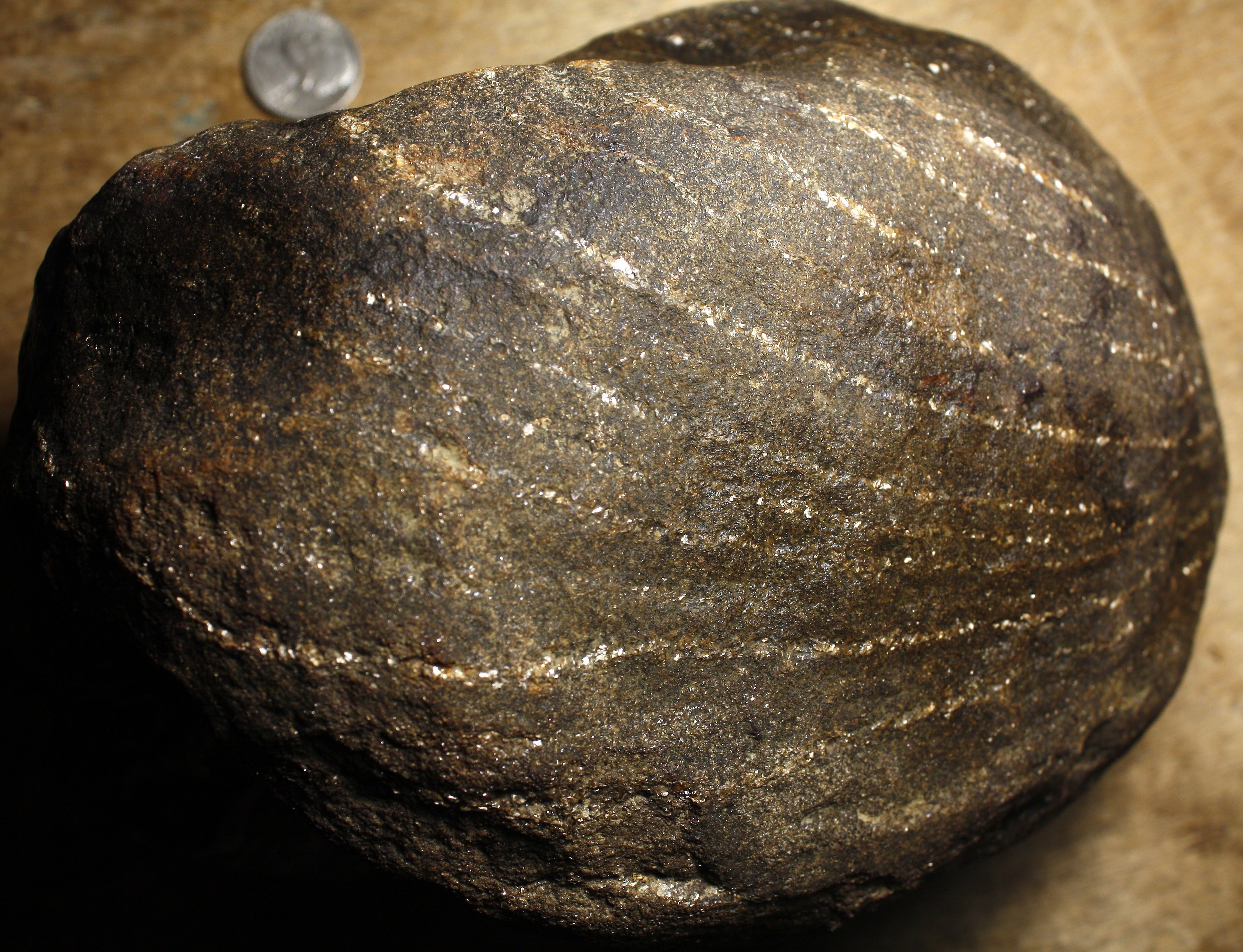
Figure 8
Narrow, parallel, bands of muscovite mica in Wissahickon schist
¶
Detrital zircons:
¶ Abrasively-rounded detrital zircons in metamorphic rock, such as Wissahickon schist, appears to rule out zircon formation by aqueous precipitation, instead indicating an internal source, presumably igneous, perhaps similar to zircons coughed up in terrestrial stratovolcanoes. And once again, the partly unconsolidated nature of the outer layers of sedimentary KBO cores may provide the cause for some of the abrasion. Unconsolidated sediments that slumped and choked off hydrothermal vents between hydrothermal pulses may have created a considerable plug of abrasive grit for hydrothermal plumes with entrained zircons to force their way through. This suggests brief aggressive abrasion of igneous KBO zircons, compared to gradual abrasion of clastic terrestrial zircons over geologic time.
Congruity between Algoma-type BIF and banded metamorphic rock:
¶ The remarkable similarity in felsic-mafic banding and extensive small-scale tight folding between Algoma-type BIF and banded metamorphic rock presumably indicates a common formation process. Pirajno and Yu (2021) states that banding in Algoma-type BIF is attributable to hydrothermal activity. “[S]ilica is probably always present, but where the Fe is dominant the first banding is of Fe oxides. The next stage, when Fe is exhausted, silica precipitation occurs.” Pirajno and Yu states that the initial banding from hydrothermal plumes is of Fe oxides, but in migmatite, the mineral grains in felsic leucosomes are coarser than those in mafic melanosomes, indicating that felsic minerals are the first precipitates from a hydrothermal pulse in banded metamorphic rock.
¶ Despite the similarities, coarse-grained (phaneritic) banded metamorphic rock cannot be formed directly by aqueous precipitation on our high-gravity planet, although conceivably, subsequent metamorphic granitization could have coarsened the mineral grains in terrestrial sedimentation. But metamorphic coarsening of mineral grains doesn’t overcome the objection to the enormous volume of metamorphic rock formed from hydrothermal plumes, nor does it overcome the difference between iron oxides in BIF and mafic silicates in banded metamorphic rock. If the coarse mineral grains in metamorphic rock are indeed formational, then they require a microgravity environment, namely the sedimentary cores of hot classical KBOs, and extraterrestrial mafic silicates versus terrestrial iron oxides may be explained by elevated temperatures and reduced oxygen fugacity in KBOs, compared to Earth.
¶ Compare the compelling simplicity of modulated sedimentation for felsic-mafic banding, which unifies migmatite, gneiss and BIF, to the hand-waving complexity of the standard model, which requires separate processes for felsic-mafic segregation in:
– migmatite (anatexis),
– banded gneiss (solid-state diffusion/dislocation creep/metasomatism/pressure solution/recrystallization), and
– BIF (modulated sedimentation).
And felsic-mafic segregation, in the standard model, does not begin to address the far trickier problem of coaxing the differentiate into parallel felsic-mafic layers, like pages in a book.
………………..
5. Gneiss domes and their metasedimentary mantling rock
¶
¶ “Most gneiss domes are elongate parallel to the strike of the orogen” (Whitney et al., 2004)
¶ “Domes with long dimension ≤90 km have a ratio of long to short axes of ~2:1–3:1.” “Despite the wide range of dimensions, most gneiss domes have map-view axial ratios between 1:1 and 3.5:1, independent of the size of the dome (Fig. 5B), indicating that the elliptical shape is independent of dome size.” (Whitney et al., 2004)
¶ In linear belts of gneiss domes, there may be a characteristic spacing between domes (Fletcher, 1972; Yin, 1991); e.g., 40–50 km in the northern Cordillera (e.g., the Frenchman Cap, Thor-Odin, Pinnacles, Passmore-Valhalla domes of the Shuswap metamorphic complex; Whitney et al. [2004]), 25 ± 5 km in the northern Appalachians (Fletcher, 1972), and 8–22 km along ridges in the Karelides gneiss domes of eastern Finland (Brun, 1980)” (Whitney et al., 2004)
Gneiss domes as former ‘hydrothermal volcanoes’:
¶ Terrestrial volcanoes create cinder cones from explosive eruptions, and shield volcanoes are formed by lava flows. This study suggests that KBO hydrothermal vents created similar cones around hydrothermal vents from sedimentation precipitated from hydrothermal plumes, warranting the term ‘hydrothermal volcano’, which this study suggests to be the primary origin of gneiss domes. The typical elliptical 2:1–3:1 aspect ratio of gneiss domes could indicate elongate clusters of vents, or could indicate the existence of former ocean currents that carried hydrothermal plumes down current, creating elongate precipitation fields around hydrothermal vents.
¶ Migmatites are common attributes of gneiss domes (Klepeis et al. 2016) (Whitney et al., 2004), which indicate proximity to hydrothermal vents, in the context of migmatite formation by modulated sedimentation. The large mineral grain size characteristic of the leucosomes that define migmatite fall out of aqueous suspension quickly, which means close to their hydrothermal vent origins. Therefore, migmatites formed near their hydrothermal origins, which indicates that gneiss domes cored with migmatites formed as hydrothermal volcano cones around hydrothermal vents.
Gneiss domes as former KBO anticlines:
¶ Diagenesis and lithification densified KBO sedimentary cores by expelling buoyant connate fluids, which caused dehydration folding, presumably in the form of synclines, anticlines and reverse faults on the surface of sedimentary cores, like grapes shriveling to form raisins. Precipitate mounds formed by hydrothermal volcanoes may have partly controlled the location and strike of dehydration orogeny, and/or dehydration orogeny may have partially governed the formation of hydrothermal vents, by creating internal weaknesses in the folded sediments that were exploited by buoyant connate fluids rising to the surface. Thirdly, dehydration folds in the form of anticlines could constitute a second type of gneiss dome, with anticlines naturally exhibiting elongate aspect ratios. So, both hydrothermal volcanoes and anticline gneiss domes may have tended to align gneiss domes with dehydration orogeny.
¶ And subsequent terrestrial orogeny of KBO rock may tend to follow the strike of dehydration orogeny, due to the inherent stiffening of KBO rock perpendicular to the dehydration folding axis, which may tend to align gneiss domes with the strike of terrestrial orogeny.
Mantled gneiss domes:
¶ In his seminal 1948 paper, The Problem of Mantled Gneiss Domes, Eskola (1948) notes the composition of the metasedimentary mantles shrouding Finland’s gneiss domes, “the basement stratum is a layer of quartzite, above which follow dolomite and micaschist; and in still others, dolomite forms the basement”. “In some, the lowest horizon of the mantle consists of basal conglomerate with boulders of the same gneiss that forms the dome.” Baltimore gneiss domes exhibit a similar metasedimentary sequence, as illustrated in Fig. 3, suggesting a universal process. Gneiss dome mantling rock is the frosting on the gneissic cake, presumably representing the final sedimentary deposition on KBO sedimentary cores.

Figure 3
Typical gneiss-dome mantling sequence—gneiss, quartzite, marble, schist—covering Grenville-age Baltimore gneiss near Baltimore, Marylandbr />Reference: Fourteen Geologic Cross Sections through the Gneiss Domes near Baltimore Maryland Geological Survey, 1937; Volume 13, Plate 32
¶
Quartzite & marble in gneiss dome mantles:
¶ Schist, quartzite and marble constitute the metasedimentary sequence mantling gneiss domes, where mantling sequences haven’t completely eroded away. While schist is presumed to be hydrothermal in origin, quartzite and marble may be the result of bulk precipitation from the cooling of internal oceans, as KBOs gradually dissipated their heat of formation by thermal radiation.
¶ Silica/quartz solubility is highly temperature sensitive, such that ocean cooling following the termination of igneous differentiation caused early quartz precipitation, which lithified and metamorphosed into quartzite formations. Cooling, however, increases calcium carbonate solubility until solubility peaks at about 10° C (Sulpis et al., 2021), followed by a decline in solubility with additional cooling. So as the internal ocean cooled toward freezing, quartz precipitated first, followed by calcite/aragonite, which lithified and metamorphosed into marble and dolomitic marble.
¶ Bulk precipitation from solution of quartz, forming quartzite (such as Setters Formation in the Glenarm Series) and bulk precipitation from solution of carbonates, forming marble (such as Cockeysville Marble in the Glenarm Series) stand in contrast to hydrothermal schist, concentrated around hydrothermal volcanoes. Schistose sediments presumably precipitated before, during and after bulk silica and carbonate deposition, presumably causing an interleaving of schist with quartzite and marble in the mantling rock of gneiss domes.
Schist in gneiss dome mantles:
¶ Primary sedimentation at formation by gravitational instability presumably formed KBO sedimentary cores with a swirled composition, like rainbow gneiss. Then in large KBOs, radioactive heating from SLRs in the primary sediments, induced igneous differentiation, which densified partially-unconsolidated sediments by expelling their connate fluids. Subsidence events accompanying densification expelled connate fluids as hydrothermal plumes into the overlying ocean that precipitated precipitated sediments with a gneissic character. When igneous differentiation had generally run to completion, further core densification was the result of diagenesis and lithification of gneissic sediments, which precipitated schistose sediments at lower temperatures.
¶ Gneiss constitutes the heart of gneiss domes, which transitioned to schist in the overlying metasedimentary mantling rock, marking a temporal transition in the character of precipitates from hydrothermal plumes. This temporal transition was presumably largely temperature mediated, as the radioactivity of SLRs exponentially decayed. Aqueous precipitation favors hydrated minerals at low temperatures, but elevated temperature favors the precipitation of anhydrous minerals, because higher thermal energy drives off water molecules from the crystal structure, destabilizing hydrated forms. Anhydrous minerals precipitate at high temperatures (> 400°C ), such as feldspars and quartz. At medium temperatures (200–400°C) partially hydrated minerals predominate, such as micas, chlorite and epidote. And at low temperatures (< 200°C ), hydrated minerals precipitate, such as clays, zeolites and opal. Aluminum typically coordinates with 6 oxygen atoms in an octahedral arrangement (Al-O octahedra). These octahedra naturally link together by sharing edges to form continuous sheets. This creates the characteristic layered structure of many aluminum-rich minerals like micas, clay minerals, chlorite and talc. Al³⁺ is a small, highly charged cation that strongly polarizes water molecules, creating a strong affinity for water and hydroxyl groups (OH⁻). This makes aluminum-bearing minerals likely to incorporate water or hydroxyl groups into their crystal structures, creating platy minerals that are hydrated. By comparison, silicon forms tetrahedral coordination with 4 oxygen atoms (Si-O tetrahedra). These tetrahedra link by sharing corners, rather than edges, creating 3-dimensional framework structures rather than sheets. So, early precipitation at elevated temperatures tended to form anhydrous gneissic sediments, forming metaluminous gneiss, while later precipitation at lower temperatures tended to form hydrated, platy schistose sediments, forming peraluminous schist. The transition from gneiss to schist may have been largely temperature controlled, although there may also have been a transition in solute chemistry of expelled connate fluids from early igneous differentiation to late diagenesis/lithification.
No fossils in the late Proterozoic to early Phanerozoic Glenarm Series:
¶ This study suggests that the complete absence of fossils in the metasedimentary Glenarm Series overlying the Baltimore gneiss domes, which formerly constituted Setters Formation, Cockeysville Marble, Wissahickon Formation, Peters Creek Schist, Cardiff Conglomerate, and Peach Bottom Slate, may be a glaring shortcoming of the standard model, since zircon ages predict that the Glenarm Series is at least partially Phanerozoic in depositional age. And the Glenarm Series encompasses a broad variety of rock types and metamorphic grades for the preservation of macro-morphology of fossils much larger than the metamorphic recrystallization scale. Indeed, fossils have been identified in greenschist (Hail et al., 2020) and blueschist (Scherer & Briggs, 2010) elsewhere.
The possibility of biologically mediated mineral precipitation:
¶ In an igneous melt, peraluminous conditions prevail when the molecular proportion of aluminum oxide is higher than the combination of sodium oxide, potassium oxide and calcium oxide (Al₂O₃ > (CaO + Na₂O + K₂O)) , but microbial mats and biofilms can create steep pH, Eh and ionic gradients at the micrometer scale that can locally concentrate cations necessary for mineral formation outside of the canonical temperature-pressure window for aqueous precipitation. Thus, aqueously-dissolved solute loads may not necessarily have been peraluminous to precipitate mica, when assisted by extracellular polymeric substances (EPS) in biofilms, with abundant carboxyl and hydroxyl groups that bind cations like K⁺, Mg²⁺ and Fe²⁺, and biological catalysts may have promoted the precipitation of minerals outside their canonical pressure-temperature windows for aqueous precipitation. But even extremophiles have upper temperature limits, and the gneiss-to-schist transition might have been more dependent on the temperature range at which extremophiles thrived than the temperature-pressure windows for aqueous precipitation.
¶ A new study (Moody et al, 2024) pushes back the date of the last universal common ancestor (LUCA) of Archaea and Bacteria to 4.2 Ga (4.09–4.33 Ga). This is a meaningful date in the context of a bimodal late heavy bombardment (LHB) proposed by this study, where an early bright-line pulse of a bimodal LHB occurred at 4.22 Ga, based on Apollo return samples (STARS, PLANETS, MOONS, MINOR PLANETS AND COMETS). A bimodal LHB, proposed by this study (STARS, PLANETS, MOONS, MINOR PLANETS AND COMETS), indicates that the inner solar system was bombarded with Plutinos at 4.22 Ga in a bright-line early pulse and by cubewanos (classical KBOs) from about 4–3.8 Ga in the more sustained main pulse. A 4.2 Ga date for LUCA implies that a Plutino KBO, with LUCA prokaryotes, was perturbed into the inner solar system where it contaminated one or more of the terrestrial planets with prokaryotes, and Archaea and Bacteria rapidly diverged from LUCA on 1 or more terrestrial planets. This reasoning points to hot classical KBOs populated by LUCA, based on the molecular clock determination for LUCA corresponding to the bright-line early pulse of a bimodal LHB.
…………………
6. Folding in metamorphic rock and Algoma-type BIF
¶

Figure 4
Analogous felsic-mafic banding and small-scale tight folding in gneiss-migmatite (left) and banded iron formations (right) may indicate a common formation mechanism by modulated sedimentation from hydrothermal plumes, forming sedimentary mounds that slide or slump when the slope of the mounds exceeds the critical angle, causing small-scale tight folding.
Migmatite image credit: ©José Zendrera
BIF image credit: Chris’s Granite Paradise https://www.youtube.com/watch?v=SqRGJsP66vw&ab_channel=Chris%27sGraniteParadise
¶
The standard model of metamorphic folding:
¶ In the standard model, kink bands, crenulation folding, and c-s fabrics form in high grade metamorphic environments where strain causes ductile deformation. The oriented and repeating nature of these folds are clearly caused by strain, which is not disputed by this study.
¶ The standard model for small-scale tight folds in metamorphic rock is buckling of more competent layers during episodes of compressive shortening, with less competent layers providing the necessary compliance to buckle into. This study recognizes buckling in tectonic settings on a decameter to hectometer scale of mountain building, where folding occurs up into the void of the atmosphere, creating mountain ranges. But this study suggests that small-scale tight folding in metamorphic rock occurred surficially in partially unconsolidated sediments, with folding into the relative void of the overlying internal ocean.
¶ Shear zones can create deformed rocks called mylonites and can also form elongated, non-cylindrical sheath folds. These folds occur as rock layers slide past one another, with ductile rock undergoing differential movement into a sheath-like configuration. Within a sheath fold, the internal layering or foliation becomes reoriented parallel to the elongated direction of the fold. This reorientation aligns the layers along the length of the fold, enhancing its sheath-like form. This study does not dispute the possibility of sheath folding in shear zones for a tiny proportion of metamorphic folding.
Small-scale tight folding in metamorphic rock and in Algoma-type BIF:
¶ Small-scale folding in Algoma-type BIF appears to mirror small-scale folding in banded metamorphic rock (Fig. 4), suggesting a common formation mechanism, despite the differences. Then if both BIF and metamorphic rock formed by modulated sedimentation, forming sediment mounds around hydrothermal vents then these mounds would have been subject to underwater slides and slumps, particularly during subsidence events causing in KBO-quakes.
¶ The degree of small-scale tight folding in modulated sedimentation was a function of the slope of the mound, with steep slopes proximal to hydrothermal vents resulting in a greater degree of slumping and sliding than shallower slopes more distal to vents. If the bright-line felsic-mafic segregation in migmatite is due to proximity to hydrothermal vents and the more muted banding in gneiss is due to distality, then stromatic migmatite should exhibit a greater degree of folding due to sliding and slumping on steeper mounded slopes than gneiss, which is indeed the case. Thus, proximal deposition to hydrothermal vents on the steep slopes of hydrothermal volcanoes formed vivid banding and extensive folding in migmatites, whereas distal deposition on flatter terrain formed muted banding and less-extensive folding in gneiss.
¶ Slides and slumps occurred spontaneously when the angle of sediment slopes exceeded the ‘critical angle’, also called the ‘angle of repose’, but KBO-quakes caused by catastrophic subsidence events dramatically lowered the critical angle, such that the vast majority of sliding and slumping presumably occurred catastrophically during subsidence events.
¶ Folding in BIF presumably occurred by the same folding mechanism as in KBO metamorphic rock, with the degree of folding in BIF dependent on the depositional distance from hydrothermal vents, and perhaps similarly triggered by earthquakes.
¶ Slide and slump folding on precipitate mounds was surficial or relatively surficial in nature, with the relative void of the overlying ocean accommodating the folding of soft, partly-consolidated (competent) sediments. This contrasts sharply with folding at depth in solid rock required by the standard model, which is forced to assume compressive shortening, with a high competency contrast. In addition to the small degree of local accommodation required by small-scale tight folding in the standard model, the compressive shortening mechanism for small-scale tight folding and ptygmatic folding requires large-scale global accommodation of (soft) low competency rock.
¶ From exposed rock faces of the Wissahickon Creek valley, small-scale slide and slump folds range in size from centimeter- to meter-scale.
Metatexite vs. diatexite migmatite:
¶ In The Atlas of Migmatites, Sawyer broadly divided migmatites into metatexites and diatexites, along with their associated subtypes. Within metatexites, stromatic migmatite is characterized by parallel felsic-mafic layering, which is often intensely folded. By comparison, diatexite migmatite (fig. 10) is defined by its patchy or nebulous appearance, with schlieren (streaks), rafts (schollen), or irregular leucosome pockets rather than persistent layers, but folding in diatexite migmatite tends to be mild or absent altogether.
¶ According to the alternative modulated sedimentation hypothesis, all migmatites initially form with parallel layering, but this primary layering can be distorted by turbidity currents (underwater avalanches) in unconsolidated sediments and by folding in partially consolidated sediments. For simplicity, the easily visualized term (underwater) avalanche will stand in for the more technical term, turbidity current, and ‘metatexite’ and ‘diatexite’ will be written hereafter with single quotes to redefine them by appearance alone.
¶ Gneiss formed early and rapidly, when the KBO core was hot and subsidence events causing hydrothermal plumes occurred in rapid succession, while schist formed much later, when the core was cooler and hydrothermal plumes were much less frequent. The rapid succession of hydrothermal plumes in gneissic terrain provided insufficient time for sediment consolidation, allowing unconsolidated sediments to slide like an avalanche in response to KBO-quakes caused by subsidence events, smearing the even depositional layers into the patchy or nebulous appearance of ‘diatexite’. By comparison, the wider temporal spacing between hydrothermal plumes in schist terrain allowed sediments to partially consolidate between plumes, resulting in folding of partially-consolidated (competent) sediments. This suggests that the difference between folding (‘metatexite’) or sliding (‘diatexite’) was due to the competency of the sediments on slopes surrounding hydrothermal vents.
¶ But sliding is not confined to gneiss terrain nor partial consolidation to schist terrain. In ‘diatexite’ migmatite, rafts (schollen) are clearly partially consolidated. And the typically mafic composition of rafts in ‘diatexite’ migmatite appears to indicate that mafic melanosomes consolidated quicker than felsic leucosomes. And in schist terrain, the variable thicknesses of leucosome and melanosome layers over short distances may indicate sliding prior to partial consolidation.
¶ Diatexite migmatite can resemble the streaky results of moving sand art, and possibly for the same reasons. In moving sand art, the different colors of sand have different densities so they don’t irrevocably mix together. And similarly in migmatites, the mineral grains in mafic melanosomes are finer and denser than the mineral grains in felsic leucosomes. So, differences in size, density and perhaps mineral grain shape help prevent homogeneous mixing during avalanches on the slopes of hydrothermal volcanoes.

Figure 10
Chelan Migmatite Complex, North Cascade Mountains, Washington state. Single frame from the Nick Zentner video, “Chelan Migmatite Complex”, https://www.youtube.com/watch?v=wt2jNr6tilQ
¶
Slump folding and delamination:
¶ Most forms of soft sediment folding in metamorphic rock have been identified in terrestrial sedimentary rock; however, KBO folding was greatly amplified (Fig. 11), due to the frequency of seismic events caused by continual core subsidence. And liquefaction during seismic events would have specifically promoted convolute folding (Fig. 12).
¶ Additionally the differential properties of banded sediments promoted delamination in weak layers during seismic events, causing ‘sheaths’ of partially-consolidated sets of layers to sag and crumple. Delamination, in turn, promoted tearing at the perimeters of delaminated sheaths, due to the inertia of the sheath subjected to seismic displacement. And tears at the edges allowed greater mobility for sliding and folding, like a rug sliding down a ramp that crumples when it encounters an obstacle.

Figure 11
Convolute folding in Wissahickon Valley Park. Kennedy half dollar for scale.
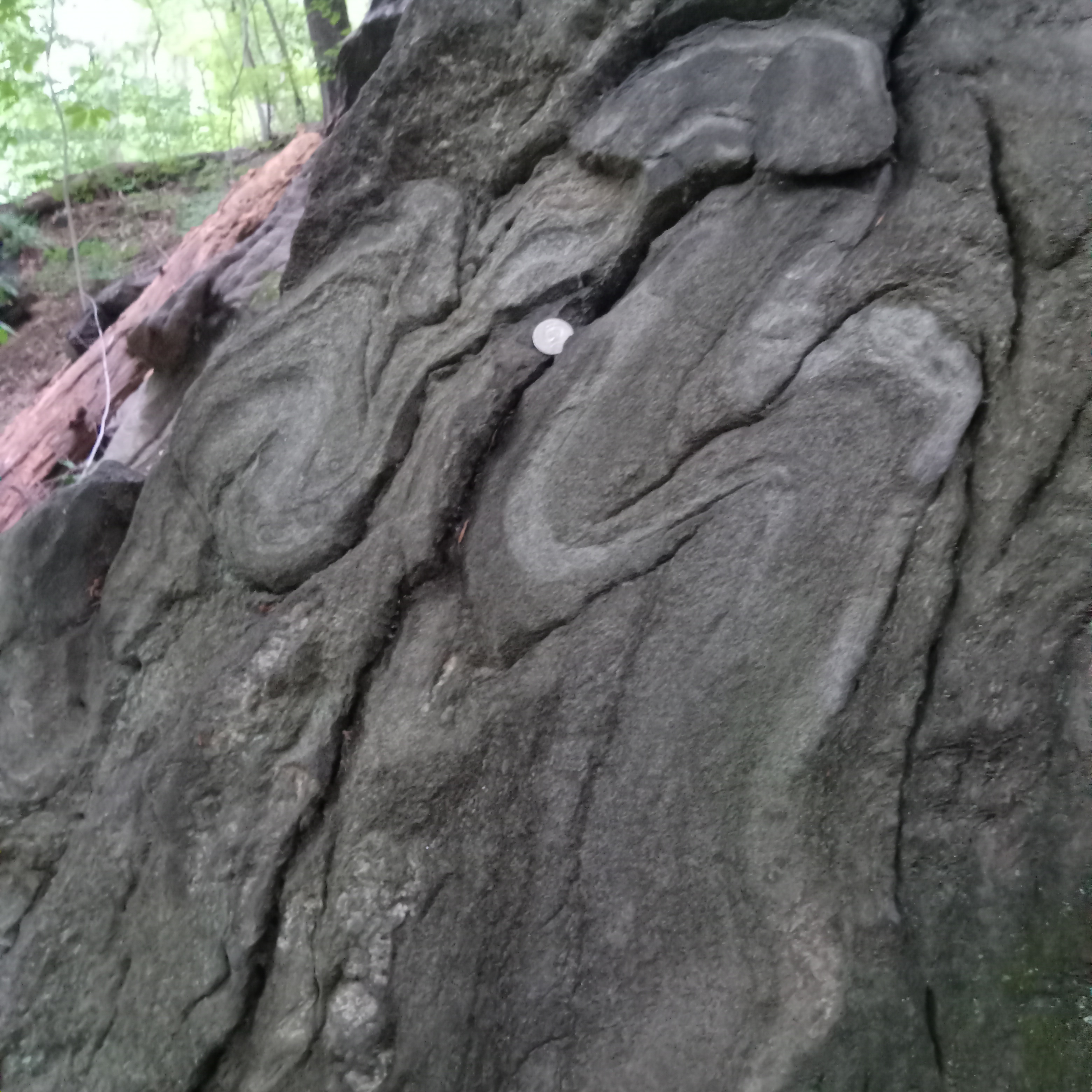
Figure 12
Dramatic fold in Wissahickon Valley Park. Kennedy half dollar for scale.
¶
Dehydration folding:
¶ The densification of KBO sedimentary cores due to igneous differentiation and diagenesis-lithification caused a significant volume reduction in the cores, which forced sedimentary layers to fold. Much of this type of folding may occurred suddenly, during catastrophic subsidence events, which may have affected both lithified rock and partially consolidated sediments. This type of core densification is essentially a dehydration process, in which buoyant aqueous fluids are expelled from the core in hydrothermal plumes, as the porosity is reduced during igneous differentiation and diagenesis-lithification. The effect is similar to a grape shriveling to form a raisin, with the wrinkles in the grape corresponding to the folding of sediments. This type of folding is designated ‘dehydration folding’.
¶ The degree of dehydration folding experienced by a sedimentary layer corresponds to the percent reduction in volume of the underlying core, following sedimentary deposition. Essentially all primary sedimentation, which took the form of rainbow gneiss, occurred prior to igneous differentiation, since the heat from SLRs took some time to reach the melting point of silicates. Sand has a porosity of 40-50%, so the degree of dehydration folding in primary sedimentation would have been quite high, although the inherently swirled nature of rainbow gneiss could mask significant secondary folding. Early secondary sedimentation, in the form of banded gneiss, may have occurred prior to a majority of igneous differentiation, but not prior to all igneous differentiation, since early secondary sedimentation was derived from hydrothermal fluids expelled by igneous differentiation. Unlike swirled primary sedimentation, modulated secondary sedimentation faithfully records folding, due to the inherent parallel nature of banding. And late sedimentation, such as schist, will have experienced a smaller degree of underlying volume reduction than banded gneiss. Terrestrial sedimentation, by comparison, experiences an unnoticeable volume reduction of the underlying planetary core, even during the lithification of thick formations, due to the enormous volume of the planet, although dehydration folding could be evident in special cases on Earth, such as the lithification of sediments filling V-shaped submarine canyons.
¶ The scale of dehydration folding is unclear, particularly since dehydration folding may be difficult to untangle from terrestrial orogeny, but the scale of dehydration folding is assumed to be larger than small-scale folding caused by sliding and slumping.
Flattening at Earth impact:
¶ Finally, a large degree of flattening presumably occurred at Earth impact, thinning portions of spherical KBO core fragments into flattened tectonic plates, like the radial splattering of a mud ball on impact with a hard surface. While thinning and flattening were presumably the most significant effect of Earth impact, a certain degree of folding was inevitable.
………………..
7. Ptygmatic folding
¶
The standard model of ptygma:
¶ The standard model for ptygmatic folding explains its formation by a significant competency contrast between an intrusive layer (such as a dike or vein) and its host rock. The intrusive material, often composed of rigid minerals like quartz and feldspar, is comparatively competent, while the surrounding host rock is composed of a more ductile (incompetent) material. When the rock unit undergoes compressive shortening, the competent vein or dike buckles, while the less competent host rock deforms or flows around it. This differential deformation creates the characteristic convoluted or “rootless” folds observed in ptygmatic structures.
¶ The most extreme examples of a phenomenon will cause a robust theory to shine, while potentially straining a failing theory beyond the point of credibility. In the standard model, the most extreme examples of ptygmatic folding may require as much as a 5/6 volume reduction of the surrounding incompetent matrix and a 1000:1 viscosity contrast between the competent vein or dike and the surrounding matrix (Stel, 1999), all without tearing or ballooning the vein or dike.
¶ When a vein or dike undergoes compressive shortening, one would expect tearing or buckling at weak points, not neat zig-zag folds like ribbon candy. And when ptygma cross at right angles or in a tangled mass, as in Fig. 5, there would appear to be no single episode of compressive shortening that could explain the resultant specimens.
¶ To avoid the absurdity of the standard model exposed by extreme examples, 2 alternative models have been proposed by Stel (1999) and Shelley (1968), which are discussed below.

Figure 5
Ptygmatic folding vs. vein fattening in contrasting matrix material
Image credit, Mountain Beltway, Callan Bentley structural geology blog
http://blogs.agu.org/mountainbeltway/2010/10/15/friday-fold-wavelength-contrast/
¶
Stel theory of ptygma:
¶ The Stel solution to the ptygma enigma is a progressive replacement front that migrates away from the vein boundary, in which “volume loss takes place in the vein mantles, while the limbs of the folds increase in volume” (Stel, 1999). Harry Stel agrees with Brown (Brown et al.,1995) that “ptygmatic structures are not ‘diagnostic’ for the presence of partial melt phases in migmatites”, and “[t]he most direct evidence for the relation of fluid activity and mica breakdown is the presence of offshoot veinlets”, with some veinlets exhibiting relict foliation of the host rock, indicating that veinlets are not melt-injection structures, where ‘fluid’ is understood to be an aqueous brine.
Stel critique:
¶ The typically narrow melanosome ‘shadows’ surrounding much-fatter ptygmatic leucosome veins would require additional distant felsic input for mass balance. Additionally, no motive force is offered to drive the replacement front, and no explanation is provided for why here and not there.
Shelley theory of ptygma:
There are two internal forces of expansion
within the vein: that of increase in volume
due to crystallization from solution and
that of force of crystallization of the vein
mineral.
The ptygmatic veins, having a relatively
small surface area for internal volume,
were formed as a result of expansion of
the vein material during growth and
simultaneous accommodation of the host.
Possible mechanisms are that the initial
cracking of the rock is the result of high
water pressures developed during
metamorphism and that the vein expansion
results from internal forces created during
crystallization of the vein mineral from
highly supersaturated solutions.
(Shelley, 1968)
Shelley critique:
¶ Shelley states that the force of crystallization within veins creates expansion of veins into the accommodating surrounding host, where the driving force is crystallization on bulk mineral grains in the vein. This makes the ‘Shelley mechanism’ the opposite of the standard model, such that rather than reacting to external compressive shortening, the vein itself provides the motive force, buckling outward due to internal expansion into an accommodating, passive host matrix. Ptygmatic folds are characterized by small-scale folds with no axial alignment to regional stress fields and with uniform wall thickness through the limb and hinge of the fold, which are all predictive characteristics of isotropic outward pressure driven by the force of authigenic crystallization.
¶ This study accepts the Shelley mechanism, provided that it operates in unconsolidated sediments rather than lithified rock. In a terrestrial setting, Shelley is constrained to operate within solid lithified rock, which requires “cracking of the rock” to accommodate buckling veins. Alternatively, if ptygma form during diagenesis of sediments rather than during the metamorphism of solid rock, the plausibility is greatly enhanced.
¶ While the standard model does not make a distinction in the origin of ptygma, whether formed as dikes or veins, the Shelley mechanism generally adopted by this study requires that ptygma form(ed) exclusively from veins.
¶ The Shelley mechanism is based on authigenic crystallization from aqueous solution on coarse mineral grains in veins conveying connate fluids saturated in various mineral species. A quote from the Stel article supports the Shelley mechanism: “The grain size of quartz and feldspar in the veins is between 10 and 25 times larger than in the host rock (0.2 mm in the latter)” (Stel, 1999). Authigenic crystallization on mineral grains in veins causes internal volume expansion, which is directed in 3 dimensions, with the 1 ‘lateral’ dimension causing vein thickening and the 2 ‘longitudinal’ dimensions, potentially causing ptygmatic buckling. While ptygmatic folding is best known from (KBO) ‘metamorphic rock’, the mechanism presumably may also occur in terrestrial sediments undergoing diagenesis.
¶ The coarse mineral grains in leucosomes functioned as built in French drains to channel buoyant fluids out of sedimentary cores, but because leucosomes were laid down in the bedding plane, secondary vertical veins were also necessary to cut through the less permeable melanosome layers. Vertical veins that reached the overlying ocean became hydrothermal vents, which expelled buoyant brine from the core and precipitated modulated sediments, with the largest hydrothermal vents presumably forming gneiss domes.
¶ Sediments precipitated at a distance from hydrothermal plumes would have had less felsic-mafic modulation, such that massive deposits remote from hydrothermal plumes may have largely lacked native leucosomes to drain connate fluids. The buoyancy of connate fluids trapped in massive deposits may have forced the formation of ad hoc veins that carried much greater flux than typical leucosomes and thus were particularly susceptible to ptygmatic folding, predicting that some of the most dramatic ptygmatic folding may be found in massive metamorphic rock, with little or no gneissic banding.
¶ Fig. 6 may be a terrestrial example of a pair of white (quartz or calcite?) veins cutting through two very different matrix types, apparently tan sandstone at the bottom and black shale above. The vein developed very differently in the contrasting mediums. The black shale sediments were apparently much more compliant than the tan sandy sediments, such that the vein expansion was able to buckle ptygmatically into the soft shale, while the stiffer sandy sediments effectively suppressed longitudinal buckling, forcing the volume increase of the vein to manifest itself exclusively in the lateral dimension by fattening the vein. This example suggests that ptygmatic folding may have required particularly compliant unconsolidated sediments.
¶ To the extent that a rock exposure provides a 2-dimensional section view of a formerly 2-dimensional vein distorted into the third dimension by ptygmatic folding, a rock exposure perpendicular to the bedding plane may also be perpendicular to the main ptygmatic folding axis, highlighting small-scale ptygmatic folds, while providing substantially less information about folds in the perpendicular dimension (into and out of the rock face). Thus, if a leucosome is deposited in the horizontal x-y bedding plane, then vein expansion in the x-axis that folds up and down into the z-axis will be clearly evident in a x-z plane rock exposure, appearing undulating like a section view of the ridge and valley terrain of the Appalachian Mountains in Pennsylvania. But if vein expansion and ptygmatic folding were isotropic (equal in both x-y-axes), then the terrain would more closely resemble the more conical hills in western West Virginia (if the valleys were similarly conically shaped). With comparable folding in both x- and y-axes, an x-z or y-z section view through conical hills and valleys would appear like an irregular ‘heartbeat’ that occasionally skipped beats. But the most convoluted examples of ptygmatic folds appear to be too regular to be isotropically folded, which would seem to support the standard model, which predicts folding in 1 axis only. However, heterogeneous conditions that promoted folding in one axis would considerably stiffen the vein in the perpendicular axis, the way corrugated steel is much stiffer in the dimension perpendicular to the folded dimension, perhaps sufficiently to suppress folding in the perpendicular axis altogether, like the suppression of ptygmatic folding in the sandstone matrix of Fig. 6. But more likely, ptygmatic folding in the preferential axis only suppresses short-wavelength folding in the perpendicular axis, promoting longer-wavelength folding in the perpendicular axis, which may explain why ptygmatically-folded veins often appear to have a rolling component at longer wavelengths than the small-scale ptygmatic folding.

Figure 6
Ptygmatic folding vs. vein fattening in contrasting matrix material
Image credit, Mountain Beltway, Callan Bentley structural geology blog
http://blogs.agu.org/mountainbeltway/2010/10/15/friday-fold-wavelength-contrast/

Figure 9
A quartz vein exposed on one side, revealing its 3-dimensional form, which may be slump folding or ptygmatic folding. From the Wissahickon Formation.
…….………….
8. Late Heavy Bombardment
¶
¶ Former Binary-Companion presumably orbited the Sun between Saturn and Uranus, where its 1:4 MMR was close to that of the Kuiper belt. Secular perturbation of Binary-Companion by the Sun caused its super-Jupiter-mass binary components to gradually spiral in, progressively increasing its heliocentric eccentricity and period to conserve angular momentum. This progressive increase in the heliocentric period of former Binary-Companion may have caused its 1:4 MMR to sweep through the Kuiper belt from 4.2–3.8 Ga, perturbing KBOs into Neptune’s influence, which presumably caused the late heavy bombardment (LHB) of the inner solar system by hot classical KBOs.
¶ Then at ~ 654 Ma, the binary components ultimately merged in an asymmetrical-merger-explosion kick that gave newly merged Companion escape velocity from the Sun.
¶ A meteoroid on a prograde orbit into the inner solar system effectively falling from infinity that caught up with Earth in its orbit around the Sun would impact Earth with 18 times less specific kinetic energy than one on a retrograde orbit that hit Earth head on in its orbit around the Sun. While Oort Cloud comets exhibit both prograde and retrograde orbits, all KBOs formed by streaming instability from a prograde trifurcation debris disk formed in prograde orbits. A KBO essentially falling from infinity to a distance of 1 AU from the Sun attains a heliocentric speed of 42.1 km/s, would have overtaken Earth in its orbit around the Sun traveling at 29.78 km/s, resulting in a modest differential speed of 12.3 km/s. Adding in Earth’s gravitational acceleration results in an Earth impact speed of 16.6 km/s under optimal conditions.
¶ Large impacts are expected to melt or vaporize the entire impactor, but evidence has found unmelted fragments of impactors preserved in a few impact structures. Within the 145-million-year-old Morokweng impact melt sheet, scientists discovered a 25 cm ‘fossil meteorite’ clast (an LL6 chondritic fragment) that survived largely unmolten (Maier et al., 2006). Geochemical evidence at the K–Pg boundary indicates that a small fraction of the asteroid was not vaporized. A deep-sea study reported that “several percent of the debris is unmelted meteorite material,” present as clasts and inclusions within impact melt droplets (Kyte, 2002). The Moon’s Imbrium basin (~ 1,200 km across) was formed by an enormous impactor (perhaps ~250 km) that struck at an oblique angle. Analyses of Imbrium’s ejecta patterns and modeling indicate that the impactor broke into multiple large fragments during the collision. Shock physics simulations suggest that “multiple fragments (up to 2% of the initial diameter) from [the Imbrium] basin-forming impactor…should have survived” as intact pieces. Secondary craters around Imbrium imply that 5–8 large unmelted chunks of the impactor were flung downrange, rather than being pulverized. This is direct evidence that in basin-scale impacts, significant masses of the projectile can remain solid. (Schultz & Crawford, 2016)
¶ These findings are supported by numerical impact models. Hydrocode simulations (e.g. iSALE) have started to quantify what fraction of an impactor can remain solid (unmelted) after an impact and under what conditions. Higher speed drastically reduces survivability and impact angle matters. An oblique impact (e.g. <30° from horizontal) spreads the energy out that results in a glancing blow where a substantial portion of the projectile’s mass escapes high shock pressures. “Oblique and low-velocity impacts result in concentrations of unmelted projectile material down range from the impact site,” especially at shallow angles (~15°). Target density and softness influence the outcome. Impacts onto dense rock deliver stronger shocks back into the projectile than impacts onto a softer target. A water or ice target can cushion that blow to some extent. A strong, coherent low-porosity impactor survives better than a porous or fragile one. Porous materials collapse and convert kinetic energy into heat very efficiently (like a crumple zone), so a loosely consolidated body would tend to disintegrate and heat up. (Potter & Collins, 2013) (Halim et al., 2024)
¶ In a hypervelocity impact, at say 20 km/s, the partitioning of energy between the meteorite and the target/environment may be on the order of 5–10%. The specific kinetic energy of a 20 km/s hypervelocity impact is 200 MJ/Kg. The specific heat of fusion (~300,000 J/Kg) and the specific heat of vaporization (~7,500,000 J/Kg) amount to 7,800,000 J/Kg. Assuming a specific heat of ~1,000 J/Kg-K, a partition of 10% into the meteorite would result in vapor temperature of 12,200 K, without taking ionization into effect. The survival of a significant portion of a meteorite could remain in this 5–10% partition range if the temperature of the vaporized sacrificial portion were elevated to multiple tens of thousands of K, with significant ionization.
¶ The spin–orbit evolution of binary trans-Neptunian objects (TNOs) offers an insight into their tidal history, which is governed by their internal thermal history. Spin–orbit evolution is mediated by tides between a TNO and its satellite. Tides cause deformation, which is a function of internal structure and temperature, mediated by internal thermal history. Internal heat depends heavily on radioactive elements like potassium-40 or uranium-238, which are found in the rocky parts of these objects. So, by examining current spins and orbits of TNOs and modeling how they evolved, a determination of the rock mass fraction necessary to produce the heat that drove the spin–orbit evolution may be calculated. Arakowa et al. (2025) performed this modeling on the 2 undifferentiated binary TNOs: Orcus–Vanth and Salacia–Actaea. ‘Undifferentiated’ indicates objects that have not undergone internal melting of water ice (aqueous differentiation) due to their intermediate size (Orchus 460 km R, Salaca 420 km R). In this regard, it’s important to make a distinction between hot and cold classical KBOs, since this study suggests an almost 4 billion year age difference between the 2 populations. Orcus–Vanth is a resonant Plutino, and almost all cold classical KBOs are non-resonant objects, aligning Orcus–Vanth with the old hot classical population. And the Salacia–Actaea inclination (23.9°) is well above the 5° threshold for cold KBOs, also aligning it with the old hot classical population. So, the slightly >4,567 Ma age of hot classical KBOs proposed by this study accords well with the presumed 4,567 Ma age of all KBOs in the standard model. Arakowa et al. (2025) find that a 20−30% rock mass fraction matches the observed spin periods, and they estimate the organic mass fraction comparable to the rock mass fraction, suggesting a chemical composition for TNOs that closely resembles that of comets. A low rock mass fraction presupposes a high ice mass fraction, which along with a high organic mass fraction could have provided substantial cushioning for a silicate core at Earth impact, since ices and organics are much more compressible than silicates.
Abiogenic impact hydrocarbons?:
¶ Endothermic chemical reactions could sequester energy in hypervelocity impacts, rather than merely focusing the heat in compressed ices and organics acting as shock absorbers.
¶ By Le Chatelier’s Principle, a change in conditions will adjust chemical reactions to a new equilibrium in the direction that counteracts the effect of the change. Thus, elevated pressure in a gas can be counteracted by polymerization, which decreases the gaseous number count, reducing the gas pressure. Dissociation of H₂O during hypervelocity impacts would create H₂, which could reduce CO to hydrocarbons via reactions like CO + 3H₂ → CH₄ + H₂O. And dust embedded in KBO ices could have acted as a catalyst for chemical reactions by the Fischer-Tropsch process or its analogues. In simulations of shocked methane, long-chain alkanes are formed at 60 GPa and 4509 K (Li et al., 2011), and Arakowa et al. (2025) suggests that the organic mass fraction of TNOs is similar to that of the rock mass fraction. Russian geologists have a long history of advocating an abyssal abiogenic origin of petroleum, and the endothermic formation of hydrocarbons in LHB impacts might conceivably be its origin.
¶ An extraterrestrial origin for the continental basement rock requires aqueous differentiation, which would have sublimed the most volatile ices, but a large percentage of these volatiles likely ‘snowed out’ on the planet’s surface rather than escaping to outer space, creating a crust of volatile ices over an internal ocean of water ice.
¶ But a thick icy crust and mantle over a sedimentary silicate core doesn’t assure cushioning protection in an Earth impact, since the fragile icy crust and mantle would be particularly
susceptible to tidal fragmentation inside Earth’s Roche limit. While the tensile strength of rock in a silicate core is much lower than that of iron in an iron meteorite, it greatly surpasses the tensile strength of ice, such that tidally fragmented silicate fragments would likely have been much larger than ice fragments at Earth impact. And even if the entire icy crust and mantle had fragmented from the silicate core inside the Roche limit—offering no cushioning for silicate core fragments upon Earth impact—the connate fluids remaining in the KBO sedimentary core itself would have provided a degree of built-in shock absorption. The bulk modulus (the inverse of compressibility) of quartz is about 16.7 times that of water (CRC Handbook of Chemistry and Physics 63rd Ed.), such that connate fluids will undergo 16.7 times as much PdV compressive heating from impact shock waves as surrounding quartz grains. Thus, the connate fluids in sedimentary cores would have damped impact shock waves as they propagated backwards from the sacrificial leading edge. This compressive heating of connate fluids would have promoted melting toward the sacrificial leading edge, while protecting the trailing edge by progressively attenuating impact shock waves as they propagated backward through the silicate core.
High-pressure polymorph and geochronology reset:
¶ Terrestrial metamorphism, deep within LHB-era impact basins, may have erased high-pressure polymorphs caused by impact shock waves, but macroscopic features like shatter cones should have survived terrestrial metamorphism, but it’s possible that giant impacts may not exhibit the small-scale differential pressures necessary to form shatter cones.
¶ The high temperatures of terrestrial metamorphism presumably reset the radiometric ages of extraterrestrial mineral grains. Then KBO basement rock gradually cooled during its buoyant ascent and exhumation at the surface, with geochronology dating to the closure temperature at which extraterrestrial mineral grains, such as zircon, began to retain the daughter products of radioactive decay.
¶ In the exhumation of a right-way-up gneiss dome with mantling rock, the surmounting mantling rock would reach the closure temperature before the underlying gneiss, and therefore the mantling rock should measure slightly older than the underlying gneiss, which contradicts the standard model prediction. But the theoretical framework assumed can bias the test results. The dating of a metasedimentary rock, like schist according to the standard model, requires finding the youngest “detrital” zircons, and the schist is necessarily younger than the younger then the youngest detrital zircons. And if the underlying gneiss were deemed to be orthogneiss, presumably having formed by the metamorphism of igneous rock, then the associated zircons would not be subject to sorting for the youngest ages. But alternatively, if gneiss and schist formed by the same aqueous precipitation process, then the same selection standards should be applied to zircons from both gneiss and schist.
¶ Thus, a metasedimentary hypothesis for the origin of schist in gneiss dome mantling rock may bias its age determination toward apparent youth, which could cause it to unjustifiably contradict a KBO origin hypothesis.
………………..
9. Discussion
¶
Probable impossibilities are to be preferred to improbable possibilities — Aristotle
¶ The alternative solar system formation mechanism presented here (§ 2) unifies a number of formerly disparate solar system phenomena, most notably providing a predictive formation mechanism for the 3 sets of twin planets in our highly unusual solar system. Additionally, this alternative formation mechanism creates an in situ formation mechanism for at least 2 of the short-lived radionuclides of the early solar system, namely 26Al and 41Ca. Calcium-41 has a half-life of less than 100,000 years, which otherwise requires an improbably-nearby and improbably recent supernova according to the standard model. This alternative star-planet formation mechanism is a requirement for creating a solar system reservoir with the properties of the continental tectonic plates (siderophile depleted, with low oxygen fugacity that lies on the TFL), along with a clockwork mechanism for delivering hot classical KBOs to the inner solar system.
¶ This study suggests that the physical similarity between BIF and gneiss-schist-migmatite, namely felsic-mafic banding and small-scale tight folding, is formational, pointing to modulated sedimentation from hydrothermal plumes, creating precipitate mounds that were subject to slumps and slides, resulting in surficial folding of partially consolidated sediments. While the formational similarities are striking, the mineral and mineral grain size differences point to substantial environmental differences that are best explained by terrestrial formation of BIF and a low-gravity extraterrestrial formation of metamorphic rock, with low oxygen fugacity due to formation beyond the ‘snow line’.
¶ Struggling theories may be forced to splinter to explain diverse phenomena, whereas strong theories tend to unify formerly diverse phenomena into more comprehensive theories. The most extreme examples of phenomena will cause good theories to shine, while straining the credibility of struggling theories. Extreme examples of banding, such as Fig. 8, where narrow, uninterrupted felsic layers run through a specimen from side to side and repeat from top to bottom like pages in a book are more intuitively explained by modulated sedimentation than by secondary differentiation.
¶ In the standard model, migmatites form by partial melting (anatexis) of felsic minerals, namely quartz and feldspar, in a protolith, accompanied by their mobilization and segregation into light-colored leucosomes. The residual refractory minerals are predominantly mafic in composition, which form dark-colored melanosomes. The standard model for mineral segregation in gneiss splinters into a variety of indeterminate mechanisms short of partial melting, such as solid-state diffusion, dislocation creep, metasomatism, pressure solution and recrystallization. A third level of splintering is necessary to explain banding in gneiss and migmatite, as over against some other configuration such as granitization. The standard model invokes such banding mechanisms as buoyancy, compositional layering in the protolith, and channeling by platy minerals, aligned by the stress field.
¶ Alternatively, a sedimentary origin of gneiss and migmatite intuitively explains banding by the primary mechanism of modulated sedimentation, with gneiss and migmatite unified by degree, rather than splintered by kind. Proximity to hydrothermal vents created the bright-line distinction between leucosomes and melanosomes in migmatite, while greater distance from vents muted the felsic-mafic banding in gneiss.
Small scale folding:
¶ According to the standard model, ptygmatic folds are due to variations in competency between a more competent vein/dike and a less-competent surrounding matrix in a setting that has undergone compressive shortening, causing the competent vein/dike to buckle. Additionally, much of the small-scale tight folding in compositionally layered rock, like gneiss, is also attributable to compressive shortening in the standard model, where alternating layers with different mechanical properties (e.g., quartz-feldspar vs. mica-rich layers) respond differently to compressive stress. Thus, the standard model unifies ptygmatic folding and small-scale tight folding in compositionally layered rock, due to variations in competency during episodes of compressive shortening.
¶ But unification is a high price to pay for highly improbable outlier cases. Ptygmatic folding can occur in veins that cross one another perpendicularly (Fig. 5), apparently requiring an improbably fortuitous sequence of compressive shortening episodes in fortuitously perpendicular directions. Extreme cases of ptygmatic folding could require an unlikely 6-fold volume reduction to explain the degree of ptygmatic folding, which requires a extrusion of incompetent matrix rock without billowing out the competent vein/dike like a sail.
¶ The alternative Shelley mechanism, generally supported by this study, hypothesizes the internal growth of mineral grains in veins due to authigenic crystallization, forcing veins to expand in 3 dimensions, causing them to buckle ptygmatically. This turns the compressive shortening argument on its head, requiring an active growing vein surrounded by a passive matrix.
¶ This study suggests an alternative mechanism for small-scale tight folding of compositionally layered rock, which is the surficial sliding or slumping of compositionally layered, partially consolidated sediments, which slump/slide and fold under the influence of gravity, while the underlying sediments remain passively intact. Surficial folding has the advantage of the relative void of the overlying ocean to fold into, whereas folding at depth in solid rock, according to the standard model, requires a continuous accommodation between the folding material and the accommodating surrounding material. Surficial folding does not disturb the underlying strata, nor the yet to be deposited overlying strata. Surficial folding occurs, followed by continuing sedimentation that drapes over top of already folded sediments, covering them like a blanket, with each new depositional layer muting the underlying fold.
Granite space problem:
¶ The granite space problem refers to the geological challenge of explaining how large volumes of granitic magma are emplaced into the Earth’s crust, particularly in the upper crust, where there appears to be insufficient space to accommodate these intrusions without significant deformation or displacement of the surrounding rock. Granites, being plutonic igneous rocks, form from large magma bodies that cool slowly beneath the Earth’s surface. The problem arises because the crust is relatively rigid, and creating space for these voluminous intrusions requires mechanisms to displace, deform, or assimilate the pre-existing “host” rock.
¶ The problem is eliminated if the host “rock” into which the granite intruded was partially unconsolidated at the time of the intrusion, facilitating its deformation and displacement. A catastrophic subsidence event in a KBO sedimentary core that over pressurized the liquid magma inner core would attempt to eject liquid magma through one or more hydrothermal volcanoes, but liquid magma being denser than partially-consolidated sediments that still contained a significant component of buoyant connate fluids, caused the magma to intrude into partially-consolidated sediments at the transition between lithified rock and partially-unconsolidated sediments, forming S-type granite plutons. Water-saturated S-type granite that intrudes into crystalline rock, like gneiss and schist, which is often surrounded with metasomatic skarn and pegmatite-(like) crystallization, is generally presumed to be old extraterrestrial granite, while drier I-type granite intruded into (terrestrial) clastic rock must be terrestrial in origin.
¶ Unconsolidated or partial-consolidated sediments deposited by modulated sedimentation makes a number of geological phenomena easier to explain, including:
– Gneissic banding by modulated sedimentation
– The granite space problem
– Ptygmatic folding
– Small-scale tight-folding in BIF and metamorphic rock
– The great abundance of sand and sandstone
No gneissic banding in ocean crust or mantle rock:
¶ The complete absence of gneissic banding in ocean crust and in mantle peridotite should be a fatal flaw of the standard model, but the extreme conditions required for metamorphic banding in the standard model significantly weakens the argument. The mafic composition of ocean plate basalt and mantle peridotite, the short lifespan of oceanic plates (< 200 million years), the relatively-thin oceanic plate thickness (~7–10 km), and the relatively-short duration of subduction events provide the leeway to explain away the complete absence of gneissic banding in ocean plates and mantle rock by the standard model.
The fatal flaw of the standard model of metamorphic geology:
¶ The observation that gneissic banding always precedes folding in compositionally layered rock indicates that gneissic banding is a primary process with respect to folding. Folding or tilting metamorphic rock alters its orientation with respect to the overlying stress field, which subjects the altered rock to loading in a new direction, such that if gneissic banding were due to secondary metamorphism, then a change in orientation due to folding or tilting should sometimes cause secondary gneissic overprinting, creating a checkered effect, which is not observed. So, the evidence that gneissic banding always precedes folding and the absence of checkered banding in metamorphic rock indicates that gneissic banding is a primary process with respect to both folding and metamorphism.
¶ The simplest explanation for these 2 findings is that gneissic banding occurs by the primary process of modulated sedimentation, which occurs only once at formation and cannot undergo secondary overprint banding, which is a fatal flaw for the standard model of metamorphic geology.
………………..
References
¶
Arakawa, S.; Kamata, S. & Genda, H., (2025), Low rock mass fraction within trans-Neptunian objects inferred from the spin–orbit evolution of Orcus–Vanth and Salacia–Actaea, DOI:10.48550/arXiv.2504.03508
Berg, T.M., Edmunds, W.E., Geyer, A.R., et al., 1980, Geologic map of Pennsylvania (2nd ed.): Pennsylvania Geological Survey, 4th ser., Map 1, scale 1:250,000
Chappell, B. W. and White, A. J. R., (2001), Two contrasting granite types: 25 years later, Australian Journal of Earth Sciences, Volume 48, Issue 4, pages 489–499, August 2001
Eskola, Pentti Eelis, (1948), The problem of mantled gneiss domes, Feb. 1948 Quarterly Journal of the Geological Society, 104, 461-457
Hail, J. G.; Smith, E. F.; Tamura, N.; Fakra, S. C. & Bosak, T., (2020), Preservation of erniettomorph fossils in clay-rich siliciclastic deposits from the Ediacaran Wood Canyon Formation, Nevada, DOI:10.1098/rsfs.2020.0012
Halim, Samuel H.; Crawford, Ian A.; Collins, Gareth S.; Joy, Katherine H. & Davison, Thomas M., (2024), Assessing the survival of carbonaceous chondrites impacting the lunar surface as a potential resource, Planetary and Space Science Volume 246, July 2024, 105905
Hodgkinson, Matthew R. S.; Webber, Alexander P.; Roberts, Wtephen; Mills, Rachel A.; Connelly, Douglas P. & Murton, Bramley J., (2015), Talc-dominated seafloor deposits reveal a new class of hydrothermal system, Nature communications 22 Dec. 2015 Article number: 10150
Kerrigan, R. J., Mengason, M. J., & Simboli, L. N. (2017). Petrology and geochemistry of the Bells Mill Road ultramafic body, Philadelphia, PA. GANJ XXXIV Annual Meeting Proceedings and Field Guide, 16–29
Klepeis, Keith A. ; Schwartz, Joshua; Stowell, Harold & Tulloch, Andrew, (2016) Gneiss domes, vertical and horizontal mass transfer, and the initiation of extension in the hot lower-crustal root of a continental arc, Fiordland, New Zealand, Lithosphere (2016) 8 (2): 116–140
Kyte, Frank T., (2002), Iridium concentrations and abundances of meteoritic ejecta from the Eltanin impact in sediment cores from Polarstern expedition ANT XII/4, Deep Sea Research Part II: Topical Studies in Oceanography Volume 49, Issue 6, 2002, Pages 1049-1061
Li, Dafang, Zhang, Ping & Yan, Jun, (2011), Quantum molecular dynamics simulations for the nonmetal-metal transition in shocked methane, Condensed Matter Materials Science, 24 March 2011, arXiv:1012.4888v2
Maier, W. D.; Andreoli, M. A. G.; McDonald, I; Higgins, M. D.; Boyce, A. J.; Shukolyukov, A.; Lugmair, G. W.; Ashwal, L. D.; Gräser, P.; Ripley, E. M. & Hart, R. J., (2006), Discovery of a 25-cm asteroid clast in the giant Morokweng impact crater, South Africa, PMID: 16688173 DOI: 10.1038/nature04751
Moody, E. R. R.; Mahendrarajah, T. A.; Dombrowski, N.; Clark, J. W.; Petitjean, C.; Offre, P.; Szánthó, L. L.; Spang, A.; Lombard, J. & López-García, P., (2024), The nature of the last universal common ancestor and its impact on the early Earth system, Nature Ecology & Evolution volume 8, pages1654–1666 (2024)
Pirajno, Franco; Yu, Hao-Cheng, (2021), Cycles of hydrothermal activity, precipitation of chemical sediments, with special reference to Algoma-type BIF, Gondwana Research, Volume 100, Dec. 2021, Pages 251-260
Potter, Ross W. K. & Collins, Gareth S., (2013), Numerical modeling of asteroid survivability and possible scenarios for the Morokweng crater-forming impact, May 2013 Meteoritics & Planetary Science 48(5):744-757 DOI:10.1111/maps.12098
Sagy, Amir; Fineberg, Jay; Reches, Ze’ev, (2004), Shatter cones: Branched, rapid fractures formed by shock impact, JGR Solid Earth, Volume 109, Issue B10, October 2004
Sandeman, Clark, Scott and Malpas, (2000), The Kennack Gneiss of the Lizard Peninsula, Cornwall, SW England: commingling and mixing of mafic and felsic magmas accompanying Givetian continental incorporation of the Lizard ophiolite, Journal of the Geological Society; November 2000; v. 157; no. 6; p. 1227-1242
Sawyer, Edward (2008). Atlas of Migmatites. The Canadian Mineralogist Special Publication 9. Mineralogical Association of Canada
Scherer, M. M., & Briggs, D. E. G. (2010, October). Cellular ultrastructure preservation in plant organic fossils in high-pressure metamorphic rocks. Paper presented at the Geological Society of America Annual Meeting, Denver, CO
Schultz, Peter H. & Crawford, David A., (2016), Origin and implications of non-radial Imbrium Sculpture on the Moon, Nature volume 535, pages 391–394 (2016)
Shelley, David, 1968, PTYGMA-LIKE VEINS IN GRAYWACKE, MUDSTONE, AND LOW-GRADE SCHIST FROM NEW ZEALAND, The Journal of Geology, Vol. 76, No. 6 (Nov., 1968), pp. 692-701
Stel, Harry Stel, (1999), Evolution of ptygmatic folds in migmatites from the type area (S. Finland), Journal of Structural Geology, Volume 21, Issue 2, February 1999, Pages 179-189
Schultz, Peter H. & Crawford, David A., (2016), Origin and implications of non-radial Imbrium Sculpture on the Moon, Nature volume 535, pages391–394 (2016)
Soboleva, Anna, (2016), in response to the ResearchGate question, “I-type granite and S-type granite, how can we distinguish in these granite.”, ResearchGate
https://www.researchgate.net/post/I-type-granite-and-S-type-granite-how-can-we-distinguish-in-these-granite
Sulpis, Olivier; Jeansson, Emil; Dinauer, Ashley; Lauvset, Siv K.; Middelburg, Jack J., (2021), Calcium carbonate dissolution patterns in the ocean, Nature Geoscience 14, pages 423-28 (2021) https://doi.org/10.1038/s41561-021-00743-y
Whitney, Donna L.; Teyssier, Christian; Vanderhaeghe, Olivier, (2004), Gneiss domes and crustal flow, Special Paper of the Geological Society of America, Volume 380
 Snowball Solar System (SSS)